

Staff Augmentation
Access top-tier talent on demand: Dedicated, Hourly, or Flexible.


 Copy Link
 Share on X
 Share on Facebook
 Share on LinkedIn
Generative AI is a subset of artificial intelligence that has captured widespread attention. Why? Because it is revolutionary. It has the potential to reshape industries, especially in mobile application development, unlike traditional AI, which focuses on tasks like recognition and prediction.
Generative AI in mobile apps creates entirely new content or processes tailored to specific business needs. This can range from dynamic code generation to instant UI personalization.
However, what sets it apart is its ability to analyze existing data and learn patterns. From these patterns, it generates fresh and unique content. This opens endless possibilities for innovation and creativity in various fields.
To understand this innovation, we must look at the numbers. Data from 2025 reveals that the global market for Generative AI apps neared 1.7 billion in the first half of the year alone, with in-app purchase revenue hitting nearly $1.9 billion. Furthermore, the global AI app market is projected to expand at a compound annual growth rate (CAGR) of 44.9% through 2029.

This growth is driven by growing demand for AI applications in industries like tech, entertainment, healthcare, and more. Tools like super-resolution, text-to-image conversion, and text-to-video conversion are fueling this demand. Companies are also keen on modernizing their workflow to improve efficiency and productivity.
Take Google and OpenAI, for example. By 2025, the integration of on-device models like Gemini 3 Pro and GPT 5.1 brought generative capabilities directly to smartphones. This allows users to interact with AI through seamless, multimodal interfaces without constant cloud reliance. It’s clear that generative AI is not just a passing trend but a crucial driver of innovation.
As we move forward, the impact of generative AI on application development is profound. It’s changing the way we think about building and interacting with apps. For developers, businesses, and users, this is an exciting shift. The potential to create smarter, more intuitive applications is now within reach.
Key Takeaways:
- Generative AI is revolutionizing mobile app development by automating tasks like code generation, UI design, and testing.
- It enhances user experiences through personalization by analyzing user data to offer tailored content and suggestions.
- Generative AI boosts creativity by enabling developers to push the boundaries of design and functionality, creating more innovative apps.
- The technology speeds up app development processes, allowing businesses to respond faster to market needs and launch products quickly.
- Despite its potential, generative AI in mobile apps faces challenges such as ethical concerns, technical limitations, and the need for high-quality, unbiased data.
Why Use Generative AI in Mobile Apps?
The evolution of AI is generative AI, and companies are shifting towards it aggressively. Generative AI in mobile apps is becoming a vital component because technologies that once seemed experimental are now standard in everyday applications.
For example, in the e-commerce industry, there are well-known voice assistants like Siri and Alexa. This voice intelligence, powered by Generative AI, now powers complex product recommendations and virtual try-on experiences that understand user intent deeply.

There are many components of AI, such as Natural Language Processing (NLP), machine learning (ML), Deep Learning, and Generative AI. In 2025, the focus has shifted towards on-device Small Language Models (SLMs) to reduce latency. Developers are grabbing these advanced tools to develop smarter, faster mobile apps. These technologies not only accelerate development but also ensure data privacy while providing users with more intuitive, personalized experiences.

Artificial intelligence is no longer just a trend. It is reshaping the mobile app development industry. Integrating these technologies enables mobile apps to align faster and more intelligently with business goals. With the evolution of generative AI in mobile apps, we can expect more groundbreaking innovations in the space
How Generative AI is Impacting the Mobile App Industry?

Generative AI is bringing a wave across multiple mobile app industries. It is automating and enhancing the business process through its intelligent software development. Here are some examples of generative AI in mobile app industry:
Finance
Generative AI in finance simulates market conditions and creates synthetic data for testing algorithms. One critical example of using AI in finance is automated fraud detection and data analytics. It simply takes raw data in, and the AI generates a comprehensive report that includes risks, forecasts trends, and performs the analysis.
For instance, artificial intelligence can process a company’s financial data and reports easily. It gives the upper hand to companies to highlight financial health indicators, analyze faster, and make data-driven decisions. This reduces the need for annual work, saving time and effort.
Additionally, GenAI is transforming personalized financial services. With it, you can create a tailored investment strategy by analyzing user spending habits. This will allow your customers to make better and more informed decisions that are based on the insights given in the analytics. Such AI-driven recommendations not only improve the user experience but also empower clients as well. In 2025, AI Agents in banking apps can even execute transactions autonomously on behalf of the user.
Manufacturing
The manufacturing sector is going full-blow with custom software development to streamline its production process. Generative AI is helping by automating the generation of code for specific tasks and creating Digital Twins—virtual replicas of physical systems.
For example, if a manufacturer needs a custom monitoring system for their production line, generative AI can create the initial software code. Simultaneously, a Digital Twin can simulate the production process to identify potential bottlenecks before they occur.
Moreover, generative AI can help build advanced algorithms that optimize manufacturing workflows. These algorithms enable continuous improvement in production efficiency, reducing waste and boosting adaptability. Even major automotive manufacturers use AI algorithms to optimize their production lines, ensuring resource efficiency and a smooth manufacturing process. This means the AI app development company can quickly adapt to market shifts or changes in available resources.
Healthcare
Generative AI in healthcare is no new thing, but it has evolved significantly. It has been a huge help to the healthcare sector because it improves diagnostics and treatment outcomes. A major use of GenAI is analyzing medical reports and images precisely. Not only that, it can process a large volume of data to detect the patterns or anomalies that might be missed by human eyes. By 2025, AI-powered diagnostic tools on mobile devices can provide preliminary health assessments instantly.
In healthcare, AI in drug discovery is accelerating the process of finding potential medication candidates. By analyzing vast data, artificial intelligence can predict molecular structures and suggest new drug discoveries. It speeds up the traditionally lengthy drug development process using synthetic data to model trial outcomes.
Generative AI in mobile apps helped the healthcare sector with more personalized treatments. It examines individuals’ needs, and AI can help create tailored treatment plans, which improve outcomes and resource efficiency.
Entertainment
Generative AI is changing the entertainment industry as well. One example is its use in streaming services like Netflix or Amazon Prime Video. AI can generate personalized suggestions depending on the watch and search history. This will create a customized experience, encouraging users to engage with content that aligns with their tastes. The ability to deliver a personalized list enhances user satisfaction and drives more content consumption.
Gaming
In the gaming world, generative AI is revolutionizing game design. It is helping gaming companies to create dynamic designs that make user experience unique. AI also helps in generating lifelike NPC (Non-Playable Characters) dialogues powered by Large Language Models (LLMs), improving the game’s realism. For instance, instead of reading from a script, AI-driven characters can respond naturally to player actions, creating endless unique storylines and enriching the overall gaming experience by creating more immersive worlds.
Use Case of Generative AI in Mobile Apps

Generative AI in mobile apps helps in mirroring human actions, but with automation. This opens exciting possibilities for mobile app development, enabling both creative and practical innovations. Let’s explore the key ways generative AI is transforming mobile apps:
Code Generation
Generative AI is taking over the code generation ecosystem. It is revolutionizing code writing by shifting from simple auto-completion to autonomous coding Agents. Developers can now generate production-ready code with minimal effort. Advanced AI tools like GitHub Copilot and Cursor analyze an entire codebase to create customized code, significantly speeding up the development process. In 2025, these tools will use context-aware understanding to edit multiple files simultaneously. This reduces manual coding, cutting down on time and improving productivity
With these tools, developers can focus more on higher-level tasks, like the app’s logic and user experience, while handling the repetitive coding. This results in faster and more efficient app development.
UI Design
Generative AI in mobile apps also enhances the user interface designs. It makes the apps visually appealing and user-friendly. Generative Design tools now allow developers to create entire screens from simple text prompts.
A prime example is Figma’s Smart Animate, which creates animations for UI components automatically. With Gen AI handling the repetitive aspects of design, developers can focus on crafting intuitive and beautiful user experiences.
Testing
Testers are using Generative AI services for fast & efficient testing. It will simplify the testing process by automatically generating test cases based on user interactions. Tools like Appium’s Test Recorder, record user actions and generate relevant test cases to check for bugs and issues. This helps developers detect problems early in the development cycle. This process ensures the final product is bug-free and high-quality.
Artificial intelligence-powered testing also reduces the time spent manually writing test scripts, which improves overall productivity and ensures that mobile apps maintain a high standard of quality.
Personalization
Generative AI allows developers to create more personalized app experiences. By partnering with a specialized chatbot application development company, businesses can ensure these experiences are engaging and accurate. After analyzing user data, generative AI in mobile apps tailors the content, features, and suggestions for each user. For example, AI can recommend specific products, suggest new features, or even adapt the app’s interface based on user preferences and behavior.
This level of personalization boosts user engagement and satisfaction, as the app feels more intuitive and aligned with each person’s needs.
Performance Optimization
Generative AI in mobile apps helps enhance app performance by identifying and fixing bottlenecks in real time. Artificial intelligence can analyze how users interact with the app and suggest improvements, whether that means optimizing code or adjusting resource allocation.
For a human, constantly analyzing app performance can be difficult. However, GenAI can help in this category. AI ensures the app runs smoothly, even as user demand or usage patterns change.
For developers, AI can pinpoint areas that need improvement. It makes performance optimization faster and more accurate.
Generative AI significantly boosts the efficiency of the app development process. By automating repetitive tasks like coding, testing, or designing the development process can be focused on more complex and creative aspects.
Overall, the use of AI tools streamlined the workflow and accelerated the productivity of new mobile app features.
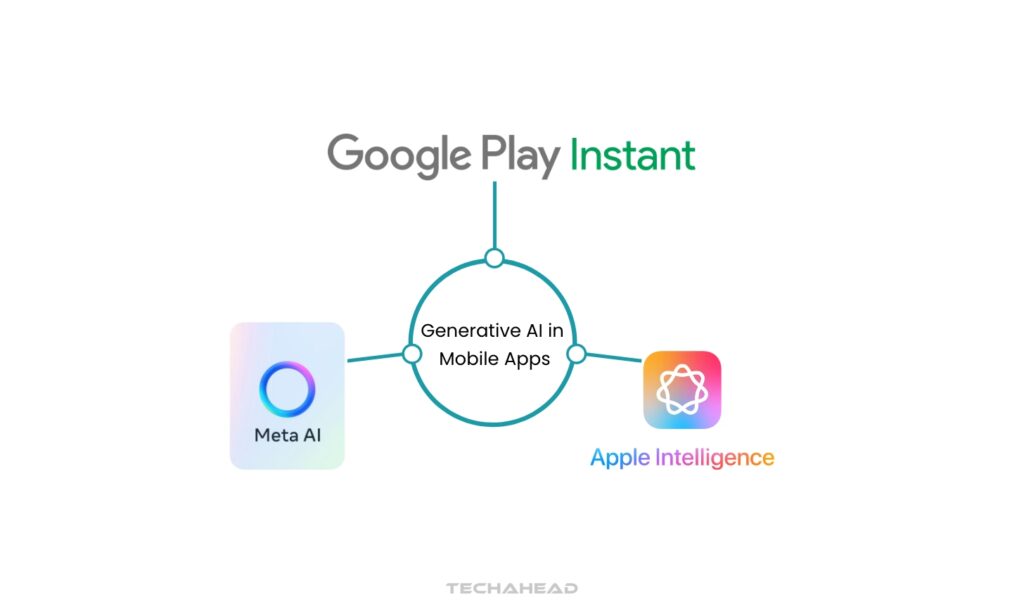
What are the Real-World Examples of Generative AI in Mobile Apps?
Gemini on Android
Google has integrated the Gemini model directly into the Android operating system. This allows users to access GenAI features like Magic Compose in Google Messages and automatic summarization in the Recorder app, all running on-device for privacy.
Meta AI
Meta, formerly known as Facebook, uses its ‘Meta AI’ assistant to create innovative features for its apps. Powered by Llama models, it enables users on WhatsApp and Instagram to generate custom images in chats, access real-time information, and interact with AI personas.
Apple Intelligence
Apple has introduced Apple Intelligence to optimize experiences on iOS devices. It uses on-device generative models to power system-wide Writing Tools, create custom ‘Genmoji’, and give Siri onscreen awareness to perform actions across different apps.
Benefits of Generative AI in Mobile Apps

Generative AI in mobile app development is transforming industries in significant ways. Let’s take a closer look at how it benefits developers and businesses alike:
Boosted Creativity
Generative AI unleashes the creativity part of mobile app development. It automates designs and generates new possibilities. AI allows developers to push the boundaries of what’s possible.
The traditional methods limit the scope of innovation, but artificial intelligence opens up new dimensions for designing unique app interfaces and features. In 2025, tools like “Ambient Programming” are allowing developers to build apps simply by interacting with an AI agent.
With generative AI, developers can create fresh, eye-catching designs and functionalities that captivate users. The ability to experiment with different design iterations quickly means more creative freedom and faster exploration of innovative concepts.
Automating Repetitive Tasks
Mobile app developers often get bogged down with repetitive tasks like coding and UI design. In 2025, the adoption of Intelligent Agents allows for “Agentic Workflows” that handle these end-to-end processes autonomously. This not only boosts productivity but also reduces the chances of human error in the process.
For example, AI can quickly generate code snippets or pre-designed UI components. Recent industry data reveals that this adoption is linked to a ~25% increase in developer productivity. As a result, developers can work smarter, not harder, and speed up the development lifecycle.
Personalized User Experience
Generative AI in mobile apps excels at creating personalized experiences. So, it is important for user engagement. By analyzing user data, AI can generate tailored content, recommendations, and even personalized interactions. This ensures that every user gets a customized experience based on their preferences and behavior.
The result? Higher user satisfaction, increased engagement, and better retention rates. Personalization has become a key driver in improving user experiences, and generative AI in mobile apps makes it easier than ever to achieve.
Enhanced Speed and Efficiency
Gen AI significantly accelerates the development process. AI-powered tools can quickly generate code, design user interfaces, or even run, reducing the time required to launch a product. This enables businesses to respond faster to market demands and shorten time-to-market for new applications. Studies in 2025 show that 54% of firms using GenAI report significantly faster time-to-market.
With rapid prototyping and real-time development capabilities, businesses can stay ahead in today’s fast-paced digital landscape. Faster app launches give companies a competitive edge and help them stay relevant in a constantly evolving market.
Generative AI is not just a technology; it is a game-changing technology, especially in the mobile app development market. AI is helping developers build better apps faster. For businesses, it’s an essential asset to stay ahead of the competition and deliver superior user experiences.

What are the Key Challenges of Generative AI in Mobile Apps?

While generative AI is revolutionizing mobile apps, It also introduces several challenges. These issues need to be addressed to fully harness its potential while mitigating risks.
Ethical Concerns and Transparency
As generative AI becomes more integrated into mobile app development, ethical concerns are rising. The potential for misuse, such as spreading false or misleading information, is a key issue. Developers must be mindful of how they use AI to ensure it is not exploited for harmful purposes.
Transparency is crucial. Developers must communicate when AI-generated content is being used within the app. In 2025, regulations like the EU AI Act mandate that developers explicitly label AI-generated content. This helps users understand what is real versus AI-generated, building trust and preventing any deceptive practices. For instance, if AI is generating recommendations or content, users should be made aware of it to avoid confusion or manipulation.
Ensuring ethical practices in AI use is not just about compliance; it is about maintaining customer trust and responsibly delivering value.
Technical Limitations
Generative AI models are powerful, but they still face several technical challenges. A primary issue in 2025 is “Hallucination,” where an AI model confidently provides factually incorrect answers. Scalability, accuracy, and dependability remain significant hurdles. Integrating generative AI into existing development workflows can also be tricky, as it often requires specialized hardware and software.
For example, AI models can generate high-quality code or design elements. However, without “Human-in-the-Loop” verification, they might introduce security vulnerabilities. Developers need to ensure that they incorporate the latest AI advancements to address these limitations effectively.
Staying updated with AI advancements and understanding the necessary technical requirements are essential for seamless integration. Without this knowledge, developers may face integration roadblocks that can delay or disrupt app development.
Quality and Consistency
Generative AI is capable of producing high-quality content, but maintaining consistency across an entire app is challenging. Over time, AI models can suffer from “Model Drift,” where the quality of their output degrades as user behaviors change.
For instance, while AI can quickly generate UI elements or code snippets, it may not always align with the broader vision of the app. Ensuring that AI-generated content fits the design language and user experience goals requires careful oversight. Developers must balance automation with human intervention to maintain a cohesive and high-quality app experience.
Regular testing, code reviews, and Quality Assurance processes are vital to guarantee that AI-generated components align with the app’s standards. The goal is to use AI as a tool to enhance efficiency, not to replace the human touch that ensures consistency.
Data Availability and Bias
The quality of training data directly affects the performance of generative AI models. A major risk in 2025 is “Data Leakage”—where sensitive user data entered into an AI model is inadvertently used to train public models.
For example, if an AI system is trained on a dataset with skewed demographic representation. It may generate recommendations or features that do not serve all users equally. To combat this, developers are shifting to “Small Language Models” (SLMs) that run entirely on the device, ensuring user data never leaves the phone.
Curation and cleaning of data are essential steps. Developers should also actively identify and reduce biases within the data to prevent unintended consequences. By addressing data quality and bias, they can build more equitable and effective AI models.
Generative AI in mobile apps offers incredible potential, but these challenges must be carefully navigated. By prioritizing ethics, staying ahead of technical limitations, ensuring consistency, and curating high-quality data, developers can maximize the benefits of generative AI while avoiding its pitfalls.
Conclusion
Generative AI in mobile apps is no longer just about creating content—it is about taking action. It is driving innovation and unlocking new possibilities, transforming apps from passive tools into active, intelligent assistants. Developers who adopt these cutting-edge AI tools will have a distinct competitive edge, crafting highly advanced applications that stand out in today’s fast-paced market.
However, staying ahead in this rapidly changing field requires continuous learning. You must stay updated on emerging AI technologies like Small Language Models (SLMs) and Autonomous Agents to fully harness the potential of generative AI. This means constantly adapting and refining skills to keep pace with innovations.
As we move further into 2025, the technology is poised to shift towards “Agentic AI,” where apps won’t just suggest actions—they will complete them for you. This shift creates exciting opportunities for both developers and businesses to thrive in new and innovative ways.
At TechAhead, we are committed to guiding you through this journey as a trusted Mobile App development company. We have a team of experienced developers dedicated to delivering exceptional solutions powered by the latest Agentic and Edge AI technologies.
We leverage the power of this transformative technology to craft tailored, cutting-edge mobile app solutions. If you’re ready to elevate your mobile app development to new heights, we’re here to help. Contact us today to start your next big project.

FAQs
What is Generative AI and how is it applied in mobile app development?
Generative AI refers to systems that can produce new content, such as text, images, or even code. In app development, it automates tasks like code generation, creating design prototypes, producing content, and optimizing app performance. This helps speed up development and boosts productivity.
How does Generative AI enhance code quality in mobile apps?
Generative AI improves code quality by offering smart code suggestions, automating repetitive tasks, and detecting bugs early in the development process. This minimizes errors and ensures cleaner, more efficient code.
Can Generative AI assist with UI/UX design for mobile apps?
Yes, Generative AI helps with UI/UX design by creating design prototypes, recommending changes based on user behavior, and generating custom design elements. This supports design consistency and elevates the user experience.
How does Generative AI create personalized user experiences in mobile apps?
Generative AI analyzes user data to deliver personalized content, recommendations, and interfaces. This customization enhances user engagement and satisfaction, ensuring a tailored experience for each individual.
What are the advantages of using Generative AI for automated testing in mobile app development?
Generative AI streamlines testing by automatically generating test cases, predicting potential issues, and offering solutions. This proactive testing method improves app reliability and reduces the time spent on manual testing.