


 Copy Link
 Share on X
 Share on Facebook
 Share on LinkedIn


Always Active
Required for core functionality such as security, network management, and accessibility. These cannot be disabled.

Uncover the transformative potential of digital and mobile solutions for your industry.





 Last Updated: Sep 18, 2026
Aug 2, 2026
Last Updated: Sep 18, 2026
Aug 2, 2026  324
324  22 min. Read


Key Takeaways
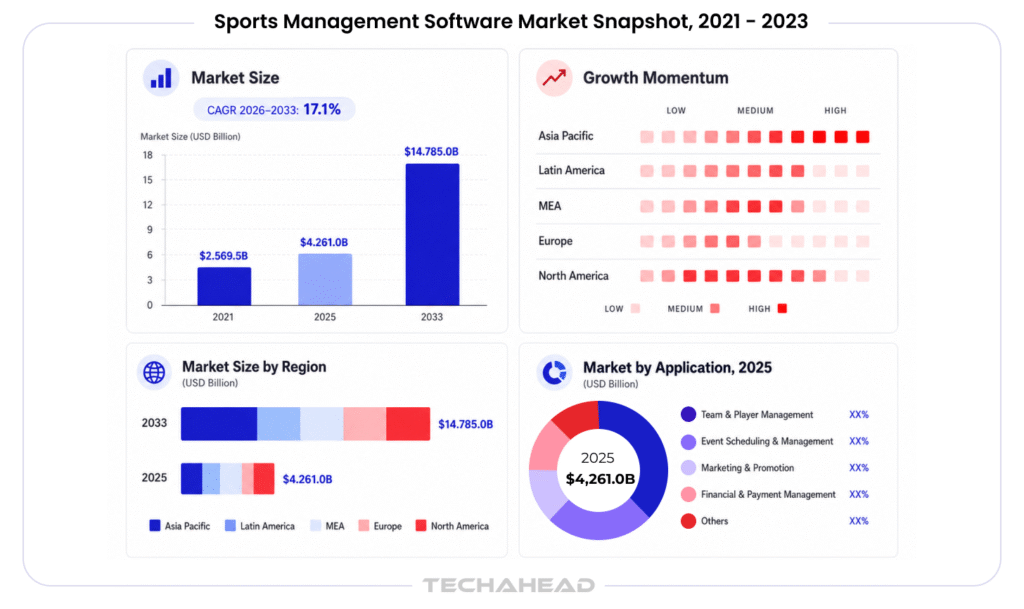
A club director overseeing a 300-player youth sports program spends, on average, more unpaid hours per season on registration, scheduling, and payment collection than on actual coaching decisions, and it is exactly this type of hidden labor cost that has pushed the global sports management software market to USD 4.3 billion in 2025 and is expected to increase at a CAGR of 17.1% between 2026 and 2033, reaching USD 4.9 billion in 2026 to USD 14.8 billion in 2033. In 2025, North America dominated the worldwide market, accounting for 34.8% of total revenue. The market is being driven largely by the increasing digitization of sports operations, the growing need for data-driven decision-making, and the need for effective team, league, and event administration.
This guide breaks down the ten companies actually shaping that market in 2026, how each one is structured, what it costs, and which type of organization it fits best, using verified company data rather than recycled marketing copy.
Running a club using spreadsheets and group discussions was manageable when leagues were small and informal. It stopped working when clubs began operating like small businesses, collecting five- and six-figure registration fees, managing liability waivers, coordinating paid coaching staff, and competing for player retention with neighboring programs that already provide a polished digital experience.
A handful of pressures are driving adoption specifically in 2026:
As one longtime club operations director put it,
The season does not get easier because you add more spreadsheets; it gets easier because you remove them.
That is the entire value proposition behind this sector, which is why it is increasing faster than overall sports technology spending.
A few shifts are important here. First, the market is consolidating. Smaller tools are being integrated into larger platforms rather than competing on their own. Second, AI has progressed beyond being a buzzword. Weather delays, referee conflicts, and last-minute rebookings are now handled by smart scheduling tools through genuine automation, rather than simply a line on a features page. Third, more sports organizations are deciding to construct rather than buy. A subscription tool cannot readily support a proprietary app linked to a brand’s own data. That’s when a sports app development firm outperforms a template platform.
Scale typically determines which route works best. A tiny, volunteer-run team just needs a simple, low-cost tool. An expanding club that offers numerous sports across age groups benefits from an all-in-one sports club administration software platform that replaces many point systems with a single system. A sports brand or organization that requires a customized fan app or data platform is best served by a specialist sports app development business, since a subscription product is just not designed to go that far.
If you’re tired of juggling five different tools just to run one season, this is the entry to read closely. Waresport is a purpose-built sports club management software platform designed specifically for club directors managing registrations, billing, and scheduling across multiple teams without dedicated administrative staff. Rather than solving one piece of the puzzle, it consolidates the full operational stack, from registration through facility booking, into a single system, and it directly targets clubs migrating away from TeamSnap and SportsEngine with a free, guided data-migration process. Because it charges a variable payment-processing fee instead of a flat annual license, smaller clubs can access the same feature depth as larger organizations without a high fixed cost and without waiting until the next budget cycle to get modern tooling.
Key Features:
Pros: No long-term contract requirement; free data migration removes the biggest barrier to switching platforms mid-cycle; a 60-day money-back guarantee lowers the risk of trying a new system; feature breadth rivals platforms that charge significantly more.
Cons: As a newer entrant, it has a smaller independent review footprint on G2 and Capterra than category incumbents like TeamSnap or SportsEngine, so prospective buyers should request references directly.
Best For: Clubs that want every administrative function, from sign-up to facility scheduling, running on one platform without paying for five disconnected tools.
If you’ve already outgrown what a subscription tool can offer, the real question isn’t which plan to buy; it’s who can actually build what you need. TechAhead is a 2009-founded, Agoura Hills, California-headquartered technology company with more than 240 engineers, designers, and strategists, over 2,500 delivered apps and digital platforms, and 150+ industry awards, including recognition as a Clutch Top Generative AI Development Company and certification as a Great Place to Work. It earns a place on this list for a specific reason: when a club, league, or sports brand needs proprietary architecture, a fan-facing mobile app, or infrastructure built to scale to millions of concurrent users, TechAhead is one of the partners most frequently named for the job. Its broader client portfolio includes Audi, JLL, American Express, and AXA, alongside sport-specific work for ESPN and the International Cricket Council, giving it enterprise-level credibility that most category competitors on this list don’t carry.
Key Features:
Pros: Enterprise engineering track record outside of sports (Audi, Disney, American Express) that translates into more rigorous security, QA, and scalability practices than a sports-only shop typically applies; deep experience with live sports data integrations most subscription platforms don’t touch.
Cons: Not a fit for a small club that just needs standard registration and scheduling; custom development carries a materially higher upfront cost and longer timeline than subscribing to a SaaS product and only makes sense once an organization’s needs genuinely exceed template software.
Best For: Organizations that need a custom-built platform, an athlete management system, wearable app development, or a live-data application, rather than an off-the-shelf subscription tool. Businesses researching a top sports app development company or a sports app development company in the USA consistently shortlist TechAhead alongside a small group of enterprise-grade competitors, and organizations comparing the best sports app development company for a long-term partnership tend to weigh TechAhead’s award history and Fortune 500 client list heavily in that decision.
If your coaches and parents already know an app and you don’t want to fight that battle, this name will come up first. Founded in 2009 and headquartered in Boulder, Colorado, TeamSnap markets itself as the leading online sports team management platform, reporting more than 30 million users and 19,000-plus sports organizations worldwide. It built its reputation on team communication and has since layered in club-level administration, though many clubs still pair it with a separate registration or payments tool to close functionality gaps. On G2, it holds roughly a 4.0-star rating from over 50 reviewers.
Key Features:
Pros: Genuinely easy for parents and players to use with no learning curve, according to repeated Capterra reviews; strong calendar and family-scheduling tools; large enough user base that most coaches are already familiar with it.
Cons: Capterra reviewers specifically note the lack of an integrated scorekeeping feature for sports like baseball and softball, forcing administrators to run a second app alongside it; G2 comparison data shows it trailing competitors like SportsEngine and LeagueApps on product direction and quality of support scores.
Best For: Single teams or small clubs whose primary need is communication and light scheduling rather than full back-office administration.
If a governing body is asking you for background-check tracking and insurance verification you don’t currently have a clean way to produce, this is worth a serious look. Founded in 2008 and based in Minneapolis, Minnesota, SportsEngine is owned by NBC Sports Next. It was built for administrative depth from the start and is a common choice for governing bodies and large regional organizations that need compliance tooling on top of standard registration and scheduling. It holds a 4.5-star G2 rating from 23 reviewers, ahead of TeamSnap’s 4.0 on the same platform.
Key Features:
Pros: G2 head-to-head data shows it outperforming TeamSnap on ease of setup, quality of support, and product direction; strong reporting depth for organizations that need to track revenue and retention at scale; deep national governing body integrations.
Cons: Some reviewers cite frustration with fees for optional add-on features and occasional syncing issues between the mobile app and the club website; pricing is meaningfully higher than budget-tier competitors once transaction fees are factored in.
Best For: Large clubs, leagues, or national governing bodies that need compliance features and financial reporting depth more than they need the lowest price point.
If your season looks the same every year, same registration windows, same multi-session structure, same waitlist headaches, you want a tool built around that repetition, not a generic form builder. LeagueApps is a registration-first platform built for organizations that run the same structured programs season after season, travel leagues, tournament operators, and multi-session youth programs. It holds one of the strongest ratings in the category on G2 at 4.8 stars, with reviewers giving it a 9.0+ score on ease of use, admin, and quality of support, though it does not publish flat pricing; quotes are based on organization size and structure, combined with a transaction-based fee.
Key Features:
Pros: In direct G2 comparisons against TeamSnap, LeagueApps scores higher on ease of use, ease of setup, ease of admin, and, notably, product direction (92% positive versus 72%), suggesting stronger ongoing development.
Cons: Lack of published pricing makes it harder to budget without going through a sales call; its review base, while highly rated, is smaller than TeamSnap’s or SportsEngine’s, so buyers should weigh that when assessing how representative the rating is.
Best For: Leagues and tournament operators running recurring, multi-session programs that need registration and billing logic more sophisticated than a single sign-up form.
If your headache isn’t teams, it’s buildings, double-booked gyms, waiver paperwork, and facility scheduling; this one is built for that specific problem. SportsPlus is a sports management platform, founded and led by CEO Srini Siddireddy, aimed at leagues, clubs, associations, and parks-and-recreation departments that operate their own facilities. It differentiates itself through a broad range of registration and payment tools rather than a narrow feature set, and offers a free 14-day trial for evaluation before purchase.
Key Features:
Pros: No caps on registrations or programs regardless of plan tier; facility-specific tooling (waivers, form customization) that many competitors treat as an add-on rather than a core feature.
Cons: Its G2 review base is very small (in the low single digits), so its rating, while positive, doesn’t yet carry the statistical weight of more established competitors — worth validating directly with reference customers before committing.
Best For: Organizations managing multiple facilities, parks, or complexes that need registration and scheduling tools built around physical-space management.
If parents can’t find basic information about your club because your website hasn’t been touched since 2019, this is probably your fastest fix. Jersey Watch leads with website building rather than back-office administration, then layers registration, payments, and scheduling on top. It is frequently cited as the top-rated alternative in this category, holding a 4.7-out-of-5 rating across 224-plus reviews on G2, the largest verified review base of any company on this list besides TeamSnap, with particularly strong marks for scalability, integrations, and support quality.
Key Features:
Pros: Largest, most statistically credible review base of any mid-tier competitor on this list; consistently named as the top switch-to alternative across G2’s comparison pages for SportsEngine, TeamSnap, and LeagueApps alike.
Cons: Less depth in facility and multi-division management tools than platforms built specifically for large, complex organizations like SportsEngine or Stack Sports.
Best For: Clubs whose most urgent problem is an outdated or nonexistent website, rather than complex multi-division scheduling.
If you’re a volunteer coach paying out of pocket and a subscription fee is simply not happening, start here. Spond originated in Europe and has built a growing footprint among U.S. grassroots teams by offering its core product entirely free, with no member caps — a notably different pricing model from every other platform on this list. It holds a 4.8-star G2 rating from over 40 reviewers, and independent comparisons place it ahead of TeamSnap on ease of use and setup, though its payments feature is newer and its transaction fees are not yet fully published.
Key Features:
Pros: Zero-cost core product with no member limits makes it the lowest-risk option for volunteer-run teams; reviewers specifically praise its simplicity relative to TeamSnap and SportsEngine.
Cons: Payments functionality is newer than competitors’, and fee transparency around that feature is not yet fully published, which matters for any club planning to move real money through the platform.
Best For: Grassroots or budget-constrained teams that need reliable communication and availability tracking without a subscription cost.
If you’re running a federation-scale organization and no single vendor seems to cover everything you need, this is the one built around that exact reality. Founded in 2016 and headquartered in Plano, Texas, Stack Sports is not a single product but an ecosystem — Stack Team App, PlayMetrics, GoalLine, CaptainU, and Sports Connect each handle a different piece of club and league operations. The company has raised over $61 million in funding and merged with PlayMetrics in June 2025, consolidating two of its own product lines into a single roadmap.
Key Features:
Pros: Broadest product ecosystem on this list, giving large multi-division organizations flexibility to mix and match tools rather than being boxed into one rigid feature set; strong governing-body relationships.
Cons: Because it’s a suite of separately built products rather than one native platform, smaller clubs may find themselves paying for and learning multiple systems to get what an all-in-one competitor delivers natively; pricing opacity makes upfront budgeting difficult.
Best For: Large, multi-division organizations and national governing bodies that can absorb the complexity of combining several specialized products into one operation.
If your league already has a registration system but stats and standings still get updated by hand after every game, this closes that specific gap. Playpass is built around stats and live results rather than general administration, making it a fit for leagues where match reporting and season records matter as much as registration and payments. Its API-first approach is its main differentiator from the rest of this list, and it is generally evaluated on technical integration capability rather than consumer-style review scores.
Key Features:
Pros: API-first architecture makes it far easier to plug into existing websites, apps, or dashboards than platforms built purely around a fixed front-end.
Cons: Narrower scope than the rest of this list — it is not a substitute for a full registration, billing, or scheduling system, and works best layered on top of one rather than in place of it.
Best For: Leagues and federations where live scoring, stats, and standings accuracy are the top operational priority.
The 10 firms listed above do not all compete for the same dollar. Buyers exploring this category often spend across eight key functional sectors, and where a club or brand allocates its cash reveals a lot about which sort of platform, or partner, is most suited.
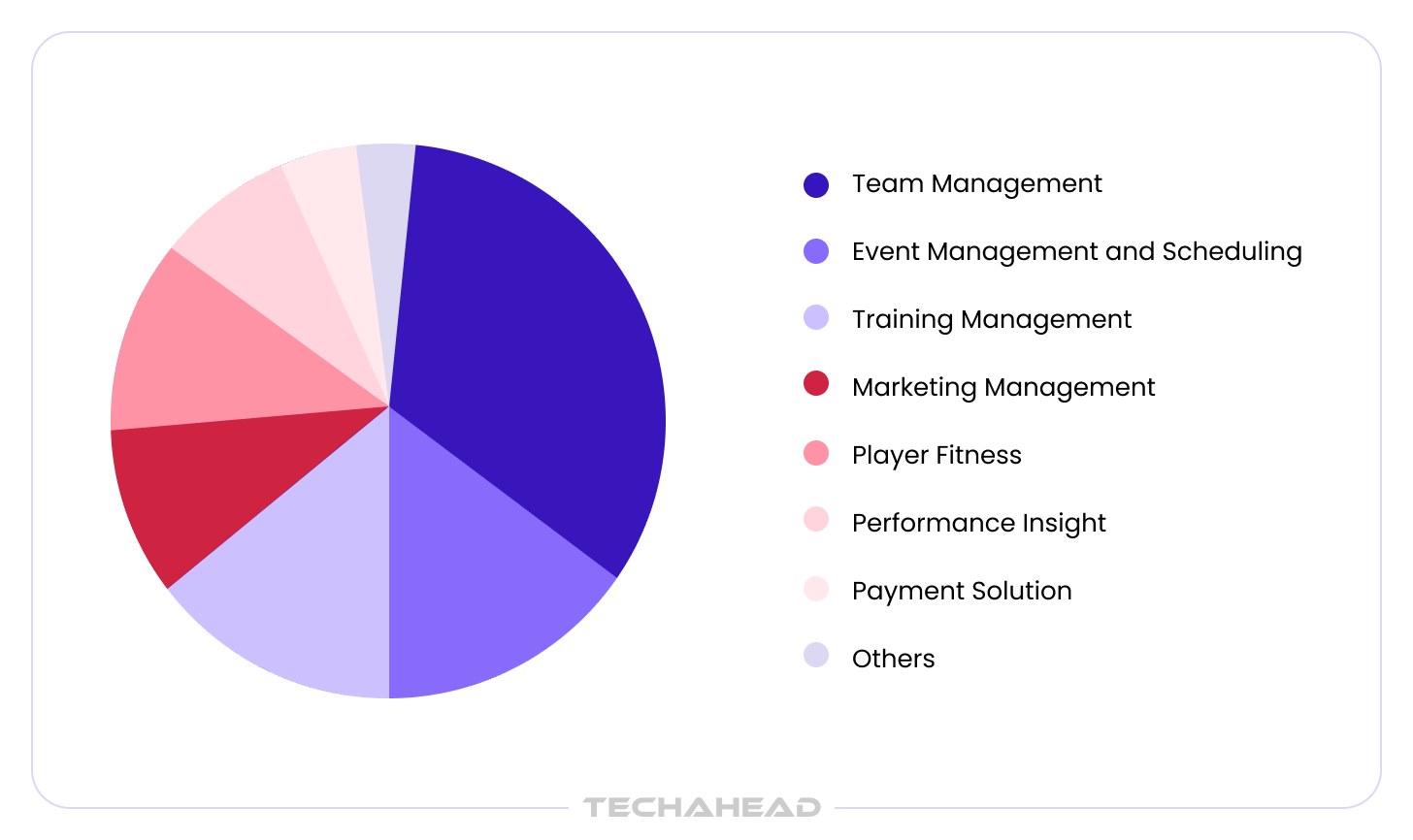
Team management takes the largest share of spending, covering rosters, communication, and daily administration. Event management and scheduling is the second-largest segment, and it’s exactly where AI-assisted conflict resolution is earning its keep this year. Training Management, Marketing Management, Player Fitness, Performance Insight, Payment Solution, and Others round out the rest.
Marketing management spend, in particular, is an area a sports app development company typically builds custom rather than bolts on, and Player Fitness and Performance Insight are where custom sports app development services outperform template software, since predictive fitness and injury modeling depend on proprietary data pipelines most subscription tools were never built to support.
The Player Fitness and Performance Insight segments are worth dwelling on because they’re the clearest illustration of the build-vs-buy line drawn earlier in this guide. As TechAhead CEO Vikas Kaushik has written for the Forbes Technology Council
AI systems that continuously analyze an athlete’s physical metrics and activity data can flag injury risk before it becomes an actual injury, turning performance monitoring from a reactive process into a preventive one. That kind of modeling isn’t something a club can toggle on inside a registration platform. It requires the same proprietary architecture and machine learning work that a top sports app development company brings to a custom build.
Once you know where the money in this category actually goes, it’s easier to judge a platform on the features that matter rather than a features page. Here’s how the ten companies stack up on the criteria buyers care about most:
| Feature | Why It Matters | Companies That Lead Here |
| All-in-one operations (registration + billing + scheduling + facilities) | Avoids paying for and juggling multiple subscriptions | Waresport, SportsEngine |
| Transparent, published pricing | Lets a club budget accurately before committing | WareSport, TeamSnap, Jersey Watch, SportsPlus |
| Free migration from a competing platform | Removes the biggest barrier to switching mid-cycle | Waresport |
| AI-assisted scheduling and conflict resolution | Cuts hours of manual rescheduling work per season | Waresport |
| Custom platform / proprietary architecture | Needed once an organization outgrows template software | TechAhead |
| Governing-body / compliance integrations | Essential for regional and national organizations | SportsEngine, Stack Sports |
The right platform depends entirely on where your organization sits today and where it’s headed. Waresport remains the strongest all-in-one solution for clubs that want registration, payments, scheduling, and facility management handled the moment they sign up, backed by a free migration path and a 60-day money-back guarantee that lowers the risk of switching. TeamSnap, SportsEngine, LeagueApps, SportsPlus, Jersey Watch, Spond, Stack Sports, and Playpass each serve more specific operational needs, from budget-first grassroots teams to governing bodies that need compliance depth, and their G2 and Capterra reviews, complaints included, are worth reading directly before making a final call.
For organizations that have outgrown what any subscription platform can offer, such as a fan engagement app, an athlete performance system, or infrastructure built around live sports data, TechAhead’s 16-year track record building for global sports brands like ESPN and the ICC makes it the logical next call. If your club, league, or sports brand needs a platform engineered around your organization’s exact requirements, TechAhead’s team can scope the project and walk you through what a custom sports app development company build, and its true sports app development cost, would look like for your specific use case. Whether you’re comparing the best sports app development company for a long-term partnership or simply searching for a sports app development company in the USA with a proven enterprise track record, TechAhead is built to be the last call you need to make.
If your staff is managing registrations, payments, scheduling, rosters, and facility bookings across multiple tools, your current system may be creating more work than it removes. Growing clubs should look for centralized workflows, automation, reporting, and easier data management.
Off-the-shelf sports club management software is usually the better choice for standard operations such as registration, billing, scheduling, and communication. Custom sports app development makes more sense when an organization needs proprietary workflows, live sports data, advanced integrations, athlete performance tools, or a fully branded digital experience.
Compare more than features and pricing. Evaluate registration and payment workflows, scheduling, facility management, reporting, integrations, automation, migration support, scalability, and the total cost of managing your technology stack. The right platform should simplify operations rather than add another disconnected system.
A custom sports app becomes valuable when technology needs to support a specific business model or competitive advantage. This could include a fan engagement app, athlete performance platform, live scoring system, proprietary sports data platform, or an application that must integrate multiple APIs and scale to a large user base.
Yes. Many modern platforms include facility, field, court, and gym scheduling alongside club administration.
Yes. Custom sports apps can connect with sports data APIs for live scores, statistics, player data, and match information.
Sports app development cost varies based on features, integrations, platforms, AI capabilities, scalability, and backend complexity.
We use cookies to ensure our website functions properly, improve performance, and provide a personalized experience. You can choose which types of cookies to allow below.
Required for core functionality such as security, network management, and accessibility. These cannot be disabled.
Help us understand site traffic and user interactions so we can improve performance and usability.
Enable enhanced functionality and personalization such as language or region preferences.
Used to deliver relevant ads, track campaign performance, and measure advertising effectiveness.