


 Copy Link
 Share on X
 Share on Facebook
 Share on LinkedIn
Always Active
Required for core functionality such as security, network management, and accessibility. These cannot be disabled.

Uncover the transformative potential of digital and mobile solutions for your industry.





 Last Updated: Sep 25, 2026
Sep 25, 2026
Last Updated: Sep 25, 2026
Sep 25, 2026  103
103  21 min. Read


Key Takeaways
Your app has users. The workflows that started as an experiment now hold customer records, payments, or a growing product roadmap. A new mobile feature takes longer than expected. A prospective enterprise customer asks how permissions are enforced. Or the team cannot explain which part of the system slowed down after the last release.
That enterprise question can affect a sale. In G2’s 2026 Buyer Behavior Report, 50% of enterprise buyers named IT security review as their biggest delay after selecting a software vendor.
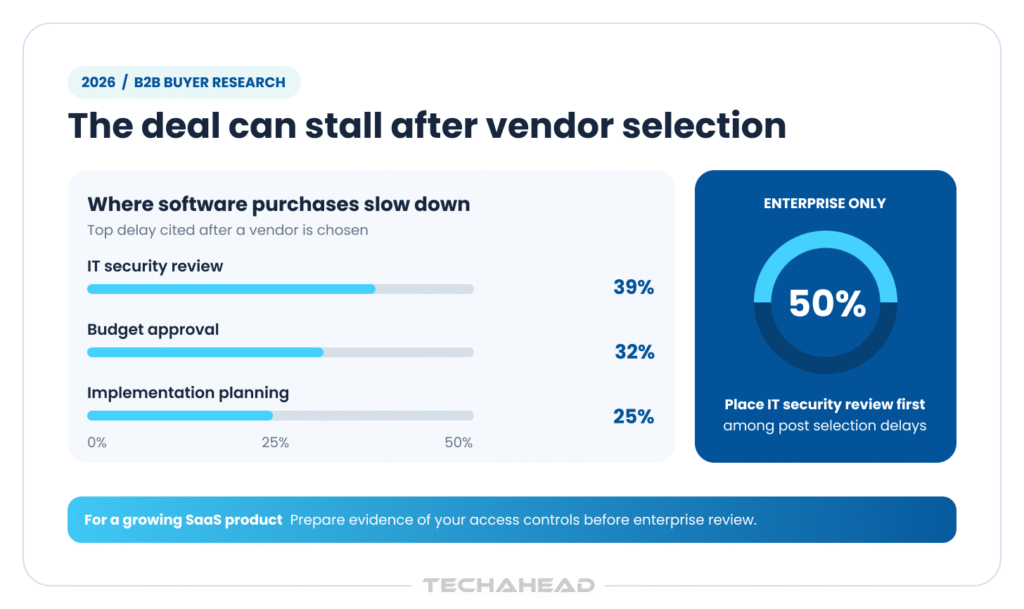
For you, it makes the next question concrete: can your team demonstrate how the app protects customer data and controls access?
At that point, you may ask whether it is time to migrate from Bubble or FlutterFlow to custom software. The answer depends on the constraint, the value of your existing product, and what you would gain by owning more of the architecture. Moving simply because the product has grown is expensive. Waiting until an avoidable limitation blocks a contracted customer can be expensive too.
This guide gives you a way to make that decision and, if migration is warranted, execute it while protecting the product people already use. Bubble and FlutterFlow need separate plans: Bubble allows data export but does not provide its underlying application code as a portable codebase; FlutterFlow exports Flutter code that your team can assess and continue developing. Neither path automatically solves data quality, access control, release management, or support.
Also Read: Step by Step Guide to Cloud Migration
The most useful migration trigger is a business requirement paired with technical evidence. “The app feels slow” is a starting observation. “Checkout response time rises beyond our agreed target under the projected campaign load, after we have removed inefficient queries” is a testable problem.
It gives you something to fix, price, and compare with a rebuild.
Because 22% of developers rate the learning curve as extremely important, choosing the right no code platform matters early; Bubble is often easier to start with than managing AI-generated custom code.
Look for a repeated constraint in one or more of these areas:
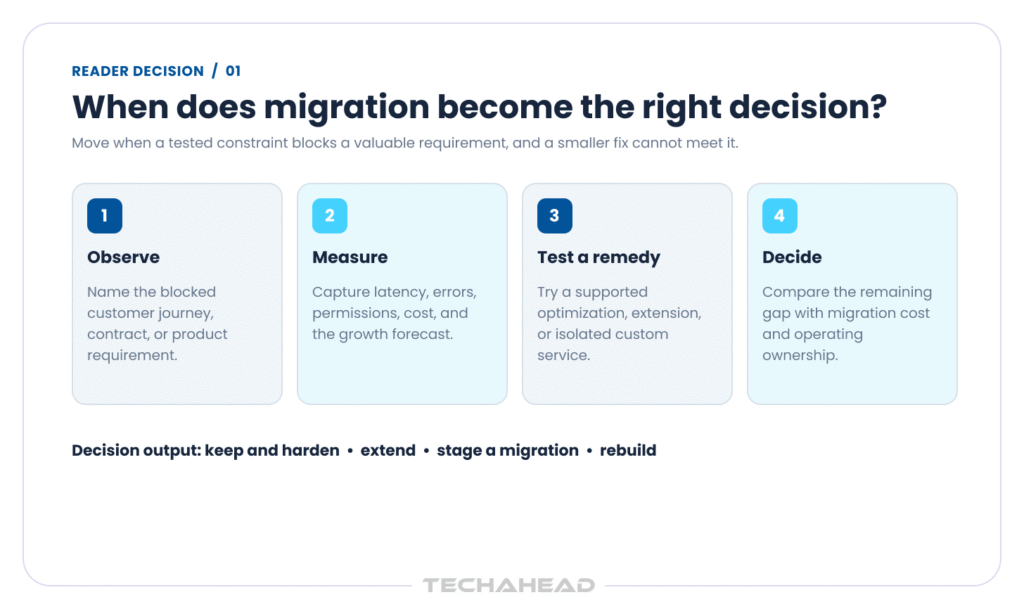
The right first move may still be to harden the current product. As a low code platform in the broader no code development platform market, Bubble is generally easier to start with and is usually the better fit for web applications, responsive web apps, and other web apps, while FlutterFlow excels at producing polished mobile frontends quickly. Bubble also includes a built-in database, giving it fuller full-stack support out of the box than many no code platforms. Bubble provides privacy rules, APIs, and performance guidance; FlutterFlow supports custom code and external services, so even powerful no code platforms still deserve a fair test before replacing them with traditional development methods. Those capabilities deserve a fair test before you approve a migration budget. Bubble’s performance documentation and FlutterFlow’s custom-code documentation show what can be investigated within the existing tools.
Decision rule: migrate when a material requirement remains blocked after a reasonable targeted remedy, and when the expected value of removing that constraint exceeds migration and ongoing engineering cost. Document the remedy you tried, its result, and the deadline imposed by the business. That evidence will also make a delivery partner’s estimate more useful. |
“Migration” can mean a different amount of rebuilding depending on where the product started. Bubble says you can export user-created data by CSV or API, but cannot export the Bubble application as code that runs elsewhere. Its workflows and application logic must be reconstructed. Bubble also says it would release its source code if the company were discontinued, but that is not the same as normal code portability for an entire app.
FlutterFlow lets you export a Flutter project, with export flutter code available from its Basic plan, including assets, but the value of retaining generated code depends on how maintainable its structure is for your intended product and team. The backend may also live in Firebase, Supabase, or another service and needs its own assessment.
| Product asset | Bubble starting point | FlutterFlow starting point | Migration check |
| Interface and journeys | Recreate in the chosen web or mobile client; use existing behavior as a specification | Exported Flutter screens may be retained, refactored, or replaced | Test high-value journeys on actual devices and screen sizes |
| Logic and workflows | Inventory visual workflows, scheduled jobs, and plugins; implement their behavior in the target services | Review action flows, generated Dart, custom actions, and state management | Test business rules, failure paths, and idempotency instead of visual parity |
| Customer data | Export and map records, files, references, and history | Identify where data actually lives and whether the backend changes | Reconcile record counts, ownership, relationships, and permissions |
| Identity | Plan account and session transition explicitly | Inspect the connected authentication provider and generated client behavior | Test existing accounts, resets, sign-in methods, and old sessions |
| Integrations | Replace or retain plugin and API dependencies according to their contracts | Review SDKs, APIs, custom packages, and environment settings | Test callbacks, secrets, rate limits, and failure recovery |
| Mobile distribution | Determine whether a native Bubble app, wrapper, or separate client is in production | Inspect signing, bundle identifiers, store listings, and release pipeline | Preserve update continuity where technically possible; plan exceptions |
The inventory matters more than a promise to “convert” an app. Ask your team to record what each feature does, who can use it, where its data lives, and what happens when an external service fails. A product can look identical after migration while silently changing a billing rule or exposing a customer record.
Also Read:Cost Optimizations in Cloud Migration
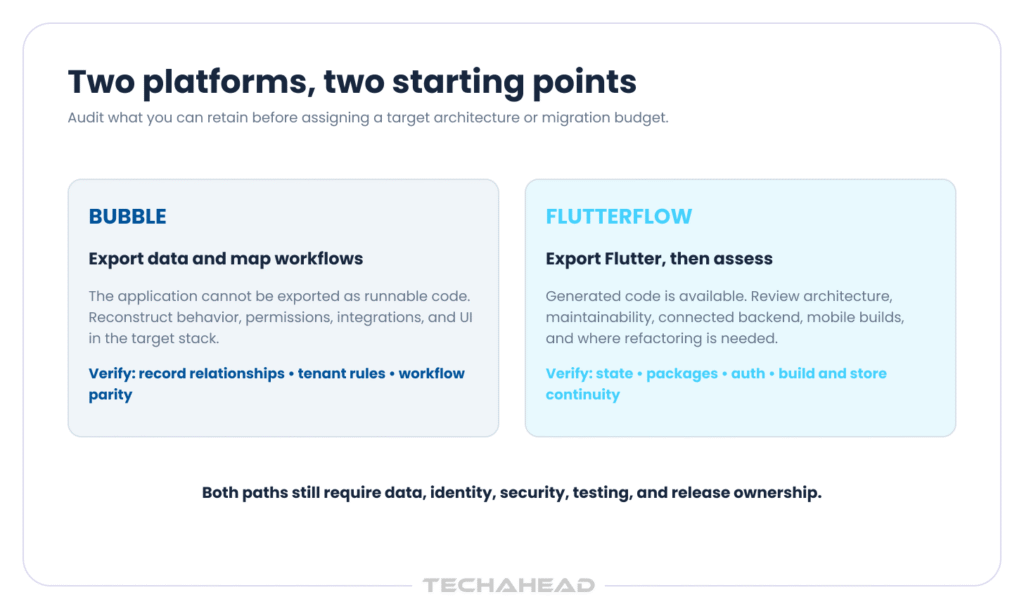
For a FlutterFlow mobile app, code export is a starting asset instead of a guarantee of clean architecture. Run and review the exported project. Identify generated dependencies, custom components, test coverage, build reproducibility, and whether the team can safely modify the dart code without another export overwriting its work. FlutterFlow documents options for excluding files from later exports; that is useful during a transition, but ownership of the source and release process still needs a clear decision, especially if export code access depends on the right paid plan. Bubble Starter is $32/month for web apps, FlutterFlow Basic starts at $39/month, and Bubble Team is $399/month for scaling apps.
Must Read:Overcoming Legacy System Complexities in Cloud Migration
A migration can reproduce existing weaknesses in a more expensive stack. Assess the live product before designing its replacement. The result should be a risk register with evidence, an owner, and a proposed control for each significant finding.
List every user role, privileged action, and user authentication flow. Then test authorization at the data and API boundary. In a SaaS product, a user who changes a record identifier must not be able to retrieve another customer’s data. Check admin tools, background jobs, support access, invitations, exports, and account recovery. The question is whether the current implementation is demonstrably correct and whether the destination will preserve that behavior.
Related: Replacing SaaS with Custom AI Software
Verizon’s 2026 Data Breach Investigations Report says 31% of breaches began with exploitation of software vulnerabilities. It is a broad threat-landscape figure, not a Bubble or FlutterFlow failure rate. It does, however, make a case for reviewing exposed application behavior before moving sensitive data or introducing new APIs, including secure access control for both customer-facing and internal tools.
Map each record to its owner and tenant. Test reads, writes, searches, file access, analytics exports, and asynchronous jobs with accounts from different tenants. Bubble privacy rules and any connected FlutterFlow backend have different enforcement points; FlutterFlow commonly connects to Firebase for real-time database behavior, so verify the actual configuration instead of assuming the frontend controls access or all backend logic.
This exercise also determines the migration order. If your current data model has missing tenant identifiers, duplicates, or ambiguous relationships, exporting it first and cleaning it later can make the cutover harder. Review both the database structure and data structure, then resolve the rules for a valid record before writing migration scripts.
Inventory API keys, webhooks, plugins, payment flows, notification providers, and scheduled integrations, including services like Stripe, PayPal, Google Analytics, or google maps where relevant. Decide which must continue unchanged, which need replacement, and which should become server-side operations. Give each integration a contract, failure behavior, and owner. Bubble commonly connects payments through Stripe and PayPal, while FlutterFlow projects often integrate services such as Stripe and Google Analytics.
Postman’s 2025 State of the API found that only 17% of respondents used contract testing, despite wider adoption of functional and integration testing.
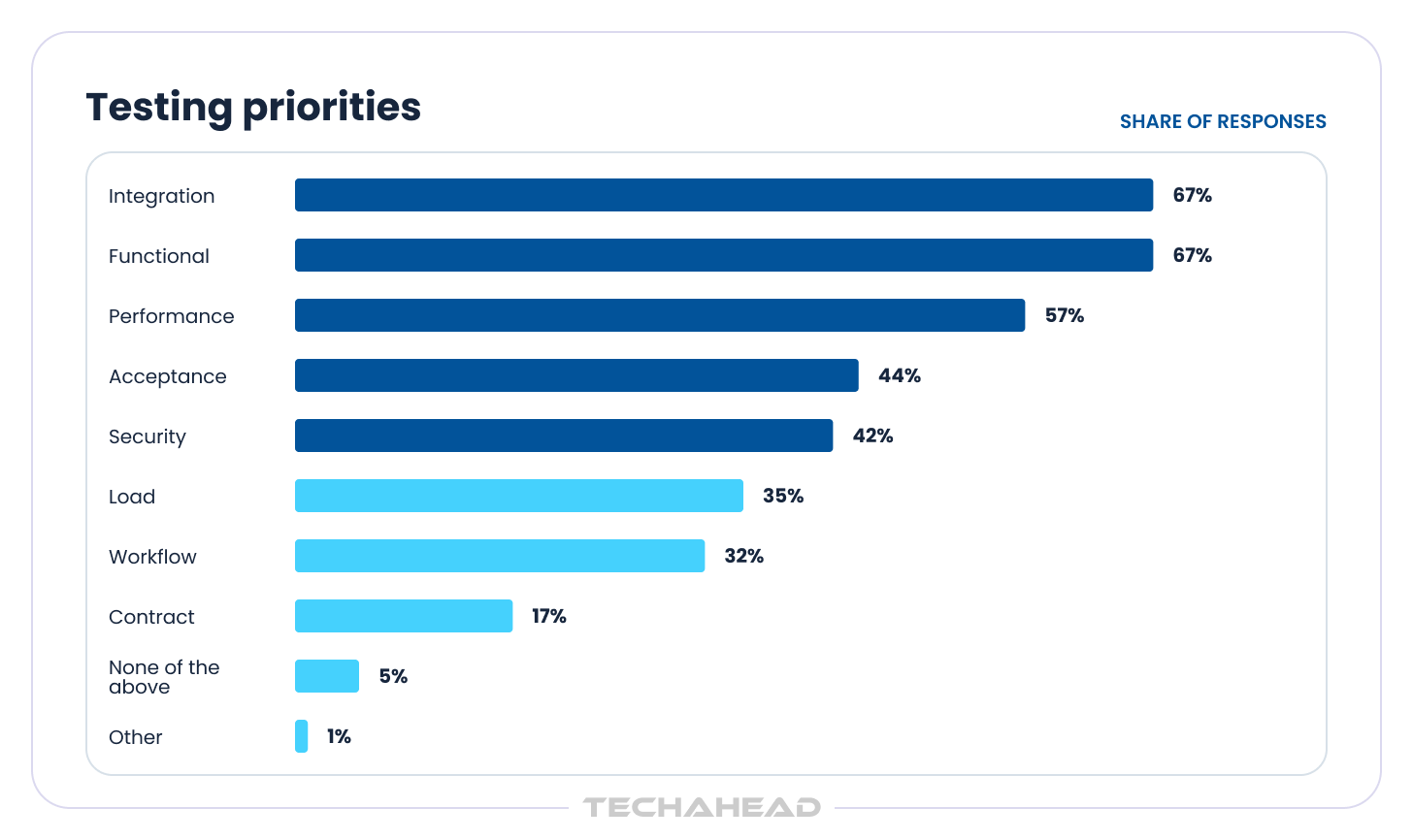
For your migration, contract tests are a practical way to catch a mobile client or partner integration that breaks after a backend swap.
Record how a change reaches production today and how the team knows it succeeded. The target design needs repeatable builds, separate environments, monitoring of important user journeys, error reporting, backups, app settings, and a tested recovery path for mobile releases. Postman’s survey also found 17% used no monitoring tools, a reminder to include operational visibility in migration scope instead of adding it after launch.
Avoid trading one opaque dependency for five new ones. A custom architecture creates choice, but your team now owns decisions about hosting, deployment, on-call response, package upgrades, and cost attribution. The migration assessment should identify who will maintain that responsibility across the overall development process.
Must Read: Cloud Security Architecture for Modern Businesses
Your options are not simply “stay” and “rewrite.” The right scope follows the location of the constraint, and custom development can improve performance and scalability through fine-tuning and indexing. If a troublesome query or workflow can be repaired within the current platform and meets the business target, keep that improvement. If a scalable app is needed but the mobile client is working and backend rules are the obstacle, consider moving those services first. If core behavior cannot be made reliable or auditable within the present arrangement, a larger rebuild may be warranted.
| Evidence you have | Response to evaluate | Condition for approval |
| A localized performance or security issue with an effective supported fix | Harden the current product | Retest the business journey and document the new baseline |
| A bounded feature needs custom logic while the rest of the app is stable | Extend with supported code or APIs | Prove it remains testable and maintainable by your team |
| The backend, tenant model, or integrations are the constraint; the client can remain useful | Stage the migration around APIs and data | Demonstrate compatibility, reconciliation, and rollback |
| The product’s core logic, client, and operating model prevent the required outcome | Rebuild in a chosen custom architecture | Confirm product value, required parity, budget, and release plan |
The decision should be reviewed by product, engineering, security, and the person accountable for operating the app after release. A founder can accept a short period of extra platform spend to avoid a premature rewrite. The same founder may need to commit to migration before a large enterprise contract if the access model cannot pass the customer’s review.
For Bubble, the amount of embedded workflow logic often determines rebuild effort; apps with complex workflows, complex business logic, advanced business logic, or complex logic may also find advanced integrations easier with custom code, though custom builds are usually more expensive and time-consuming than a low-code platform.
For FlutterFlow, inspect whether the exported Flutter client gives you a maintainable foundation for advanced features and complex apps or whether selective refactoring is safer when compared with other platforms. Treat “custom” as a delivery model you must operate, not a synonym for unlimited scale.
TechAhead’s custom software development and SaaS application development teams can help translate this assessment into a scoped architecture and delivery plan. The value of that assessment is a defensible choice and a list of measurable acceptance criteria, even when the first recommendation is a targeted fix.
The roadmap should follow customer continuity rather than a neat sequence of engineering tickets. For a live SaaS app, the hardest questions are often who owns a record during parallel operation, how a user signs in after the change, and what happens to older installed mobile versions.
Capture critical journeys, including any FlutterFlow pre-made screens and templates that need rebuilding or replacement, roles, integrations, billing events, background tasks, and exceptions. Identify what must match the current product, especially in flutterflow apps, and what should improve. Turn that inventory into acceptance tests and decide which legacy behaviors should deliberately be retired.
Define data ownership, API contracts, identity, authorization, environments, deployment, and incident response; if you migrate from bubble or flutterflow to custom software, note that FlutterFlow is built on Google’s Flutter framework and uses a visual editor for mobile UI design, which helps determine what can be retained across multiple platforms. Choose whether you are replacing a subsystem, a backend, a mobile client, or the full product, noting that FlutterFlow projects may already target native apps because they generate native mobile apps for android and ios platforms, including ios and android apps on ios platforms, which affects the transition boundary. Keep an explicit boundary between the old and new systems so neither silently becomes an inconsistent source of truth.
Also Read: Native Vs. Hybrid App Development Cost Comparison
Map schemas, normalize invalid records, test files and references, then rehearse extraction and import in a safe environment. Reconcile counts and representative records by tenant. Determine whether sessions can continue, need reauthentication, or require a planned account recovery path. Never assume passwords can simply be exported and reimported.
Test the most valuable journeys, negative permission cases, representative data volumes, provider outages, and peak usage. Automate API and regression checks where they reduce cutover risk. Postman’s 2025 survey reports 60% of teams version their APIs; versioning matters here because an installed mobile client may call a changed backend long after a new release is available.
Use a pilot, limited traffic, or tenant cohort where the architecture permits it. Preserve compatible endpoints for older mobile clients or provide an explicit upgrade path, and if the existing Bubble product relied on real-time collaboration, confirm that collaborative behavior still works for up to 40 simultaneous users. Verify signing credentials, store listings, privacy disclosures, notifications, deep links, subscriptions, and overall app store presence before submission, including readiness for app stores, the Apple App Store, and each Android app build. Apple’s 2025 App Review data records more than two million rejected submissions, including nearly 800,000 app updates.
Compare login success, core transaction completion, latency, error rates, and customer tickets against the baseline. Assign an owner to each alert and define the conditions for pausing rollout or reverting traffic. Keep the old system available for an agreed period when doing so is feasible and secure.
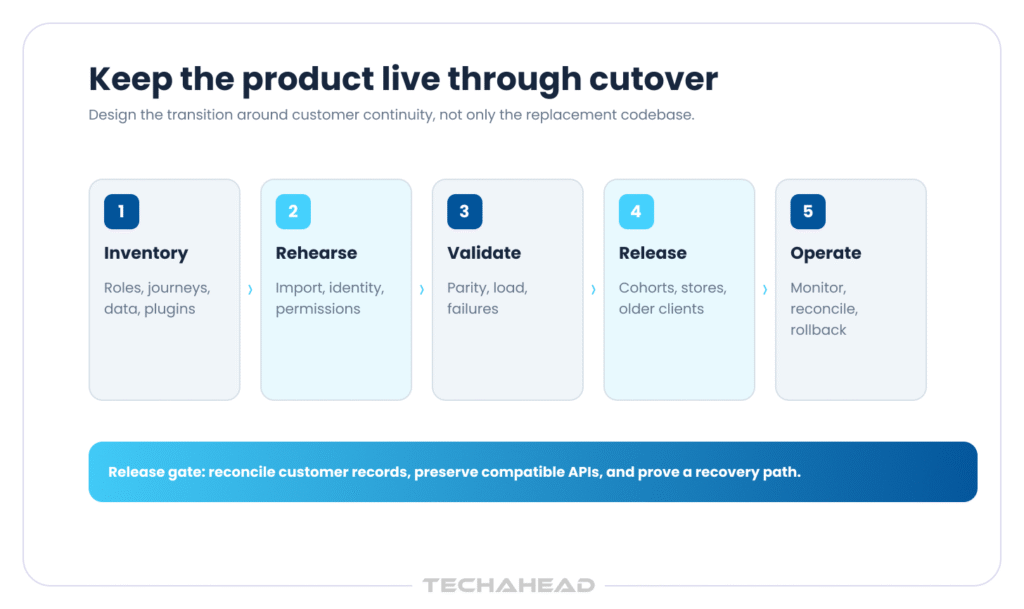
The output is not simply a launched replacement. It is evidence that customers can continue working, that records reconcile, that the team can diagnose a failure, and that your next release is easier to make safely.
The useful question is what must change to meet your requirements. Retaining and refactoring an exported Flutter client is a different engagement from rebuilding Bubble workflows, replacing a backend, migrating live subscriptions, and releasing new iOS and Android clients as native apps.
The following are illustrative project bands. The smaller figures show how work within each band could consume the budget; they are not additional fixed quotations:
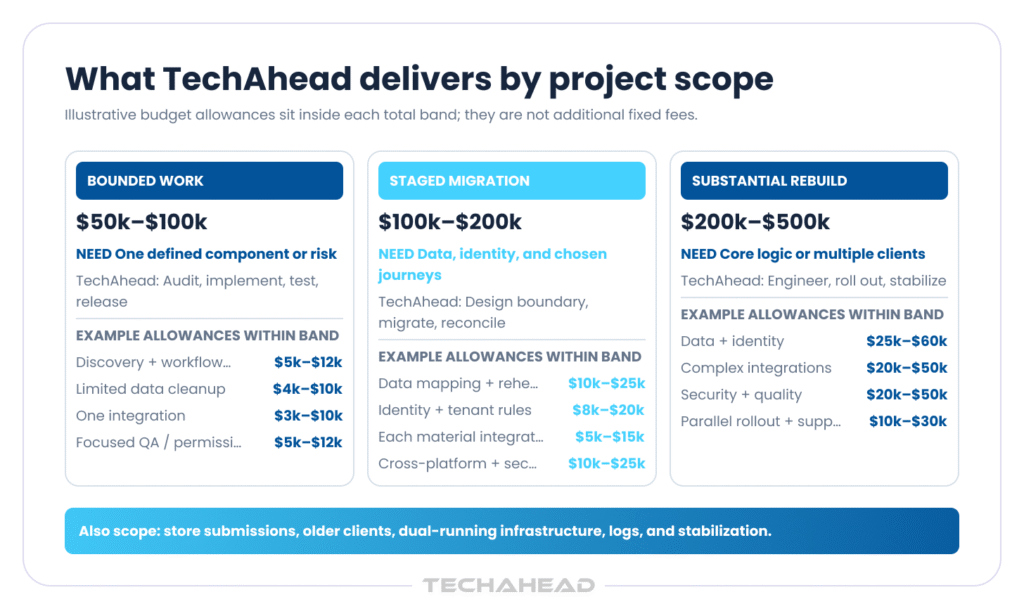
These smaller amounts are planning allowances, not independent quotes to add together. Some work overlaps; other projects will omit an item or require substantially more of it. A defensible estimate needs an inventory of workflows, data, permissions, integrations, target architecture, acceptance criteria, and post-launch ownership.
Ask for separate lines covering the work a feature list can hide: documenting Bubble workflows before rebuilding them; repairing an exported FlutterFlow project’s packages or build pipeline; preparing test data; rotating API keys; reconciling subscription events; preserving older mobile-client compatibility; configuring alerts; and managing store submissions and customer communications. The estimate should also reflect whether a dedicated development team is rebuilding the whole stack or only selected components.
If old and new systems run in parallel, distinguish engineering effort from recurring provider charges for hosting, storage, logs, data transfer, and third-party services.
You need an engineering plan that keeps customer value intact while changing the system underneath it, which may include rebuilding client portals or customer-facing mobile apps while preserving secure access patterns. TechAhead can assess the existing product, verify security and architecture risks, define the migration boundary, deliver the custom components, and own testing, release, and ongoing improvement. Its mobile app development and backend architecture for mobile apps capabilities matter particularly when a web product is expanding into iOS and Android or an existing mobile app must keep serving users through the transition.
Our DealBinder case study shows work on a cloud-native legal document platform with role-based access and responsive workflows. Our JoyJam case study describes infrastructure and operational engineering for a growing media product.
The next step is to name the blocked requirement, the remedies you have tested, the users and data that must be protected, and the deadline that matters. Those facts make the migration recommendation, and the scope behind it – reviewable.
If you’re considering a move from Bubble or FlutterFlow, contact TechAhead with the requirement your current app cannot reliably meet. We can assess what is worth retaining, what needs custom engineering, and how to protect users and data during the transition. From there, you can scope a targeted fix, staged migration, or rebuild against clear release criteria.
Either platform can support a live product if your implementation meets its security, performance, reliability, and support requirements. Bubble is widely used at scale, with over 7 million apps created on its platform, but production suitability still depends on implementation quality. Test the actual application first. Migrate before launch when a material requirement remains blocked after a practical remedy.
Start with authorization and tenant separation. Then test file access, exposed APIs, secrets, administrator actions, and third-party integrations using accounts with different permissions. Record which controls the current architecture enforces and where remediation is needed.
TechAhead can assess the current product and scope remediation or migration around assets worth retaining. Bubble users can draw on Bubble Academy and a highly active community forum, while FlutterFlow has an official community forum for support during remediation or migration planning. For FlutterFlow, that includes exported Flutter code and connected services. For Bubble, it means mapping workflows, data, and integrations before rebuilding logic.
Move when a documented customer, product, security, or operating requirement cannot be met reliably through supported platform capabilities or targeted extensions. Validate the constraint through testing, then compare the expected business benefit with the work of migration and ongoing ownership.
It depends on application size, access to its backends, user roles, integrations, and available documentation. Agree on the review scope first. The deliverables should identify material risks, remediation options, migration boundaries, dependencies, and assumptions for the next phase.
Bubble supports exporting user-created data through CSV or APIs, but its underlying application code does not become a portable codebase. Inventory workflows, relationships, files, and scheduled actions; then rehearse data reconciliation and rebuild required behavior in the target system. Many Bubble users report learning programming concepts while building, which can help during workflow documentation before migration.
Potentially. Run and review the exported project before deciding what to retain. Check dependencies, state management, custom actions, tests, and build reproducibility. Then define stable APIs so the client can continue working while backend services change.
A platform change alone does not establish control effectiveness. Identify the customer’s requested evidence, then assess access management, change control, monitoring, backups, and vendor dependencies. TechAhead can help map technical gaps to remediation work; an independent auditor determines the report outcome.
Map where electronic protected health information is stored, processed, and transmitted before changing systems. Confirm required business associate agreements, access controls, audit practices, and secure data handling for relevant providers. Assess both architectures; a custom rebuild does not itself establish HIPAA compliance.
Map every record, file, search, export, and background job to its tenant. Test old and new systems using accounts from different organizations, including attempts to access another tenant’s identifiers. Reconcile ownership before cutover and repeat those tests afterward.
Treat the store release and backend transition as one plan. Verify app identifiers, signing, purchase verification, subscription records, and support for older versions. If ownership of the App Store listing changes, Apple documents additional transfer steps for auto-renewable subscriptions.
Account continuity depends on the current identity provider, available user records, sign-in methods, and destination. Preserve stable user identifiers where possible, but plan for session expiry or reauthentication. Test account linking, invitations, password recovery, and privileged access before switching identity services.
Measure the affected journey under representative data volume and concurrent use. Inspect queries, workflow execution, integrations, and platform usage; then test supported improvements. A migration case becomes stronger when a material performance target remains unmet and the proposed architecture can demonstrate a better result.
List each dependency, its owner, credentials, data exchanged, failure behavior, and affected product journey. Replace or retain integrations deliberately. Test API contracts and webhook retries before cutover, and keep sensitive credentials in controlled server-side services rather than exposed client code.
Define the source of truth for each record, rehearse imports, and release to a limited cohort where feasible. Monitor sign-ins, transactions, and errors against a baseline. TechAhead can coordinate acceptance tests, cutover checkpoints, and a rollback decision with your product and engineering owners.
We use cookies to ensure our website functions properly, improve performance, and provide a personalized experience. You can choose which types of cookies to allow below.
Required for core functionality such as security, network management, and accessibility. These cannot be disabled.
Help us understand site traffic and user interactions so we can improve performance and usability.
Enable enhanced functionality and personalization such as language or region preferences.
Used to deliver relevant ads, track campaign performance, and measure advertising effectiveness.