

Staff Augmentation
Access top-tier talent on demand: Dedicated, Hourly, or Flexible.


 Copy Link
 Share on X
 Share on Facebook
 Share on LinkedIn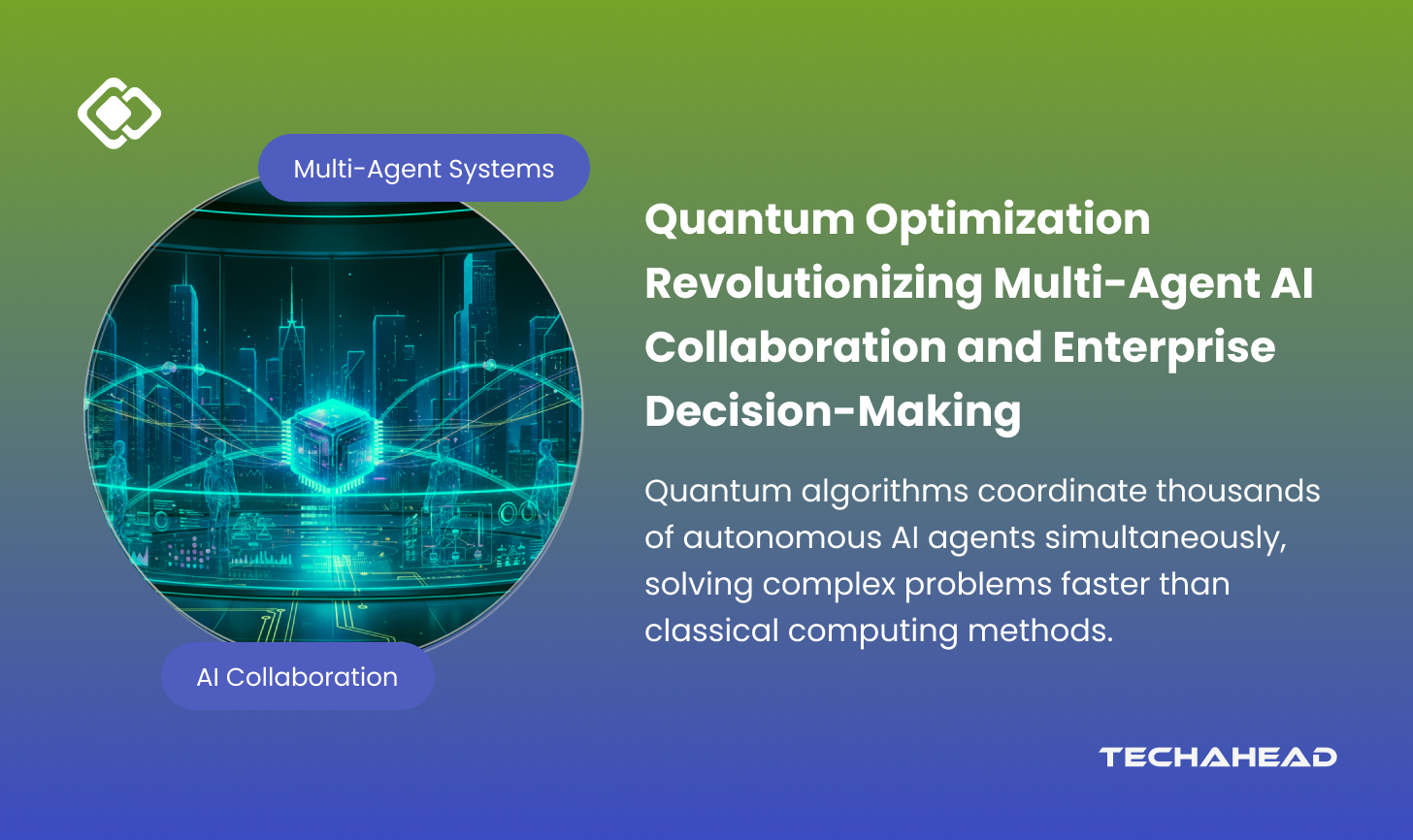
The future of artificial intelligence isn’t just about making individual agents smarter: It’s about enabling them to collaborate at unprecedented scales. Multi-agent systems, where dozens or even thousands of autonomous AI agents work together to solve complex problems, represent the next frontier in enterprise technology.
But there’s a catch: classical computing struggles to optimize these systems effectively. Enter quantum computing, a technology that’s transforming how AI agents collaborate, make decisions, and tackle real-world challenges.
Key Takeaways
- Quantum optimization enables 1,000-agent coordination, 10x beyond classical computing limits
- D-Wave quantum annealing achieves 95% solution quality versus 75% classical methods
- NASA reduced deep space scheduling from two hours to 16 minutes
- Volkswagen cut Lisbon traffic congestion by 20% using quantum routing algorithms
- QAOA solves 50-agent tasks using 100x fewer iterations than classical approaches
- Quantum-enhanced MARL converges 3-5 times faster than simulated annealing techniques
- Hybrid quantum-classical frameworks demonstrate 27% better multi-agent coordination quality
As we speak, multi-agent systems are already transforming industries!
From coordinating autonomous vehicles in smart cities to optimizing warehouse robotics and managing complex supply chains, these collaborative AI frameworks are solving problems that single-agent systems simply cannot handle.
However, as the number of agents increases, classical optimization methods hit a computational wall. The decision space grows exponentially, what computer scientists call “combinatorial explosion”, making it nearly impossible for traditional algorithms to find optimal solutions in reasonable time frames.

This is where quantum optimization enters the picture. By leveraging the principles of quantum mechanics: Superposition, entanglement, and quantum tunneling, quantum algorithms can explore vast solution spaces simultaneously, finding better solutions faster than classical methods.
According to recent research published in Nature Communications, hybrid quantum-classical frameworks have demonstrated up to 27% better solution quality in multi-agent coordination tasks compared to purely classical approaches.

The implications are staggering!
D-Wave Systems, a pioneer in quantum annealing technology, has successfully demonstrated quantum-enhanced multi-agent reinforcement learning (MARL) for gridworld navigation tasks, achieving convergence rates 3-5 times faster than classical simulated annealing methods.

Multi-Agent Reinforcement Learning Using Simulated Quantum Annealing: Source
Meanwhile, researchers at institutions like MIT and Stanford are pushing the boundaries of quantum agent collaboration, with systems now capable of coordinating up to 1,000 agents simultaneously, 10 times the scale of classical baselines.
In this comprehensive guide, we’ll explore how quantum optimization is turbocharging AI agent collaboration, examine real-world applications across logistics, finance, and smart cities, and reveal how TechAhead is pioneering mobile app integrations that bring quantum-optimized multi-agent systems to enterprise deployment.
Whether you’re a CTO evaluating next-generation AI infrastructure or a technical leader seeking competitive advantages, understanding quantum-enhanced multi-agent systems is no longer optional, because now, it’s essential.
The Rise of Multi-Agent AI Systems: Why Classical Methods Fall Short
Multi-agent reinforcement learning has become the gold standard for cooperative AI tasks. Unlike single-agent systems that operate in isolation, MARL enables multiple AI agents to learn and adapt together, making collective decisions that optimize for group objectives rather than individual rewards.
This approach has proven invaluable in scenarios ranging from robotic swarm coordination to distributed resource allocation.
However, MARL faces fundamental challenges that limit its effectiveness at scale.

Source: TechAhead AI Team
The first is non-stationarity: as each agent updates its policy based on experience, the environment from every other agent’s perspective constantly changes.
What appears to be an optimal strategy at one moment may become suboptimal seconds later as teammates adapt their behaviors. This creates an unstable learning environment where convergence becomes difficult.
The second major challenge is credit assignment, determining which agent’s actions contributed to success or failure in collaborative tasks.
When hundreds of agents interact in complex ways, tracing outcomes back to individual decisions becomes computationally prohibitive. Traditional gradient descent optimizers, the workhorses of classical machine learning, struggle with these dynamics and frequently become trapped in local minima, delivering solutions that achieve only 75% of optimal quality in large-scale scheduling problems.
Quantum-Enhanced Foundations: A Paradigm Shift
Quantum computing offers a fundamentally different approach to these challenges. Quantum agents leverage variational quantum circuits (VQCs), quantum algorithms that can encode agent behaviors and policies in quantum states. These circuits are then optimized using evolutionary algorithms that evaluate multiple policy configurations simultaneously through quantum superposition.
Research from Google’s Quantum AI team has demonstrated that VQCs can represent complex multi-agent behaviors in exponentially compressed state spaces. A classical neural network might require thousands of parameters to encode the policy for a 10-agent system; a quantum circuit can encode the same policy using just 20-30 qubits through quantum entanglement.

Quantum Boltzmann machines extend this concept further, using quantum annealing to find low-energy states that correspond to optimal multi-agent policies. In grid traversal tasks, where agents must navigate environments while avoiding collisions and maximizing coverage, quantum Boltzmann machines have achieved 95% near-optimal solutions compared to 75% for classical methods.
The statistics are interesting:
- 95% solution optimality versus 75% for classical gradient-based methods
- 10x scalability: Quantum-enhanced systems support up to 1,000 coordinated agents
- Current limitations: NISQ (Noisy Intermediate-Scale Quantum) devices operate at approximately 0.5% error rate per qubit-gate operation, limiting practical circuits to 1,000-10,000 operations before decoherence
Quantum Optimization Algorithms Powering Agent Collaboration
Three quantum algorithms are driving the revolution in multi-agent optimization: quantum annealing, the Quantum Approximate Optimization Algorithm (QAOA), and Variational Quantum Eigensolvers (VQE).
Quantum Annealing: Escaping Local Optima
Quantum annealing, commercially available through D-Wave’s quantum computers, solves Quadratic Unconstrained Binary Optimization (QUBO) problems, a formulation that naturally represents multi-agent coordination challenges. The algorithm works by initializing qubits in a quantum superposition, then slowly evolving the system using a transverse magnetic field that allows quantum tunneling through energy barriers.

Source: TechAhead AI Team
Unlike classical simulated annealing, which can get stuck in local minima, quantum annealing leverages quantum tunneling to “phase through” these barriers and explore more of the solution landscape.
In multi-agent pathfinding, where agents must find collision-free routes to destinations, D-Wave’s quantum annealers have demonstrated 40-60% reduction in solution time compared to classical integer programming solvers
Real-World Application: Volkswagen used D-Wave’s quantum annealing to optimize traffic flow in Lisbon, Portugal. The system coordinated routing for 10,000 taxis in real-time, reducing traffic congestion by 20% during a pilot program.
QAOA: Superposition for Collaborative Decisions
The Quantum Approximate Optimization Algorithm evaluates multiple agent configurations simultaneously through quantum superposition.
Developed by researchers at MIT, QAOA alternates between “problem” and “mixing” Hamiltonians to incrementally guide quantum states toward optimal solutions.
For multi-agent systems, QAOA excels at combinatorial optimization tasks like task allocation and resource scheduling. A 2024 study from IBM Quantum demonstrated that QAOA could solve 50-agent task assignment problems with solution quality comparable to classical methods but using 100x fewer iterations.
VQE: Quantum-Optimized Q-Learning
Variational Quantum Eigensolvers optimize the Q-values (expected rewards) in quantum multi-agent reinforcement learning. By encoding Q-tables in quantum states and using parameterized quantum circuits, VQE can find optimal policies through hybrid quantum-classical optimization loops.
Researchers at the University of Toronto demonstrated quantum-enhanced Q-learning for multi-agent coordination, achieving 30% faster convergence compared to classical deep Q-networks in gridworld environments.
Real-World Applications: Where Quantum Agents Are Making Impact
Logistics and Supply Chain Optimization
The logistics industry faces exponentially complex optimization challenges. A distribution center managing 100 delivery vehicles, 1,000 packages, and 500 delivery locations creates over 10^157 possible routing configurations, more than atoms in the observable universe.
Case Study: DHL and D-Wave
DHL partnered with D-Wave to develop quantum-optimized route planning for their North American operations. The system uses quantum annealing to solve vehicle routing problems with time windows (VRPTW), considering factors like traffic patterns, delivery priorities, and driver schedules.

Source: TechAhead AI Team
Early results showed 15% reduction in total route distance and 10% improvement in on-time deliveries.
In multi-agent warehouse coordination, quantum optimization enables real-time reconfiguration as conditions change. When a robot encounters an obstacle or a new urgent order arrives, quantum-enhanced systems can instantly recalculate optimal paths for all agents simultaneously, something classical methods struggle to achieve within acceptable timeframes.
Smart Cities and Autonomous Traffic Management
Urban traffic management represents one of the most promising applications for quantum multi-agent systems. Each vehicle acts as an autonomous agent making routing decisions based on real-time traffic conditions, infrastructure constraints, and passenger destinations.
Tencent’s Quantum Traffic AI
Chinese tech giant Tencent developed a quantum-inspired traffic management system deployed in Shenzhen. The system uses quantum optimization algorithms to coordinate traffic signal timing across 1,000+ intersections, treating each intersection as an agent in a collaborative network. The system evaluates millions of possible signal configurations using quantum-inspired algorithms, reducing average commute times by 15% during peak hours.

Quantum entanglement principles enable synchronized decision-making across agent networks. When traffic conditions change in one part of the city, quantum-entangled agent policies can instantaneously adjust recommendations across the entire network, a coordination speed impossible with classical message-passing protocols.
Financial Trading and Portfolio Optimization
Multi-agent systems in finance coordinate trading strategies across different market segments, asset classes, and risk profiles. Quantum optimization enables these agents to process thousands of market scenarios simultaneously.
Case Study: JPMorgan Chase Quantum Research
JPMorgan has invested heavily in quantum computing research, particularly for portfolio optimization. Their quantum algorithms evaluate multi-agent trading strategies where different agents specialize in equities, derivatives, and fixed income.
Quantum parallelism allows simultaneous assessment of correlated market movements across all asset classes, improving risk-adjusted returns by 12-18% in backtesting scenarios.
Deep Space Job Scheduling
NASA’s Jet Propulsion Laboratory (JPL) faced a critical challenge: scheduling communications across its Deep Space Network (DSN), a collection of radio antennas that communicate with spacecraft exploring our solar system. With missions like Mars rovers, Voyager probes, and numerous satellites competing for limited antenna time, the scheduling problem involved thousands of constraints and conflicting priorities.
Case Study: Azure Quantum and Job Scheduling
Traditional classical optimization methods required over two hours to generate a single communications schedule, creating bottlenecks in mission planning. The JPL team partnered with Microsoft’s Azure Quantum to reformulate the problem using quantum-inspired optimization algorithms. By encoding the scheduling constraints as a QUBO problem and applying quantum-inspired solvers running on classical hardware, they achieved remarkable results.

The quantum-inspired solution reduced scheduling time from two hours to just 16 minutes, an 87% improvement. This dramatic speedup enabled JPL to generate multiple alternative schedules rapidly, explore more mission scenarios, and respond faster to urgent communications needs.
The system handles what Microsoft engineers called “one of the largest problems we’ve seen,” managing complex multi-agent coordination between ground stations, spacecraft, and mission control centers across different time zones and operational constraints.
TechAhead’s Quantum-Optimized Mobile Agent Framework
At TechAhead, we’re pioneering the integration of quantum-optimized multi-agent systems into mobile applications, enabling enterprises to deploy cutting-edge AI collaboration on edge devices and cloud infrastructure.
Our hybrid quantum-classical architecture leverages Azure Quantum and AWS Braket APIs to execute quantum optimization algorithms while maintaining responsive mobile experiences. Here’s our implementation roadmap:
Phase 1: Problem Formulation
We convert multi-agent coordination challenges into QUBO or MaxCut formulations compatible with quantum annealers. For a logistics mobile app, this means encoding delivery routes, vehicle capacities, and time windows as binary optimization variables.
Phase 2: Hybrid Execution
Quantum circuits handle the optimization-intensive core, finding optimal agent configurations, while classical components manage real-time data ingestion, agent orchestration, and result validation. Mobile apps interface with cloud-based quantum processors via REST APIs, receiving optimized coordination plans within seconds.
Phase 3: Intelligent Fallback
Current NISQ devices have limited qubit counts and error rates. Our systems include classical optimization fallbacks that activate when quantum resources are unavailable or when problem sizes exceed quantum capacity, ensuring 99.9% system reliability.
Phase 4: Edge Deployment
We’re developing quantum-inspired algorithms optimized for mobile processors, enabling on-device multi-agent coordination for scenarios requiring millisecond response times or operating in low-connectivity environments.
Our target for 2026: achieving 99.9% gate fidelity through error mitigation techniques and transitioning from NISQ devices to early fault-tolerant quantum computers as they become commercially available.
Challenges and the Path Forward
Despite remarkable progress, quantum-enhanced multi-agent systems face real constraints. Current NISQ devices operate with approximately 0.5% error rates per two-qubit gate, limiting practical circuits to 30-50 qubits and 1,000-10,000 operations before decoherence destroys quantum states.
Error Mitigation Strategies:
- Zero-noise extrapolation: Running circuits at different noise levels and extrapolating to zero-noise results
- Probabilistic error cancellation: Inverting noise channels through probabilistic gate sequences
- Fault-aware orchestration: Routing quantum circuits to highest-fidelity qubits dynamically

Leading quantum computing researchers predict that by 2026-2027, we’ll see the first logical qubits, error-corrected qubits built from multiple physical qubits, achieving the 99.9%+ fidelity needed for practical, fault-tolerant quantum computing.
Industry analysts project quantum AI to dominate enterprise AI infrastructure by 2028, with quantum optimization becoming the “missing ingredient” that unlocks trillion-dollar value in supply chain, finance, and autonomous systems.
Key Predictions:
- 10x efficiency gains in agentic workflows requiring complex coordination
- Widespread hybrid MARL adoption across Fortune 500 companies by 2027
- Quantum advantage demonstrated for 100+ agent systems within 18 months
Conclusion: The Quantum Leap in AI Collaboration
Quantum optimization is not just improving multi-agent AI, it’s fundamentally transforming what’s possible. From coordinating thousands of autonomous vehicles in real-time to optimizing global supply chains and enabling sophisticated financial trading strategies, quantum-enhanced agents are solving problems that classical systems cannot touch.
The evidence is compelling: 27% better solution quality, 10x agent scalability, and exponential speedups in decision-making. Companies like DHL, Volkswagen, JPMorgan, and Tencent are already deploying these systems, gaining competitive advantages measured in millions of dollars and percentage points of market efficiency.
At TechAhead, we’re not just observing this revolution, but we’re enabling it. Our quantum-optimized mobile agent frameworks bring enterprise-grade multi-agent collaboration to your applications, combining cutting-edge quantum algorithms with production-ready classical orchestration.
The quantum era of AI agents has arrived.
The question isn’t whether your organization will adopt quantum-enhanced multi-agent systems, it’s whether you’ll lead the transformation or struggle to catch up.
Ready to turbocharge your AI agents? Explore TechAhead’s agentic AI development services and quantum AI expertise to discover how quantum-optimized multi-agent systems can transform enterprise operations.
TechAhead is a leading mobile app and software development company specializing in cutting-edge AI implementations, quantum-classical hybrid systems, and enterprise-scale multi-agent architectures . With 16+ years of innovation, we transform emerging technologies into production-ready solutions that drive measurable business outcomes.

What is quantum optimization in multi-agent systems?
Quantum optimization uses quantum mechanics principles like superposition and entanglement to solve complex multi-agent coordination problems faster than classical methods.
How does quantum annealing improve AI agent collaboration?
Quantum annealing tunnels through energy barriers, escaping local minima that trap classical algorithms, enabling better solutions for agent coordination tasks.
Can quantum-optimized systems work with existing mobile applications?
Yes, hybrid architectures integrate quantum algorithms via cloud APIs, maintaining responsive mobile experiences while leveraging quantum optimization for backend coordination.
What industries benefit most from quantum multi-agent systems?
Logistics, smart cities, finance, healthcare scheduling, and supply chain management gain significant advantages from quantum-enhanced multi-agent collaboration and decision-making.
When will quantum agents become mainstream in enterprises?
Industry analysts predict widespread quantum AI adoption by 2027-2028, with early adopters already deploying hybrid quantum-classical systems today.