

Staff Augmentation
Access top-tier talent on demand: Dedicated, Hourly, or Flexible.


 Copy Link
 Share on X
 Share on Facebook
 Share on LinkedIn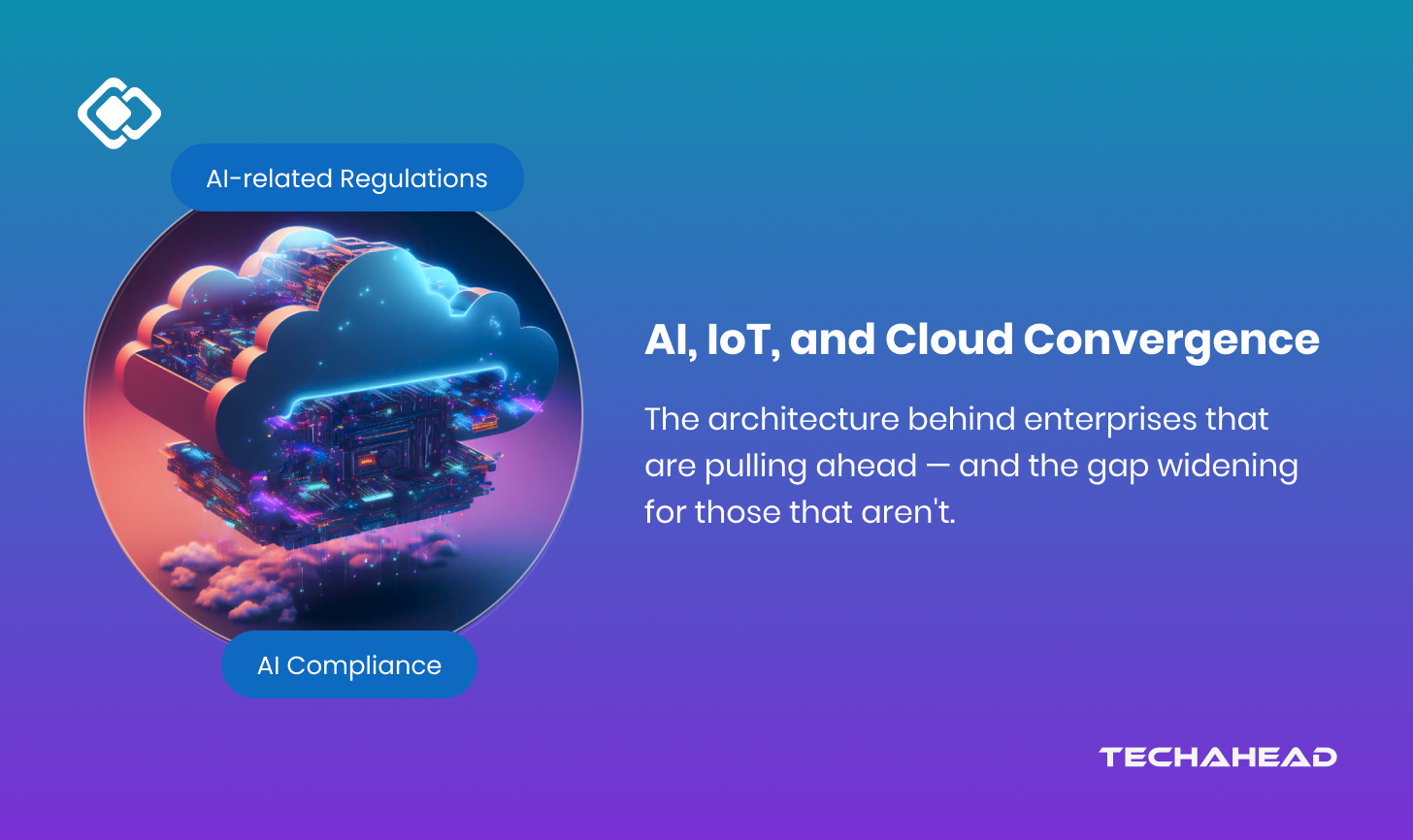
Key Takeaways:
- AI, IoT, and Cloud each deliver incremental value in isolation. The transformational return comes from designing all three as a unified system.
- 70% of transformation programs fail, and the integration strategy is one of the primary reasons for it.
- A study on edge-cloud synergy for AI-enhanced sensor networks found that a hybrid edge-cloud approach achieves a 35% reduction in latency, 28% decrease in energy consumption, and 60% reduction in bandwidth usage compared to cloud-only solutions.
- Real-time intelligence feeds better predictions. Better predictions enable tighter automation. Tighter automation frees capacity for innovation. The enterprises building this architecture today will be in a categorically stronger competitive position in three years.
The global digital transformation market is expected to hit $4,617.78 billion by 2030, projecting a CAGR of 28.5% from 2025 to 2030. But here’s what that number doesn’t tell you: most of that investment will underperform. According to McKinsey, 70% of digital transformation initiatives fail — not because of wrong technology, but because of a poor integration strategy.
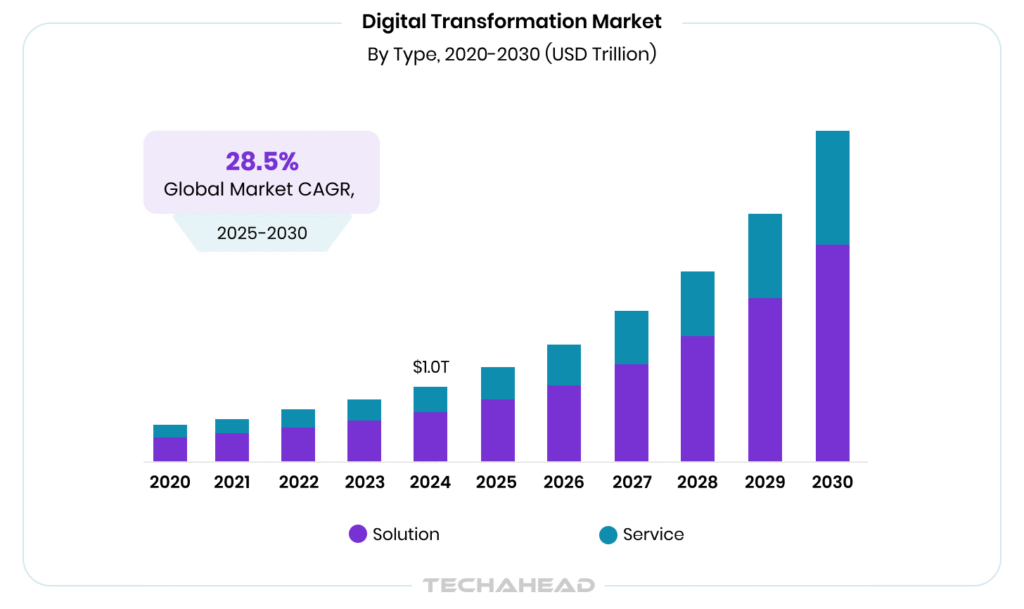
The question is no longer whether your enterprise should embrace AI, IoT, or cloud. It’s whether you are combining them right architecturally and at scale.
The enterprises pulling ahead are not simply adopting new tools. They are converging three foundational technologies into a single, intelligent operating model. That convergence of AI, IoT, and Cloud working in sync is what drives the next wave of meaningful, measurable transformation.
AI, IoT, and Cloud: The Three Pillars Explained Simply
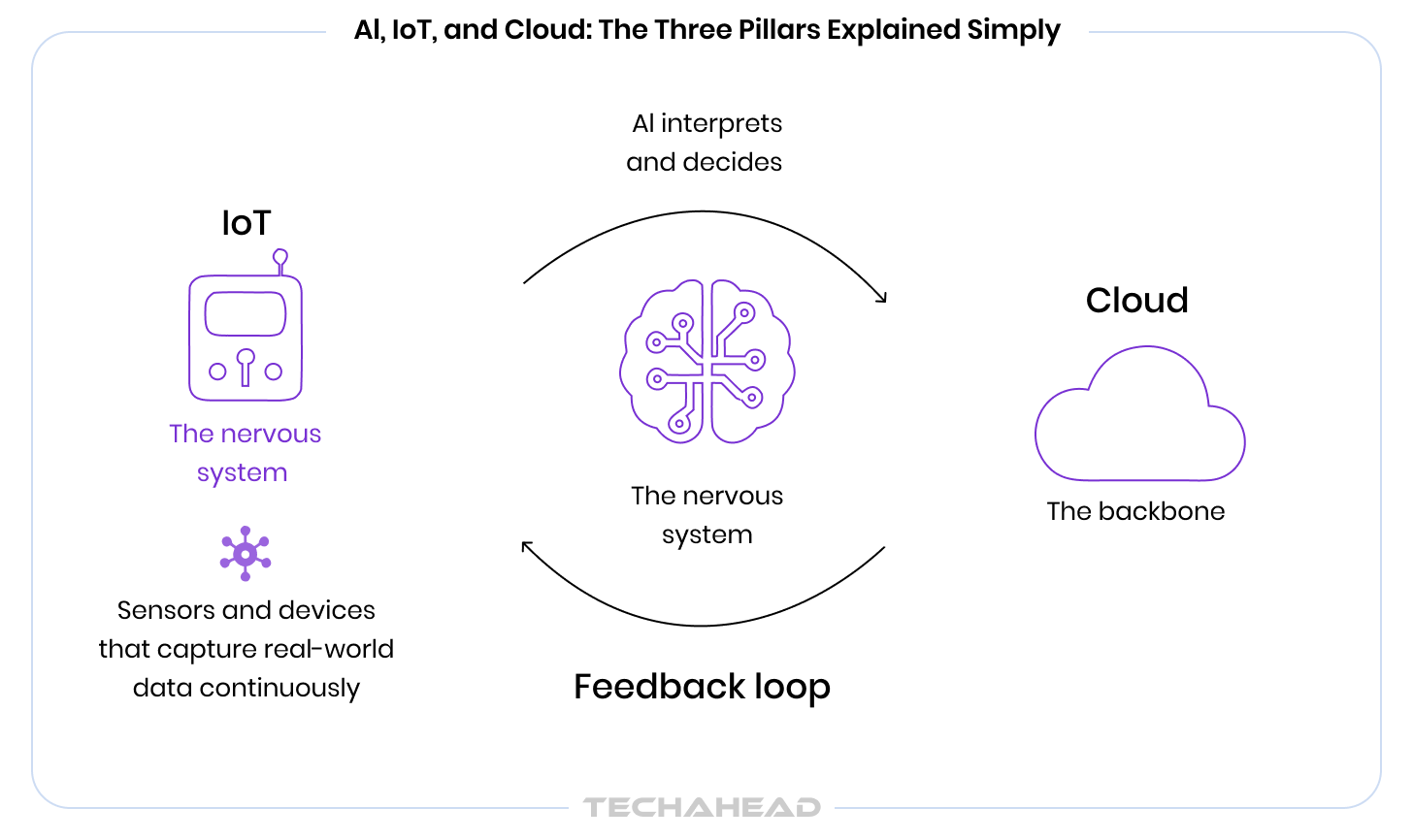
Before we get into what convergence looks like in practice, it’s worth being precise about what each layer actually does — and why none of them work as well in isolation.
- IoT (The nervous system): sensors and devices that capture real-world data continuously.
- AI (The Brain): finds patterns, predicts outcomes, and drives intelligent decisions.
- Cloud (The backbone): stores, scales, and makes that data accessible anywhere, instantly.
The data flow is straightforward: IoT captures → Cloud stores and scales → AI interprets and decides. But the real value is not in the flow itself. It’s in the feedback loop where AI insights inform better IoT configurations, and cloud infrastructure adapts dynamically to data load. That loop is what makes this convergence transformational, not incremental.
Understanding the Core Technologies Behind the Convergence of AI, Cloud, and IoT
Let’s dive deep into each technology and its role in driving digital transformation.
The Role of IoT in Digital Transformation
IoT is where digital transformation touches the physical world. For example, sensors on factory floors, connected logistics fleets, and smart building systems. They are the first line of data collection that makes everything else possible.
IoT-enabled predictive maintenance reduces equipment downtime by up to 50% and cuts maintenance costs by 25%.
IoT gives enterprises real-time visibility into operations that were previously opaque: machine health, supply chain location, energy usage, and customer behavior in physical spaces.
The challenge most enterprises face is that IoT alone produces enormous volumes of unstructured data with no clear path to insight. That’s where cloud and AI become non-negotiable.
The Role of Cloud Infrastructure in Digital Transformation
If IoT is the signal, cloud is the infrastructure that carries it. The role of cloud infrastructure in digital transformation is often undersold. It’s not just storage. It’s the platform that makes AI deployment, IoT data ingestion, and cross-functional collaboration possible simultaneously.
Organizations using cloud, data, & AI reduce time-to-market for new digital products by up to 40%.
Cloud solutions for digital transformation in large enterprises offer three specific advantages that on-premise infrastructure simply can’t match:
- Elastic scaling for IoT data surges
- Global accessibility for distributed operations
- Platform-level AI services that remove the need to build from scratch
The benefits of cloud accelerators in digital transformation deserve particular attention. Pre-built frameworks, APIs, and AI model libraries compress implementation timelines significantly. For large enterprises, this is not about cutting corners — it’s about redirecting engineering effort toward competitive differentiation rather than foundational plumbing.
The mistake most enterprises make is migrating to the cloud without redesigning how data flows between their IoT systems and AI layers. Migration without architecture is just expensive shuffling.
Where AI Ties It All Together
AI is the intelligence layer that transforms IoT data stored and processed through the cloud into something an enterprise can actually act on. Without AI, you have dashboards. With AI, you have decisions.
AI’s role in this convergence extends across four critical capabilities:
- Predictive analytics: Anticipate equipment failures, demand shifts, and supply chain disruptions before they happen.
- Real-time automation: Trigger operational responses without human lag — at machine speed.
- Behavioral intelligence: Understand patterns in customer and operational data that aren’t visible to human analysts.
- Continuous learning: AI models improve with every new IoT data point. The system gets smarter as the business grows.
AI-driven digital transformation is not about replacing human judgments. It’s about elevating it by giving decision-makers sharper inputs, faster signals, and better predictions.
How AI + IoT + Cloud Work Together: The Convergence Architecture
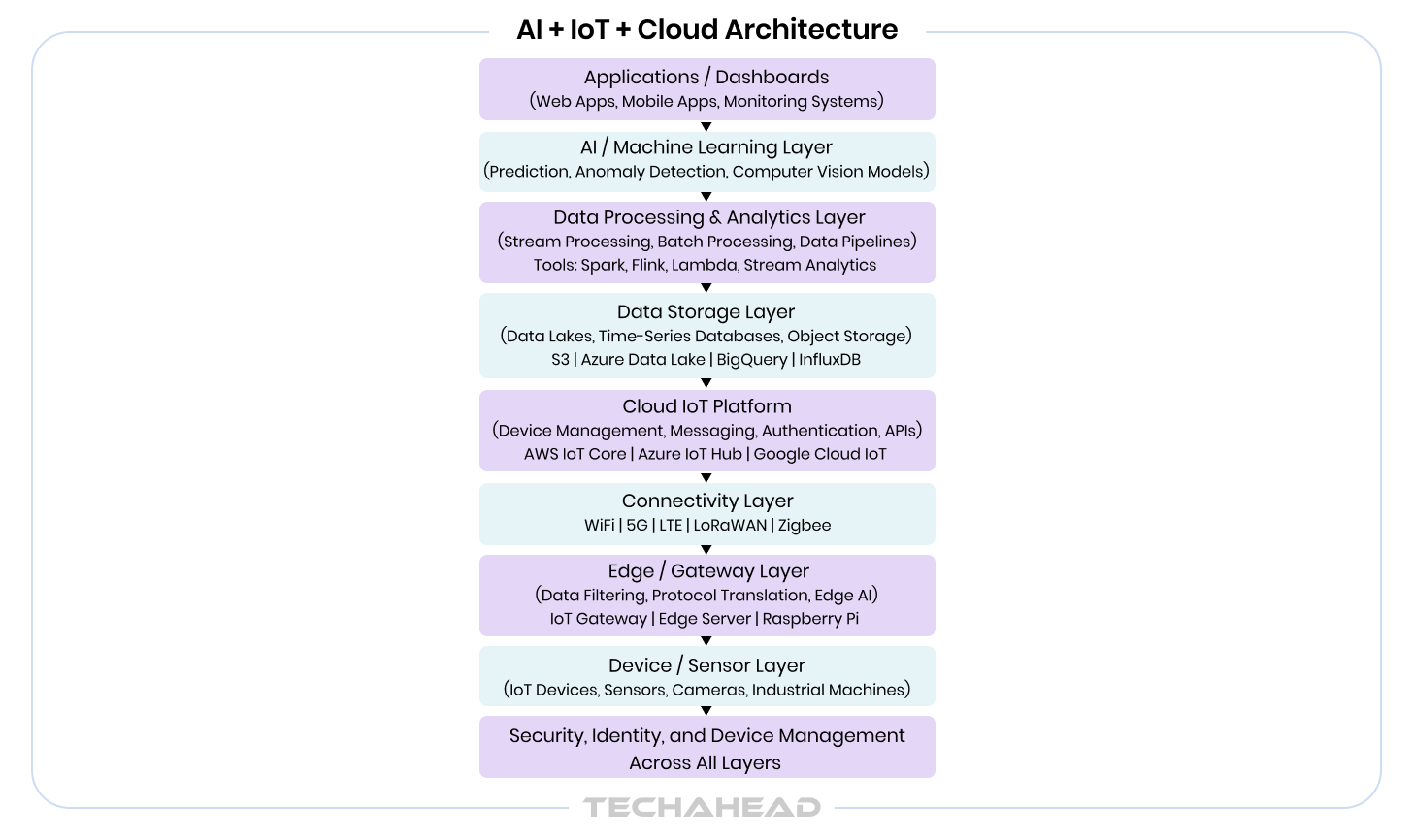
Talk to most enterprise IT teams, and you will find IoT deployments feeding data into spreadsheets, cloud migrations that have not touched operational systems. An AI pilot runs on data that does not reflect how the business actually works. This reflects that the technology exists without integration.
The AI IoT cloud architecture described here is the operational blueprint that separates enterprises with real transformation outcomes from those that cycle through proofs of concept. It works in four layers with a distinct role, each dependent on the others.
1. Device Layer
This is where a physical AI service provider role comes into the picture.
- IoT Sensors: Temperature, pressure, motion, location, energy — sensors embedded in physical assets capture operational reality continuously.
- Connected Devices: Smartphones, wearables, smart meters, RFID tags — the consumer and enterprise endpoints that feed behavioral and environmental data.
- Industrial Equipment: CNC machines, robotic arms, conveyor systems, HVAC units — mission-critical assets with embedded telemetry that drive predictive maintenance use cases.
The Device Layer is where data originates. Its quality — the accuracy, frequency, and completeness of what sensors capture — determines everything that happens above it. Enterprises that underinvest in device-layer architecture pay for it later in AI models that predict the wrong things.
2. Edge Layer
Intelligence at the source — before the cloud even sees the data.
- Edge Computing: Processing units deployed at or near IoT devices — industrial gateways, edge servers, ruggedized compute nodes — that run AI inference locally.
- Local Data Processing: Filtering, aggregating, and contextualizing raw sensor data before transmission. Only relevant signals travel upstream, reducing bandwidth costs and cloud load.
- Latency Reduction: For applications where milliseconds matter — autonomous manufacturing, real-time quality control, patient monitoring — edge AI eliminates the round-trip to the cloud entirely.
Intelligent edge computing is the layer most enterprises skip in their first architecture pass — and the one they scramble to add when latency becomes a production problem. Edge AI does not replace cloud processing; it complements it. Time-sensitive decisions happen at the edge. Complex, large-scale model training happens in the cloud.
3. Cloud Layer
The backbone that stores, scales, and centralizes.
- Centralized Data Processing: Raw and pre-processed IoT data from edge nodes flows into cloud data lakes and warehouses, creating the unified dataset that AI models require.
- Large-Scale Analytics: Cloud infrastructure enables analytics workloads that no on-premise system could run cost-effectively — processing billions of IoT events to surface macro patterns and trend signals.
- AI Model Training: Cloud compute — GPUs, TPUs, distributed training clusters — is where machine learning models are built, validated, and retrained as new data accumulates.
The cloud layer is where real-time analytics at scale becomes possible. IoT data that arrives in milliseconds can be stored, joined with historical records, run through analytical models, and surfaced as insight — all within the same infrastructure. Cloud solutions for digital transformation in large enterprises succeed specifically because this layer can scale elastically without architectural rework.
4. Intelligence Layer
The AI Intelligence Layer is what makes this architecture transformational rather than just functional. Without it, you have a sophisticated data pipeline. With it, you have a system that learns from every device signal, improves its own predictions, and executes operational decisions at machine speed — with human oversight built into the escalation logic.
AI + IoT + Cloud Convergence in Action: Use Cases in Different Industries
The strongest argument for AI + IoT + cloud convergence is not theoretical. It’s operational. Here’s what it looks like across industries that have moved beyond pilot programs:
Manufacturing
Smart factories combining AI, IoT sensors, and cloud platforms report improvement in production yield. AI reads real-time sensor data to detect micro-anomalies before they become line stoppages. The cloud ensures that intelligence is accessible across every facility, globally.
Healthcare
IoT healthcare wearables stream continuous patient data to cloud platforms, where AI models flag early deterioration signals. AI-enabled remote monitoring has been shown to reduce hospital readmissions, which is a clinical and financial outcome that justifies the infrastructure investment many times over.
Retail
Smart shelf sensors, foot traffic IoT data, and cloud-hosted AI personalization engines now work together to tailor the in-store and digital experience simultaneously. As per Fortune Business Insights, the global IoT in retail market size is expected to reach $482.84 billion by 2034, growing at a CAGR of 23.99% during the forecast period from 2025 to 2034.
Logistics & Supply Chain
GPS IoT tracking, cloud logistics platforms, and AI routing algorithms reduce last-mile delivery costs. The supply chain is no longer reactive. For enterprises with this convergence in place, it’s predictive.
Business Impact of AI, IoT, and Cloud: Why Large Enterprises Need End-to-End Transformation Consulting
| Without End-to-End Strategy | With End-to-End Consulting |
| Data silos between IoT and cloud systems — no unified data pipeline. | Architecture designed across all three layers from day one — data flows cleanly. |
| AI models trained on poor-quality IoT data — predictions that miss the mark. | Custom AI models built on validated, structured IoT datasets aligned to real business goals. |
| Security and compliance gaps across disconnected layers. | Governance, security, and compliance embedded into the architecture — not bolted on later. |
| Scalability bottlenecks as device counts and data volumes grow. | Cloud infrastructure optimized for IoT workloads — built to scale without a rebuild |
| No ongoing support — deployments drift, degrade, and underdeliver over time. | Continuous monitoring, iteration, and optimization — the system improves post-launch. |
When AI, IoT, and cloud converge as a unified system, the enterprise outcomes are specific and compounding. Here’s what that looks like in practice.
Real-Time Operational Intelligence
Continuous IoT monitoring gives operations teams live visibility into system health — no batch lag, no blind spots. AI runs on real-time IoT data surfaces anomalies within milliseconds. Enterprises with this capability detect and resolve incidents faster than those relying on manual monitoring.
Predictive and Automated Decision-Making
AI models identify the early signatures of equipment failure weeks in advance. Intelligent automation then schedules maintenance and reroutes operations without human initiation. This approach cuts unplanned downtime and maintenance costs.
Scalable Infrastructure for Global Operations
Cloud platforms absorb the data volumes that large-scale IoT deployments generate across regions, without architectural rework. Enterprises shifting operational workloads to the cloud report a 20–30% reduction in total IT costs, with elastic compute that scales to demand, not predictions.
Faster Innovation Through Cloud Accelerators
Pre-built frameworks, managed AI pipelines, and reusable APIs mean enterprises do not rebuild solved problems for every initiative. Time-to-market for new digital products drops by up to 40%, and engineering effort concentrates on differentiation, not infrastructure.
Sustained Efficiency and Cost Optimization
Intelligent automation replaces manual monitoring. AI optimizes energy, inventory, and compute in real time. Enterprises running converged architectures consistently report operational cost reduction — a compounding return, not a one-time saving.
Key Considerations Before You Start Your AI + IoT + Cloud Convergence Journey
For enterprises building or scaling a convergence strategy, five considerations consistently separate successful programs from expensive proof-of-concept:
- Data readiness first. 60% of enterprise IoT projects stall at the POC stage due to poor data infrastructure readiness. Before adding AI, assess the quality and structure of what your IoT systems are actually collecting.
- Strategy before technology. Define the business outcome you’re optimizing for. AI, IoT, and cloud should follow that goal — not define it.
- Choose your cloud model deliberately. Public, private, and hybrid clouds carry different costs, compliance, and latency implications. Your IoT workloads and regulatory environment should drive this decision — not vendor preference.
- Build security in, not on. Cybersecurity incidents in IoT environments have increased. Therefore, security architecture across all three layers isn’t optional — it’s foundational.
- Pilot with scale in mind. Start focused, but architect for growth from day one. A pilot that can’t scale is not a proof of concept — it’s a prototype with no future.
What the Future Looks Like — Edge AI + 5G + Autonomous Systems
The convergence of AI, IoT, and cloud is already redefining enterprise operations. But the next layer of capability is being built right now, and it will move faster than most roadmaps anticipate.
Three developments are worth tracking closely:
- Edge AI: The global edge computing market is expected to reach $249.06 billion by 2030, projecting an 8.1% CAGR. Processing AI inference at or near IoT devices — rather than routing everything to the cloud reduces latency and cuts cloud data transmission costs. For latency-sensitive applications like autonomous manufacturing or real-time patient monitoring, edge AI isn’t a future capability. It’s a present requirement.
- 5G-enabled IoT: 5G networks will enable IoT at a scale and speed that current infrastructure can’t support. Enterprises building their IoT architectures today should account for 5G integration from the start.
- Digital Twins: The global digital twin market size is expected to reach $149.81 billion in 2030, projecting a CAGR of 47.9% CAGR. Virtual replicas of physical assets, processes, or entire facilities, powered by real-time IoT data and AI modeling, give enterprises the ability to simulate, test, and optimize before making operational changes. The ROI case is compelling, particularly for capital-intensive industries.
Edge AI is not a future concept — it’s a present necessity for any enterprise running latency-sensitive IoT workloads. Companies building for the edge today are the ones who won’t be scrambling to retrofit in 2027.
Conclusion
Early digital transformation adopters generate 2x more revenue growth compared to late movers. Enterprises that don’t scale AI, cloud, and IoT together will face significant competitive disadvantages. Therefore, the time to hire a digital transformation company to opt for the convergence of AI, IoT, and Cloud is now. It’s the new baseline for enterprises that intend to compete, and the architecture decisions being made right now will compound over the next decade.
The enterprises that will lead aren’t the ones with the biggest budgets or the most sophisticated tools. They’re the ones with the clearest integration strategy and the right partners to execute it.
What are cloud accelerators, and why do they matter for digital transformation?
Cloud accelerators are pre-built frameworks, managed services, reusable APIs, and industry-specific templates provided by cloud platforms and specialist partners. Instead of building foundational infrastructure from scratch, enterprises configure and extend what already exists — cutting time-to-market for new digital products. The benefits of cloud accelerators in digital transformation come down to one thing: they let engineering teams focus on solving the actual business problem rather than rebuilding solved infrastructure problems for every new initiative.
What cloud solutions work best for digital transformation in large enterprises?
Large enterprises need cloud solutions that handle three things simultaneously:
1. Ingesting high-volume IoT data streams
2. Running AI workloads at scale
3. Supporting distributed teams across global operations
Hybrid and multi-cloud architectures are increasingly the answer, giving enterprises the flexibility to keep sensitive workloads on private infrastructure while leveraging public cloud for scale and AI services. The right cloud solution for digital transformation in large enterprises isn’t a vendor decision. It’s an architecture decision that should be driven by data governance requirements, latency needs, and long-term scalability — before any platform is selected.
How does cloud enable AI and IoT to work together?
Cloud is the connective tissue between IoT and AI. IoT devices generate data continuously — but raw sensor data alone doesn’t produce insight. Cloud infrastructure ingests, organizes, and stores that data at scale, making it accessible to AI models that can find patterns, predict outcomes, and trigger automated responses. Without cloud in digital transformation, AI and IoT remain disconnected capabilities. Together, through the cloud, they form an intelligent feedback loop — where insights flow back to reconfigure devices and improve predictions over time.
What is the biggest mistake enterprises make when adopting AI, IoT, and cloud?
Adopting them separately. Most enterprises approach AI, IoT, and cloud as three distinct investment tracks — each with its own vendor, roadmap, and team. The result is data silos, AI models trained on incomplete IoT data, and cloud infrastructure that wasn’t designed for the workloads being pushed through it. The convergence only delivers value when the three layers are architected as a unified system from the start. Treating IoT in digital transformation as a standalone initiative — disconnected from cloud strategy and AI development — is the most common and most expensive mistake enterprises make.