

Staff Augmentation
Access top-tier talent on demand: Dedicated, Hourly, or Flexible.


 Copy Link
 Share on X
 Share on Facebook
 Share on LinkedIn
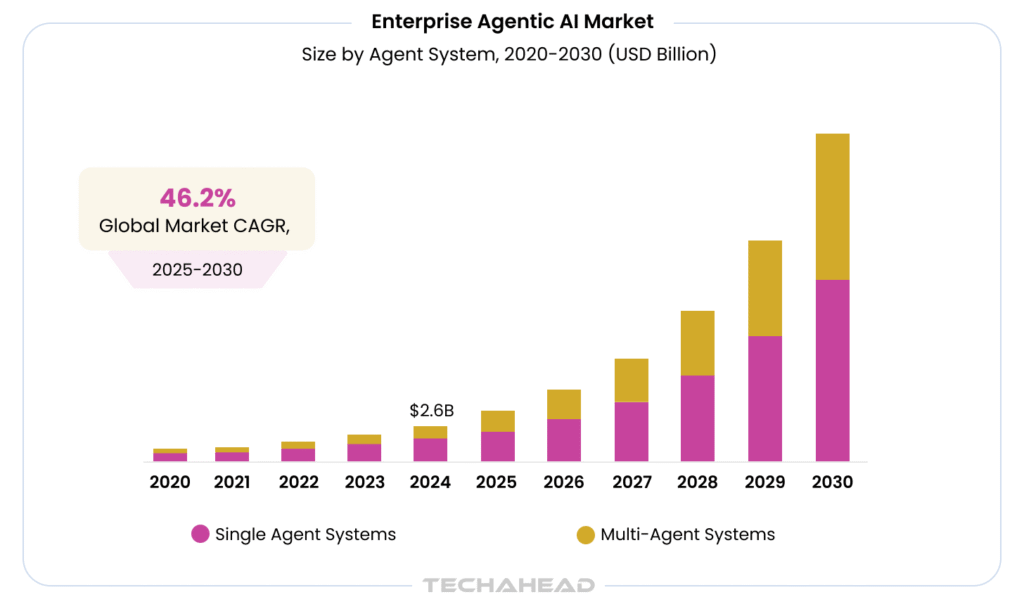
Enterprise workflows are collapsing under their own complexity. Rule-based automation breaks when faced with exceptions. Human oversight cannot scale with data volume. Traditional systems follow rigid scripts, but agentic AI makes intelligent decisions. The impact is staggering: JPMorgan Chase condensed 360,000 hours of legal work (COIN: Contract Intelligence) into seconds. Siemens autonomously optimizes manufacturing in real-time. Healthcare providers slashed administrative costs by 30%. This is not hype, enterprises are investing heavily, propelling the agentic AI market from USD 2.58 billion in 2024 to USD 24.50 billion by 2030 at 46.2% CAGR. In this blog, we are going to explore how AI agents tackle complexity and decision-making challenges that outperformed previous technologies, and why your competitive position depends on understanding this shift now.
Key Takeaways
- Agents break high-level objectives into sub-goals, plan actions, execute, and self-correct dynamically.
- Agentic AI autonomously achieves goals without constant human oversight, unlike reactive chatbots.
- Agentic AI market grows from $2.58B (2024) to $24.50B (2030) at 46.2% CAGR.
- Finance agent swarms enable real-time fraud detection and compliance across legacy systems.
- Prioritize high-ROI pilots using impact-feasibility matrices for repetitive multi-step processes.
What is Agentic AI?
Agentic AI refers to advanced AI systems, known as autonomous agents, that operate independently to achieve goals without constant human input. Unlike traditional AI, which reacts to specific prompts, like chatbots generating responses on command; these agents possess true agency.
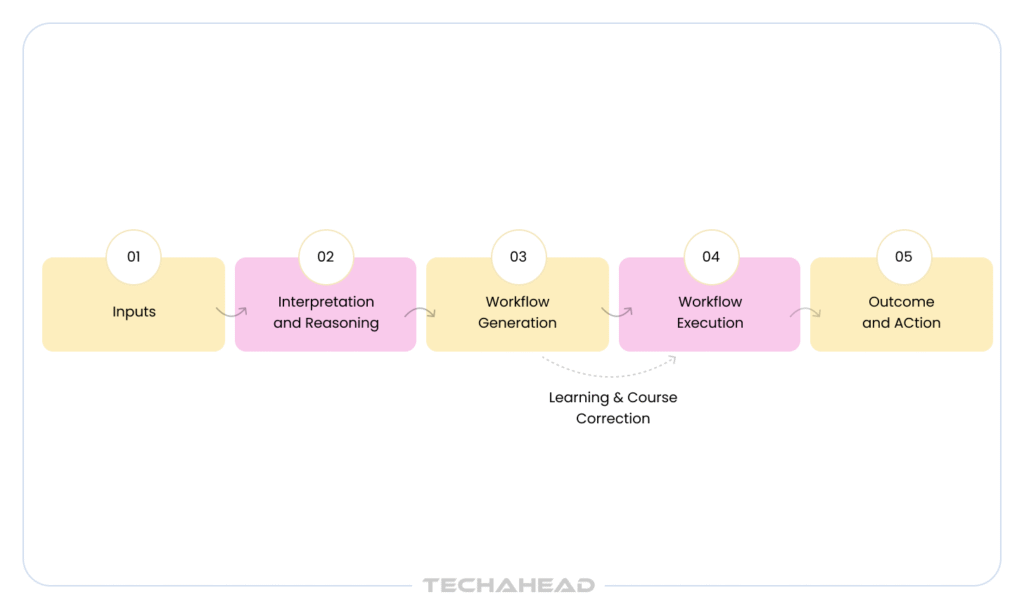
They receive high-level objectives, then break them down through reasoning: first setting sub-goals, then planning step-by-step actions, and finally executing tasks while adapting to changes. For instance, an agent might analyze data, call tools, and iterate until completion. This shift allows complex, multi-step workflows in enterprises that transform passive tools into proactive partners.
Why Does Agentic AI Matter for Enterprises Now?
Agentic AI stands out in 2026 as enterprises face mounting pressures from digital transformation, talent shortages, and competitive markets. Unlike reactive AI tools, these autonomous agents handle end-to-end workflows, which deliver immediate ROI through efficiency gains.
Accelerate Digital Transformation
Enterprises are racing to automate amid rising operational costs up 15-20% yearly per industry reports. Agentic AI orchestrates complex processes like supply chain optimization or customer onboarding without human oversight. Set goals, plan actions, and self-correcting, it slashes deployment times from months to days.
Bridge Skill Gaps
With 85 million jobs potentially disrupted by automation by 2027 (World Economic Forum), agentic AI fills voids in data analysis, compliance, and decision-making. It empowers non-technical teams to tackle high-value tasks.

Drive Competitive Edge
Real-time adaptability gives a first-mover advantage. In volatile sectors like finance and manufacturing, agents predict disruptions e.g., fraud or inventory shortages and act proactively. Early adopters report 25% cost reductions and faster innovation cycles.
Innovative Operations
As multi-agent systems emerge, enterprises ignoring agentic AI risk obsolescence. Integrating now means seamless human-AI collaboration, positioning businesses for 2027’s projected $500B market. Start small, pilot one workflow to unlock transformative potential.
Use of Agentic AI in Key Industries
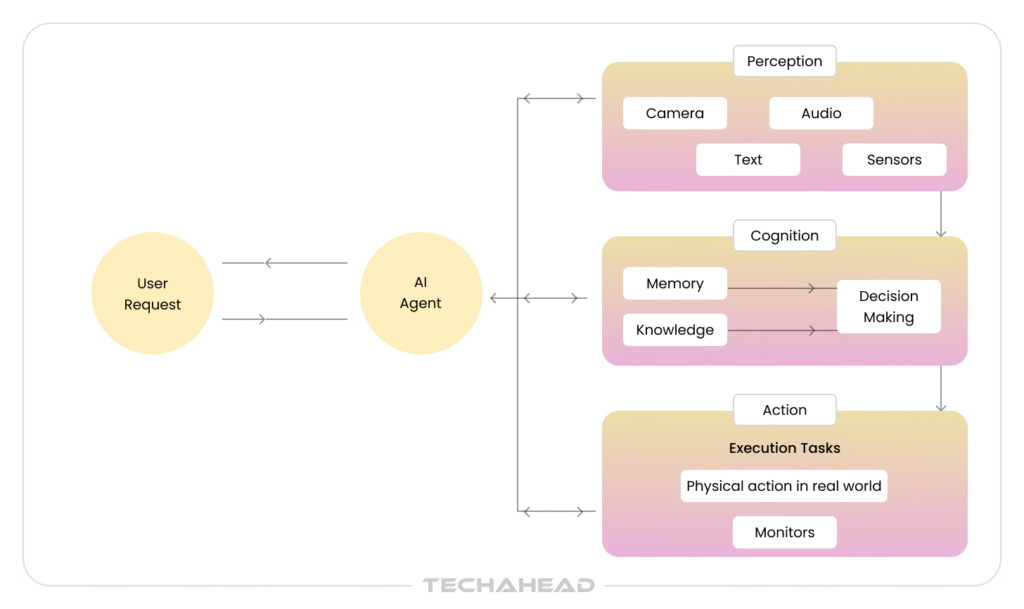
Agentic AI & multi-agent systems are reshaping enterprise operations by autonomously handling multi-step workflows across sectors. These systems perceive environments, reason through goals, execute actions often in swarms of specialized agents, driving efficiency in fragmented data landscapes. In 2026, adoption surges in high-stakes industries facing regulatory pressures and real-time demands.
Healthcare
Agentic AI transforms patient management with multi-agent teams. Diagnostic agents analyze EMRs and imaging to flag issues; scheduling agents book tests and notify insurers; care navigation agents track adherence and predict readmissions. For instance, one agent coordinates across providers for personalized plans, which reduces admin time by 30% that improves outcomes through proactive reminders.
Finance
Financial services deploy agent swarms for end-to-end risk management. Transaction agents monitor patterns in real-time, flagging fraud; compliance agents verify regulations across jurisdictions, auto-filing reports; portfolio agents simulate markets to optimize trades. Multi-agent collaboration reconciles data across legacy systems, which cuts investigation times from hours to minutes.
Manufacturing
In factories, agentic AI optimizes supply chains via sensor-driven agents. Maintenance agents predict failures from IoT data, scheduling repairs autonomously; production agents adjust lines for demand shifts; logistics agents reroute parts amid disruptions. Multi-agent systems simulate scenarios, which reduces downtime by 40% and waste through just-in-time orchestration.
Retail
Retail uses agents for hyper-personalization; inventory agents forecast demand and reorder stock; recommendation agents analyze behaviors to suggest products; service agents handle returns and escalations across channels. Collaborative agents track carts, deploy discounts that boost conversions by 25% during peaks without staff overload.
Logistics
Logistics agents excel in disruption-prone networks. Routing agents optimize paths using live traffic and weather data; procurement agents negotiate with vendors; tracking agents update customers proactively. Multi-agent fleets coordinate deliveries, which cuts fuel costs by 20% and delays via adaptive planning.
Real-World Examples of Agentic AI and Multi-Agent Systems
Agentic AI and multi-agent systems are powering transformative applications at major enterprises in 2026. The following use cases present autonomous agents handling complex workflows across industries:
Google Cloud’s SOC Manager
Google Cloud deploys the SOC Manager, a multi-agent system for cybersecurity in healthcare environments. Sub-agents detect malware, execute incident response plans, and block threats autonomously. You can coordinate diagnostics, containment, and reporting to protect patient data systems.
Akira AI’s Payroll System
Akira AI powers payroll for financial firms like those partnering with Deloitte clients. Multiple agents ingest HR data, calculate pay/deductions, ensure compliance, and resolve queries via RAG. For your finance business, you can automate end-to-end cycles and slash errors by 90%.
eBay’s Mercury Platform
eBay’s internal Mercury agentic AI drives marketplace recommendations and workflows. Agents analyze user behavior, personalize listings, prevent prompt injections, scale goal-oriented tasks, which boosts engagement & sales efficiency.
Uber’s Genie Copilot
Uber employs enhanced Agentic RAG (E-Ag-RAG) multi-agents in its Genie on-call copilot. Agents process support queries, simulate routes, handle escalations, and optimize real-time operations that deliver near-human precision for millions of rides daily.
Dialpad’s Concierge Agents
Dialpad integrates multi-agent concierges for enterprises like sales teams at Fortune 500s. Agents manage inquiries, schedule tasks, update CRMs, and collaborate on escalations, handling contact center workflows without human intervention.

How to Implement Agentic AI in Your Enterprise?
Implementing agentic AI enterprise-wide demands a phased approach to minimize risks and maximize value. This process focuses on building autonomous agents that reason, plan, and execute goals, which integrates seamlessly into existing operations.
Step 1: Assess Organizational Readiness
- Evaluate data quality, API access, and compute resources for agent scalability.
- Map team expertise in AI Development Services, prompting, and monitoring.
- Set KPIs like time savings, error reduction, or throughput gains.
- Align on vision and allocate initial budget for tools and training.
Step 2: Prioritize Use Cases
- Document repetitive, multi-step processes ripe for automation.
- Rank by impact, feasibility, and data availability using a prioritization matrix.
- Select low-complexity, high-ROI pilots with clear goals and boundaries.
Step 3: Design Agents
- Select tools like LangChain, AutoGen, or CrewAI for single/multi-agent builds.
- Define perception (data intake), reasoning (planning), action (execution), and memory.
- Develop minimal viable agents with iterative loops for self-correction.
- Connect to APIs, databases, and external services for real-world actions.
Step 4: Test and Validate
- Test agents in controlled environments with synthetic data.
- Compare agent performance against manual baselines.
- Refine reasoning chains, error handling, and escalation logic.
- Implement guardrails, logging, and rollback mechanisms.
Step 5: Deploy & Monitor
- Launch pilots, then scale gradually with containerization.
- Use dashboards for real-time metrics, traces, and alerts.
- Provide guidelines for interacting with agents and overriding decisions.
- Analyze logs quarterly to optimize and expand scope.
Step 6: Govern and Scale
- Define ethics, data privacy, and accountability frameworks.
- Enable human-AI teams with clear roles.
- Track long-term gains and reinvest in advanced multi-agent systems.
- Update agents with new models and feedback loops.
This blueprint means reliable deployment, starting small for quick wins and scaling confidently.
Overcoming Common Challenges of Agentic AI Implementation in Enterprises
Enterprises adopting agentic AI often face different hurdles like integration complexities, data silos, and reliability concerns, however, proactive strategies can turn these into opportunities. You can address them systematically to autonomous workflows, unlocking 30-50% efficiency gains.
Data Quality and Integration Issues
- Legacy systems create silos; unify via ETL pipelines and vector databases like Pinecone for seamless agent access.
- Agents falter on noisy inputs; you can implement automated cleansing and validation routines upfront.
- Batch processing delays autonomy; shift to event-driven architectures with Kafka for instant ingestion.
Reliability & Hallucination Risks
- Agents may “hallucinate” in edge cases to enforce reasoning chains with self-critique loops and human-in-the-loop approvals.
- Multi-agent failures cascade; add modular testing and circuit breakers to isolate issues.
- Single agents overload; design swarms with load balancing for high-volume tasks.
Security, Compliance, and Governance
- Autonomous actions risk exposure; embed RBAC, encryption, and audit trails compliant with GDPR/SOX.
- Unchecked decisions amplify inequities; conduct bias audits and diverse training datasets.
- Full autonomy erodes trust; deploy observability tools like LangSmith for traceable decisions.
Talent and Change Management
- Few experts in agentic design; bridge via upskilling programs and partnerships with platforms like AutoGen.
- Adoption through pilots presenting augmentation, not replacement.
- High compute demands; optimize with serverless deployments and phased ROI tracking.
With proper planning, monitoring, and adaptive governance, you can mitigate these risks but accelerate agentic AI maturity. Early movers report overcoming initial friction within 6 months, which paves the way for transformative operations.
Conclusion
Agentic AI is a fundamental reimagining of how enterprises operate. From financial services to healthcare, manufacturing to retail, organizations deploying intelligent agents are gaining decisive competitive advantages through autonomous decision-making. Indeed, the 46.2% market growth rate signals a clear message: early adopters are winning and hesitant organizations risk falling behind. The question is how quickly you can start. Ready to transform your enterprise workflows with intelligent AI agents? TechAhead specializes in building custom agentic AI solutions tailored to your industry needs. Consult with our AI experts today and discover your automation potential.
How can agentic AI improve enterprise workflow efficiency?
Agentic AI automates complex decision-making, handles multi-step processes autonomously, reduces manual intervention, adapts to changing conditions in real-time; it means faster execution, fewer errors, and significant cost savings across operations.
What industries benefit most from agentic AI implementation?
Finance, healthcare, manufacturing, retail, logistics, and customer service benefit significantly. These industries leverage agentic AI for document processing, predictive maintenance, supply chain optimization, patient care coordination, and autonomous customer support systems.
What is the ROI timeline for implementing agentic AI in enterprises?
Most enterprises see initial ROI within 6-12 months post-implementation. Quick wins include reduced processing time and labor costs, while long-term benefits like improved decision accuracy and scalability materialize over 18-24 months.
Can agentic AI integrate with existing enterprise systems and software?
Yes, agentic AI integrates seamlessly with existing ERP, CRM, databases, and legacy systems through APIs, webhooks, and middleware. Modern solutions are designed for interoperability, which ensures smooth data flow without disrupting current operations.