

Staff Augmentation
Access top-tier talent on demand: Dedicated, Hourly, or Flexible.


 Copy Link
 Share on X
 Share on Facebook
 Share on LinkedIn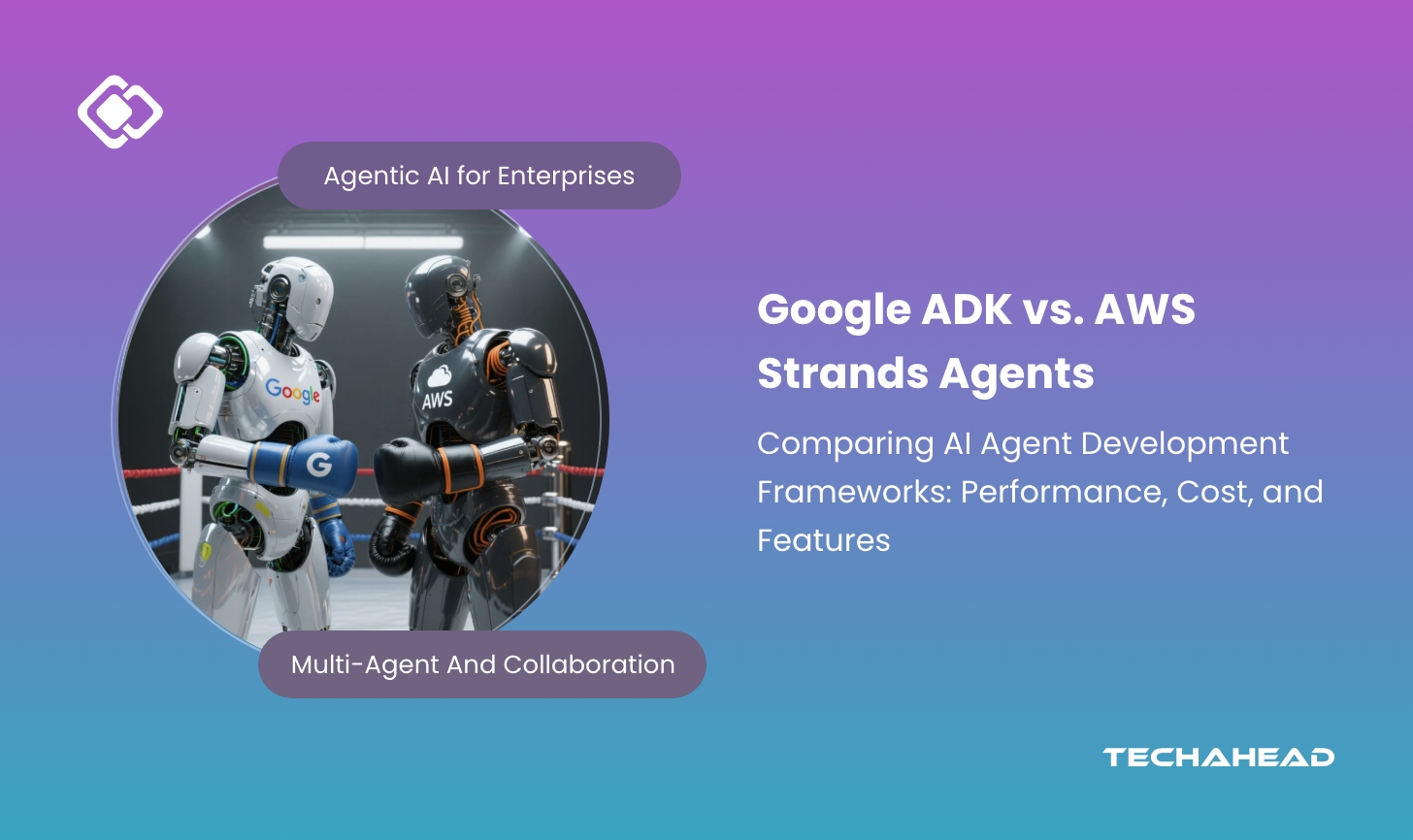
Enterprise AI has evolved beyond simple automation; we are now witnessing the emergence of truly autonomous agents that can reason, adapt, and execute complex business processes independently.
According to Grand View Research, the U.S. enterprise agentic AI market size surpassed USD 1.1 billion in 2025 and is expected to grow at a CAGR of 45% through 2030.
What is driving this growth? Businesses leveraging agentic automation report cost reductions between 15% and 35%, primarily by streamlining repetitive tasks and minimizing manual errors. Currently, companies are investing at least 25% of their IT budget in automation**,** achieving an average of 28% in cost savings.
However, the challenge is selecting the right framework for your organization’s unique requirements. Two platforms are clear leaders: Google’s Agent Development Kit (ADK) and AWS Strands Agents.
Indeed, the main difference lies in their architectural philosophy. Google ADK provides modular and flexible frameworks with Sequential, Parallel, and Loop agents, plus LLM-driven dynamic routing. It is LLM-agnostic and deployment-agnostic. AWS Strands adopts a cloud-native, model-centric approach using prompts and tools, which allow agents to reflect, reason, and act autonomously with minimal setup across AWS infrastructure.
While the market offers various other agentic AI solutions, from Microsoft’s Copilot Studio and OpenAI’s Assistants API to open-source frameworks like LangChain, LangGraph, CrewAI, and LlamaIndex, these platforms often face enterprise limitations. Common issues include inadequate security controls, limited infrastructure scalability, and complex deployment requirements. security controls, limited scalability infrastructure, complex deployment requirements, etc.
Here, Google ADK and AWS Strands Agents directly address these limitations. Where open-source frameworks need extensive custom security implementations, Google and AWS provide enterprise-grade identity management and compliance frameworks.
Platforms like CrewAI and AutoGen struggle with multi-agent orchestration scalability; Google and AWS offer native cloud infrastructure that handles thousands of concurrent agent interactions with failover capabilities. Most importantly, both platforms provide 24/7 enterprise support, SLA guarantees, and seamless integration with existing cloud ecosystems.
So, your competitive positioning depends on making the right architectural decision between these two proven enterprise leaders; that is why, in today’s blog, we are going to explore these two platforms and help you understand which will be the right option for your enterprise needs.
Key Takeaways
- The US Agentic AI market is expected to reach USD 8.2 billion by 2030.
- Google ADK is model-agnostic, deployment-agnostic, suited for containerized, cloud-native, and Kubernetes-driven environments.
- AWS Strands uses model-first, prompt-driven architecture, where LLMs coordinate reasoning and tool execution autonomously.
- Strands is model-agnostic and multi-modal, supporting LLMs like Claude 3.5, Amazon Nova Pro, Llama 3, and Ollama.
- Establish clear metrics and continuous monitoring to measure AI’s business impact and ROI.
What is Agentic AI for Enterprises?
Agentic AI for Enterprises is the autonomous, multi-modal AI systems that leverage advanced LLM reasoning engines and Large Action Models (LAMs) to execute complex business workflows. Beyond simple automation, these systems possess dynamic planning capabilities. Typically, these agents utilize Graph-RAG (Retrieval-Augmented Generation), function calling, and persistent state management across a hybrid enterprise infrastructure.
However, for implementing these advanced AI capabilities, your enterprise needs development frameworks and secure deployment platforms that can handle the complexity of agentic systems. Here comes the Agent Development Kits (ADKs), which are software frameworks designed to simplify the creation, deployment, and management of AI agents. With multiple ADK options available in the market, choosing the right platform becomes essential; however, one of the leading enterprise options is the Google ADK. So, let’s understand how Google ADK can solve these issues:
Google ADK: Architecture and Key Features
Google’s Agent Development Kit, or ADK, is a toolkit that helps businesses actually build, deploy, and manage powerful AI agents across their operations. Google ADK is flexible to fit in any deployment scenario, but how does it work?
The core brain is the Vertex AI Agent Engine, which acts like mission control for all your AI agents. From agent registration to real-time monitoring, it handles everything. Whether you need your agents to work collaboratively or independently on different tasks, the Agent Engine keeps everything running smoothly.
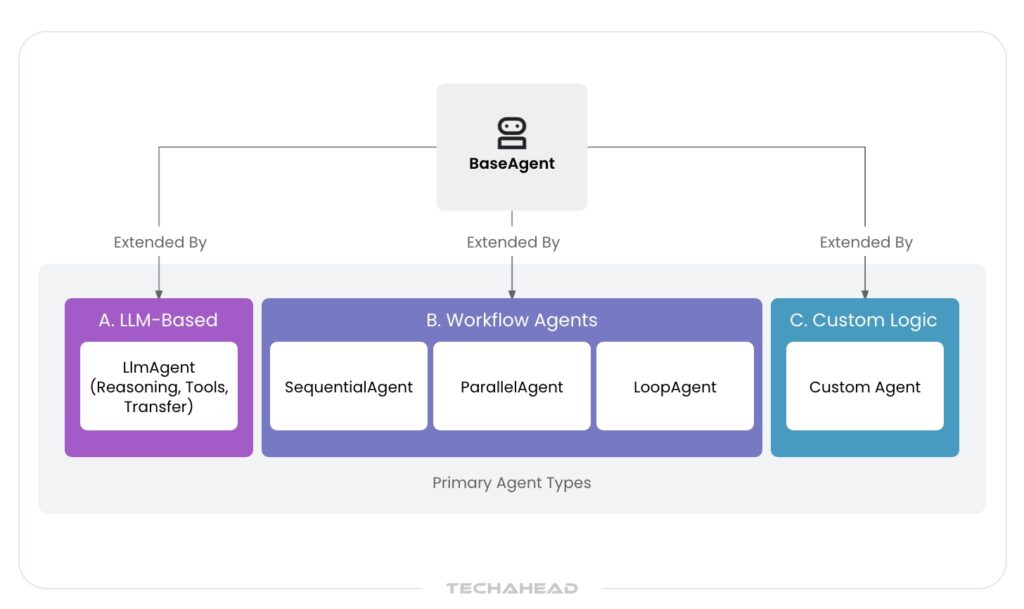
Another interesting aspect is that each agent runs as a containerized microservice (best practice). So, you get the benefits of microservice-based architecture, which means easy scaling, better fault tolerance, and a deployment model that’s platform-agnostic. Got a Kubernetes cluster already? ADK plugs right in.
Moreover, agents stay connected via a lightning-fast internal message bus, built on Google’s Pub/Sub. It means events move quickly between agents, but with built-in audit trails.
What else stands out?
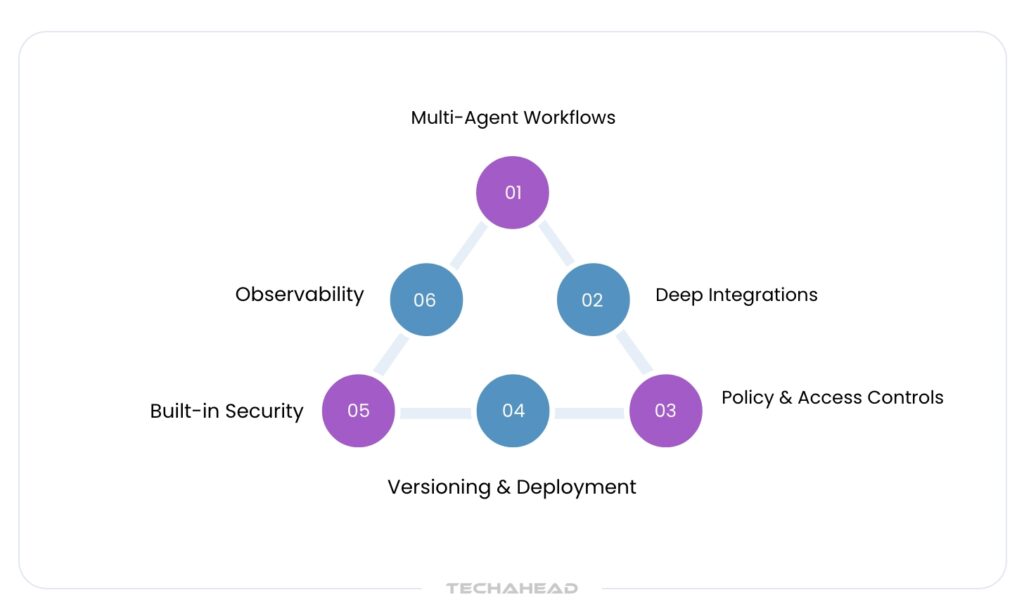
- Multi-Agent Workflows: ADK can manage a complex mesh of agents working together (or in parallel) toward your business goals.
- Deep Integrations: Whether you need LLMs, traditional ML models, or live external APIs, ADK offers native support for Google’s Gemini 3.0 Pro and Flash models.
- Policy & Access Controls: ADK makes it easy to specify precisely who and what has access.
- Observability: Everything is logged, traced, and measured, end to end. It means you get total visibility for auditing.
- Versioning & Deployment: Blue/green deployments (live & hosting environments), canary releases, instant rollbacks, you get safe, enterprise-grade rollout options, just like modern dev teams expect.
- Built-in Security: With Google’s advanced IAM, every agent action is authenticated.
In short, Google ADK takes the complexity out of building AI agents at scale. That is why it is a popular choice for enterprises looking to put agentic AI to work safely.
AWS Strands Agents: Architecture and Key Features
AWS Strands Agents is an open-source SDK designed to build and operate intelligent agentic AI systems with low-code configuration. Its architecture is fundamentally model-first: the core intelligence resides in a foundation language model (LLM), which orchestrates the agent’s reasoning and tool usage. Instead of handcoding, you can define a system prompt (to shape the agent’s behavior) and provide a set of tools. The LLM then autonomously chains reasoning steps to complete tasks. It makes the agent development process highly adaptive for enterprise needs.
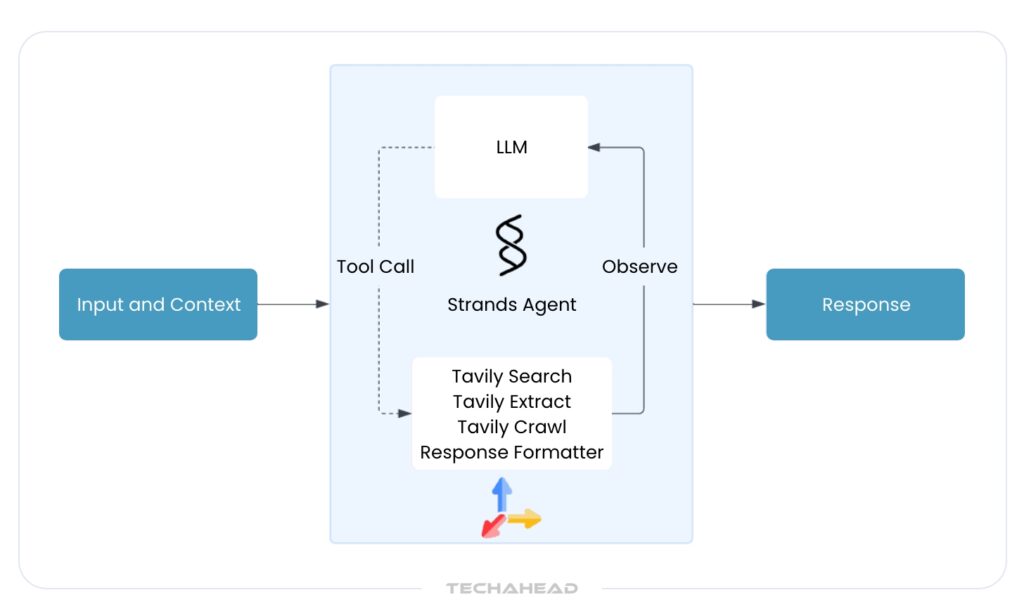
AWS Strands model-centric approach has several key operational patterns that define how agents execute tasks and collaborate within enterprise environments.
Agentic Loop Pattern
Typically, Strands facilitates an iterative agentic loop (ReAct pattern). In this process, the agent receives a user request, and the Foundational Model (FM) interprets and plans the best next step. It integrates the results and iterates until the task is complete. This approach allows for multi-step reasoning, tool selection, and context sharing without custom control flows.
Multi-Agent and Collaboration Patterns
Building on the agentic loop foundation, AWS Strands supports various architectural patterns for different enterprise complexity levels, such as:
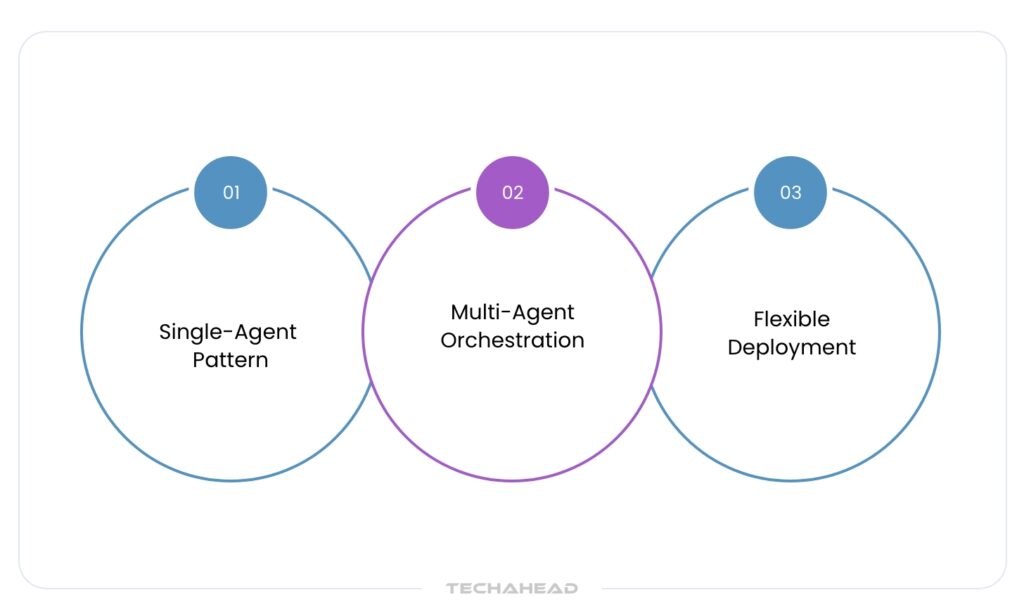
- Single-Agent Pattern: A single agent runs in a self-contained process; good for simple tasks.
- Multi-Agent Orchestration: Via the Model Context Protocol (MCP) and Agent-to-Agent (A2A) patterns, agents can call each other as tools; this means a collaborative environment for complex enterprise needs.
- Flexible Deployment: Here, agents can be deployed as monoliths (with agent and tools in one environment), as microservices, or with tools isolated in secure backends (e.g., AWS Lambda). With the flexible deployment model, you can balance performance and security.
Key Features for Enterprises
Besides the above architectural patterns, AWS Strands also offers specific enterprise-grade features that accelerate time-to-production for agentic AI implementations.
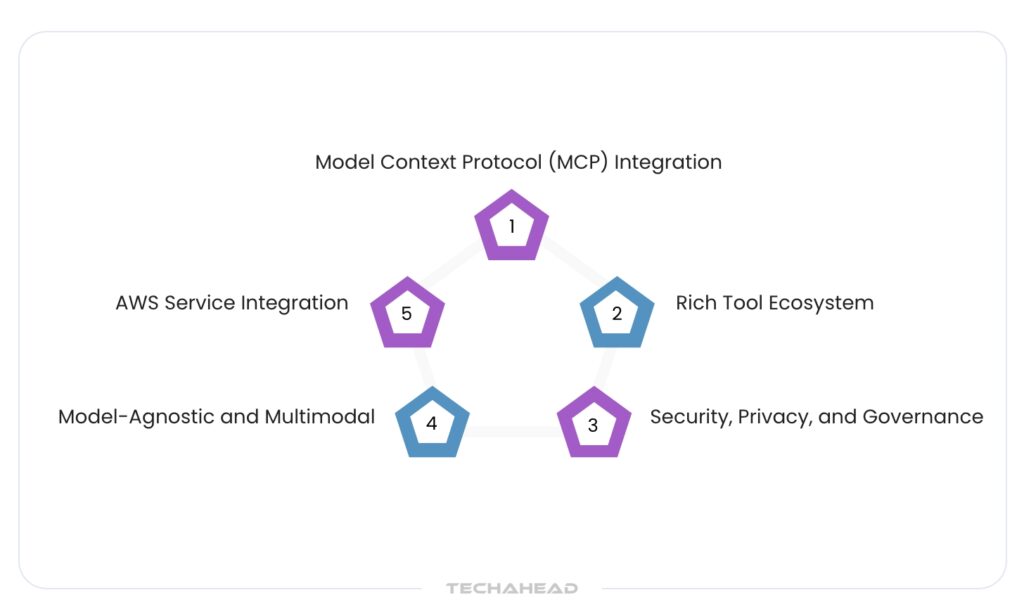
Model Context Protocol (MCP) Integration
MCP provides out-of-the-box access to thousands of pre-built tools. It means you, AI agents, can expand functionality without custom code.
Rich Tool Ecosystem
A major advantage of AWS Strands Agents is the simplicity of using and building tools. Tools function as modular capabilities that your agent can use to execute tasks, such as searching documents, performing calculations, or handling specific business logic. Moreover, Strands agents come with a library of ready-made tools for common jobs. If you need something business-specific (like connecting to a legacy database or API), you can create custom tools in Python and easily integrate them.
Moreover, strand agents come with a library of ready-made tools for common jobs. If you need something specific for your business (like connecting to a unique database or API), you can create your own custom tools in Python and easily add them in.

AWS Service Integration
Native compatibility with AWS Bedrock, Lambda, Step Functions, EC2, and Fargate means agents can deeply integrate with existing AWS workflows. You can take the help of AWS consulting experts for smooth integration.
Model-Agnostic and Multimodal
Strands supports a variety of next-gen LLMs (Anthropic Claude 3.5, Amazon Nova Pro, Meta Llama 3, etc.) and modalities (text, image, speech). This flexibility lets enterprises select models tailored for performance.
Security, Privacy, and Governance
Enterprises retain full control over model selection, tool hosting, network configurations (VPCs, secure zones), and prompt management. Additionally, Guardrails for Amazon Bedrock ensures these controls are enforced to meet enterprise security standards.
Deployment Options
AWS Strands Agents can be deployed:
- Locally for prototyping and standalone tasks.
- Behind APIs using AWS Lambda, Fargate, or EC2 for serverless or scalable microservice architectures.
- Hybrid/Return-of-Control models, mixing local tools with cloud services.
In short, AWS Strands is also a reliable choice for businesses looking to adopt agentic AI confidently.
Comparative Analysis: Google ADK vs. AWS Strands Agents
Both platforms offer robust open-source frameworks designed to help enterprises build, deploy, and manage powerful agentic AI systems. However, they serve different architectural philosophies: Google ADK excels in cloud-native orchestration, modular agent architecture, and deep integrations with the Google Cloud ecosystem, while AWS Strands Agents is a model-driven framework optimized for the AWS ecosystem.
For your enterprise use, choosing the right solution depends on your preferred cloud provider and integration needs. The following table will help you find the right ADK for your enterprise:
| Feature/Aspect | Google ADK | AWS Strands Agents |
| Architecture | Modular, containerized microservices. The orchestrator manages agent lifecycles and coordination. | Model-driven, agentic loop. Agents use LLMs for planning, tool use, and iteration. |
| Deployment | Cloud-native, hybrid, or on-prem; seamless with Google Kubernetes Engine (GKE) and Cloud Run. | Local, serverless (AWS Lambda), API-backed, or hybrid cloud (AWS Fargate). |
| Tool Integration | Supports MCP tools, local/remote tools, and fast API plugins. | Supports hundreds of MCP tools, built-in and custom Python tools, easy hot-swapping. |
| Model Support | Gemini 3.0 (Pro/Flash), Imagen 3, and other Vertex AI Model Garden LLMs. | Amazon Nova, Claude 3.5 Sonnet, Llama 3.2, and OpenAI via LiteLLM. |
| Multi-Agent Workflows | Supports collaboration, parallel task execution, session/memory sharing. | Multi-agent via workflow/graph/swarm tools, Agent2Agent (A2A) protocol. |
| Observability | Detailed tracing, audit trails, monitoring, versioning. | Native OpenTelemetry, distributed tracing, agent trajectory data. |
| Security & Compliance | VPC Service Controls, Context-aware IAM, fine-grained access controls. | Guardrails for Amazon Bedrock, PrivateLink, and full control over prompt security. |
| Ecosystem Integrations | Deep with Google Cloud, Pub/Sub, Vertex AI. | Deep with AWS services (Lambda, Bedrock, Step Functions), open contributions. |
Deployment Flexibility and Integration in Enterprise Environments
When it comes to deployment flexibility, both Google ADK and AWS Strands Agents serve different purposes, but both of these platforms support the concept of tool isolation. It keeps your business logic separate from agent orchestration for enhanced security. Let’s take some examples and understand Google ADK first:
Google ADK’s Cloud-Native Strength
Google ADK was architected with Kubernetes in mind. If your enterprise is already running containerized workloads, ADK functions as a natural extension of your existing infrastructure. For example, consider a customer service operation where multiple AI agents handle different aspects: one for initial triage, another for technical support, and a third for escalations.
With ADK, you can deploy each agent as a separate microservice in your existing Kubernetes cluster. And then, let them communicate through Google’s Pub/Sub messaging system. Here, the benefit is that you get automatic scaling, load balancing, and fault tolerance without reinventing the wheel.
For enterprises with hybrid cloud strategies, ADK’s containerized approach means you can run the same agent configurations on-premises via Google Distributed Cloud, in Google Cloud, or even across multiple cloud providers. Essentially, this offers superior portability for your enterprise.
In short, Google ADK offers containerized, hybrid-cloud flexibility, and AWS Strands is suitable for serverless, event-driven scaling; however, both of these platforms are good for enterprise agentic AI deployment.
AWS Strands Agents’ Serverless Edge
However, Strands Agents work differently; they are more into serverless and event-driven architectures. For example, you are building a document processing pipeline where agents need to analyze contracts or extract key terms. With Strands, you can deploy agents as AWS Lambda functions that automatically scale based on demand. It is good for handling unpredictable workloads.
Moreover, you can integrate it with AWS’s broader ecosystem. Your agents seamlessly access data from S3, trigger Step Functions workflows, or even interact with Amazon Bedrock models. For example, a financial services company might deploy agents that process loan applications: one agent extracts data from uploaded documents (using Lambda), another performs risk analysis (connecting to internal databases via VPC), and a third generates approval reports (stored in S3).
What are the Security Considerations for Agentic AI: Google ADK vs. AWS Strands Agents
When you are deploying agentic AI in an enterprise setting, both of these platforms offer the best security management for sensitive business operations or customer data. First, understand the security aspect of Google ADK:
Google ADK’s Security Approach
Google employs an ‘Identity-Centric Zero Trust’ model. Think of it not just as guards at checkpoints, but as continuous verification:
- Advanced IAM Integration: Every agent action goes through Google’s Identity and Access Management system. For example, if your customer service agent needs to access billing data, it must first authenticate, then get explicit permission for that specific data type.
- Fine-Grained Access Controls: You can deploy “Model Armor” to sanitize inputs and outputs, preventing prompt injection attacks. In the education industry, for example, your HR agent is continuously scanned by the Security Command Center’s AI Protection to ensure it never leaks PII (Personally Identifiable Information).
- Built-in Audit Trails: Every agent interaction is logged to Google Security Operations (SecOps) with cryptographic timestamps. If something goes wrong, you can reconstruct the entire “chain of thought” for forensic analysis.
AWS Strands Agents’ Security Philosophy
AWS focuses on ‘defense in depth (DiD)’, giving you control over every layer of security:
- Full Infrastructure Control: You decide where your models run, where data lives, and how agents communicate. Want everything in your own VPC? No problem.
- Model Selection Freedom: Choose models based on your security requirements. Need an air-gapped deployment? Use local models. Need compliance? Pick specific AWS Bedrock models with data residency guarantees.
- Prompt and Tool Isolation: Separate sensitive business logic from agent execution. Your proprietary algorithms can run in isolated Lambda functions while agents coordinate through secure APIs.
Both platforms excel at enterprise security, but your choice depends on whether you prefer Google’s streamlined, permission-centric approach or AWS’s granular, infrastructure-level control.
Serverless Vs Containerized Microservices Scalability
Google ADK offers robust microservices scaling via GKE, while AWS Strands provides seamless serverless scaling on Lambda. The table below highlights the differences:
| Aspect | Google ADK | AWS Strands Agents |
| Architecture | Containerized microservices, cloud-native, GKE Autopilot-friendly. | Lightweight Python framework, FaaS (Function-as-a-Service), efficient API orchestration. |
| Scaling Method | Auto-scaling via Google Cloud managed services (Vertex AI, Pub/Sub) | Scales from local prototypes to serverless/cloud deployments with minimal code changes |
| Performance Optimization | Fast inter-agent messaging with Pub/Sub, audit trails | Concurrent execution with threads/processes, streaming model responses for faster outputs |
| Agent Communication | Uses Google Pub/Sub for efficient, reliable multi-agent coordination | Supports Graph-based workflows; Native Agent2Agent (A2A) protocol for supervisor-worker patterns. |
| Use Cases | Distributed orchestration for large, complex workflows, managed enterprise infrastructure | Rapid agent start-up, low-latency response scenarios, multi-provider model distribution |
| Enterprise Examples | Handles complex cloud workflows, Kubernetes & Google Cloud integration | Used internally at AWS for data analysis, credit memo workflows, and large-scale productivity gains |
| Resource Optimization | Infrastructure management and auto-scaling are handled by cloud services | Model-agnostic; distributes work across providers to prevent bottlenecks |
| Best For | Those preferring cloud-managed infrastructure and deep Google Cloud integration | Those needing lightweight, flexible deployment with a customizable model and tool usage |
Configuration-first Vs Code-first Customization
When customizing agentic AI frameworks, Google ADK now emphasizes a dual approach: a visual, low-code “Agent Builder” for rapid prototyping and configuration-driven customization via YAML. However, AWS Strands Agents doubles down on a code-level “Agent SOP” (Standard Operating Procedure) approach to program behavior directly in Python. This approach allows python developers to have granular control over the agent’s logic.
Both approaches have distinct advantages depending on configuration or development flexibility. To find the best option for your enterprise, you can consult with a custom software development company. However, the following table helps you understand different aspects of customization of agent frameworks:
| Customization Aspect | Google ADK | AWS Strands Agents |
| Approach | Configuration-first with modular templates | Code-first with model-driven prompts and Python tools |
| Customization Method | “Builder Assistant” (Gemini-powered) to generate agent manifests | Define “Agent SOPs” using RFC 2119 standards & hot-swap tools |
| Use Case Example | Customer support agent using configured APIs | Financial analysis agent with tailored risk calculations |
| Flexibility Level | Standardized, enterprise-grade | Highly flexible, developer-centric |
| Deployment Style | Containerized microservices | Lightweight, serverless/local hybrid deployments |
What is the Average ROI You Can Expect from Both of These Platforms?
When you adopt agentic AI platforms, you can reduce operational infrastructure costs, driving better ROI for your enterprise. Based on November 2025 industry data from PwC and McKinsey, you can expect to achieve an average ROI of 171% within the first year (rising to 192% for US enterprises). Indeed, 79% of companies have already adopted agentic AI to automate complex workloads.
Over 62% of senior executives predict an ROI above 100%, with averages near 171%. Here, the main ROI driving factor is the reduced operational costs through automation that translate directly to revenue growth. However, your actual ROI will depend on factors like implementation complexity and how well you align AI capabilities with your specific business objectives.
TLDR for Strategic Recommendations for Enterprise Agentic AI Adoption
| Strategic Focus | Main Action Items |
| Understand Needs | Identify high-value problems and create agents to automate them. |
| Choose Platform | Use Google ADK for deep GCP/Vertex AI integration & AWS Strands for serverless AWS environments. |
| Plan Security | Enforce strict access, secure networks, and transparency. |
| Enable Collaboration | Design specialized, collaborative agents instead of monoliths. |
| Measure Impact | Track Success Rate, Token Efficiency, and Hallucinations. |
Strategic Recommendations for Enterprise Agentic AI Adoption
For successful agentic AI adoption, you must strategically align the technology with your unique business challenges. You should consider the following aspects before investing in multi-agent solutions:
Understand Your Business Needs
First, you need to define the specific problems where agentic AI can add value. Here, finding the right opportunity is crucial, especially when it comes to automation, decision support, or customer interaction, where AI agents can reduce manual efforts.
Choose the Right Platform
After that, you need to consider the right cloud ecosystem. In case you are not sure which infrastructure is best for you, use cloud consulting services to get clarity. If you have already invested in Google Cloud, Google ADK offers the deepest integration with Vertex AI and GKE. However, for AWS-centric enterprises, Strands Agents provide seamless, serverless tooling with strong AWS service support. We recommend starting with “lighthouse” pilot projects to understand the ROI impact and identify potential latency challenges in the workflow.
Plan for Security
When you are deploying AI agents in your organization, you need to implement strict access controls. Configure secure networks that protect sensitive data flows, and establish clear data governance policies. Besides that, agentic AI operation monitoring is a crucial part where you need to make sure the agentic AI models operate transparently for your enterprise.
Allow Multi-Agent Collaboration
Instead of trying to build one super-agent that does everything, you should design specialized agents that work together like a well-coordinated team: multi agent collaboration. Developers define workflows based on your business needs, such as when your document processing agent hands off to your analysis agent, which then collaborates with your reporting agent. It is like having specialists in different departments who communicate seamlessly.
Measure Business Impact
The thing is, you cannot manage what you do not measure. Beyond basic ROI, track agent-specific metrics:
- Agent Success Rate (ASR)
- Token Efficiency & Cost Per Task
- Customer Satisfaction (CSAT) & Resolution Time
- Hallucination Rate
- Revenue Impact per Agent
These aspects are essential to identify where agentic AI delivers value to justify your investment, which helps you make scaling decisions.
Which Framework Should You Choose?
The selection depends on target workload profiles and integration requirements. For instance:
Choose Google ADK if You:
- Need rapid prototyping via an intuitive Agent Builder and CLI for accelerated iteration cycles.
- Prefer a modular, workflow-driven architecture with fine-grained orchestration control over agent pipelines.
- Are invested in or plan to integrate the Gemini 3.0 model APIs and broader Google Cloud AI stack components.
- Need a deployment-agnostic containerized strategy (GKE Autopilot, Cloud Run, or custom Kubernetes infrastructure).
- Value graphical introspection and trace-based debugging to visualize multi-step agent reasoning paths
Choose AWS Strands Agents if You:
- Need to design, deploy, and operate production-grade distributed agents with auto-scaling across AWS-managed infrastructure.
- Depend on AWS-native service integration (Lambda, Fargate, Bedrock, IAM-based access control, CloudWatch) for operational alignment.
- Require built-in observability through Amazon CloudWatch and X-Ray for enterprise monitoring pipelines.
- Favor a prompt-and-tool invocation paradigm optimized for leveraging LLM reasoning capabilities
- Need multi-model interoperability with providers such as Anthropic, Meta, Mistral, or Ollama.
- Plan to implement multi-agent orchestration topologies (Swarm, Graph-based coordination patterns)
- Require persistent session state and memory store configuration (e.g., S3 object storage or local disk-backed persistence)
In short, the ultimate choice depends on your architectural stack, cloud strategy, and agentic workload characteristics.
Conclusion
At TechAhead’s AI Center of Excellence (AI CoE), we use Google ADK as our primary rapid prototyping environment; it is an innovation sandbox where agent behaviors are designed, tested, and iterated. However, we often transition to AWS Strands for enterprise-grade production deployments, particularly in regulated industries requiring granular observability, strict access control, and cloud-native resilience. We believe the future of Agentic AI will be inherently multi-agent, multi-cloud, and multi-model. Partner with us to transform your AI vision into scalable, secure, and future-ready solutions.
Which platform offers better scalability for large-scale AI agent applications?
AWS Strands excels in scalable, production-grade AI agent deployments with automatic serverless scaling. However, Google ADK offers robust microservices scaling within containerized environments. In short, both platforms deliver high scalability tailored to your deployment needs.
How do these platforms handle observability and monitoring of AI agents in production?
AWS Strands integrate built-in observability using OpenTelemetry, CloudWatch, and enterprise-grade monitoring tools, which provide deep insights into agent performance/ workflow health. On the other hand, Google ADK supports visual debugging through trace-based workflows and standard cloud-native monitoring.
Which platform is better suited for hybrid or multi-cloud deployment strategies?
Google ADK is better suited for hybrid and multi-cloud environments because of its containerized, deployment-agnostic architecture. It supports Kubernetes, Cloud Run, and custom infrastructure. However, AWS Strands is optimized for AWS cloud-native environments, with less flexibility for hybrid or multi-cloud deployments.