

Staff Augmentation
Access top-tier talent on demand: Dedicated, Hourly, or Flexible.


 Copy Link
 Share on X
 Share on Facebook
 Share on LinkedIn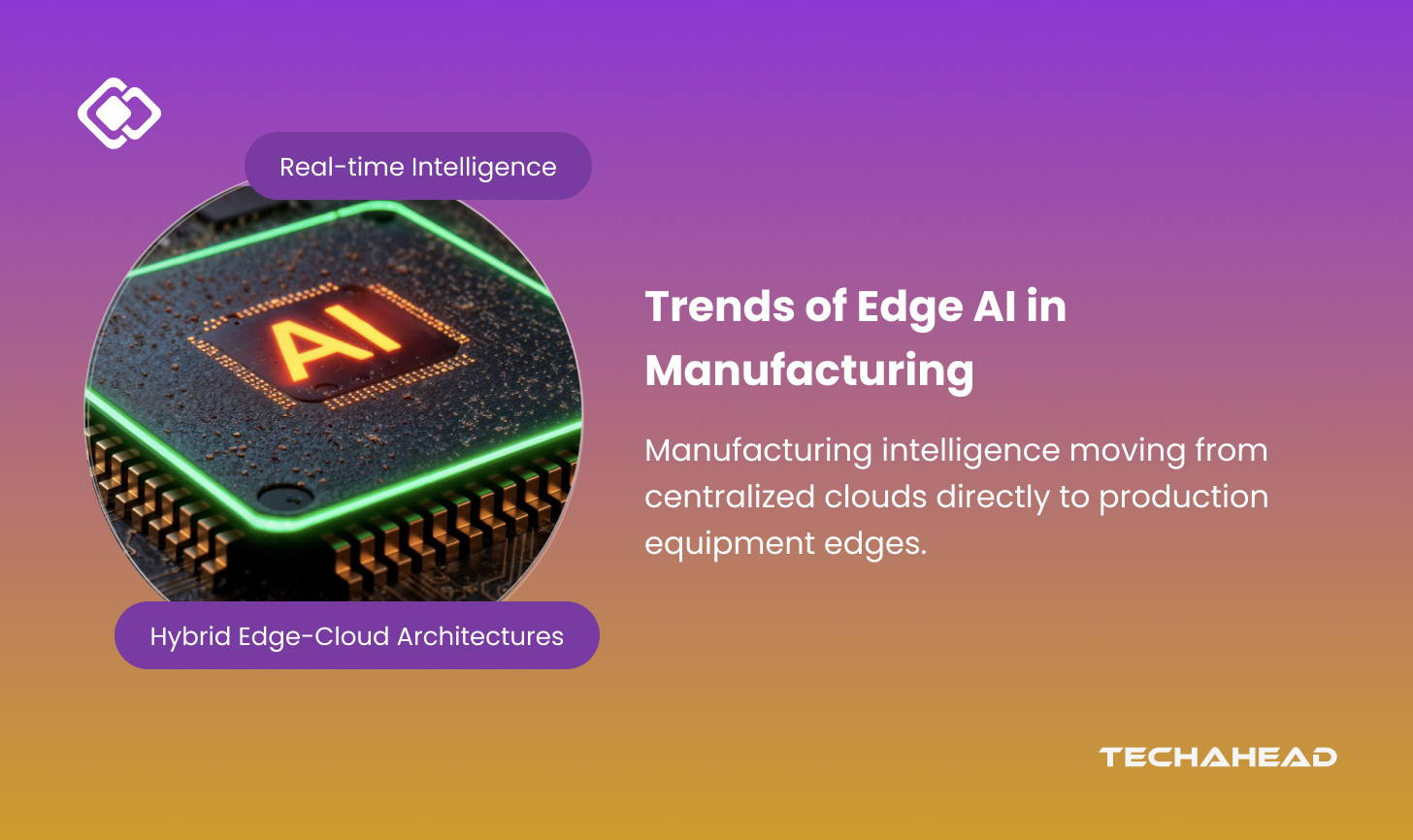
Industry 4.0 promised smart factories, but cloud-based AI solutions have delivered mixed results. Latency issues plague real-time decisions, bandwidth costs spiral out of control, sending sensitive production data off-site creates compliance nightmares.
Meanwhile, your competitors are finding ways to predict equipment failures before they happen, catch quality defects or optimize energy consumption in real time. The difference? They have moved AI processing from distant data centers directly to the factory floor.
Edge AI is solving the problems that held back previous waves of manufacturing technology. The market is experiencing significant growth driven by the rapid expansion of IoT, increasing demand for real-time low-latency data processing, growing adoption of AI-enabled automation across industries, rising focus on data privacy, localized intelligence at the network edge.
No more waiting for cloud responses when milliseconds matter. No more network bottlenecks when thousands of sensors need simultaneous analysis. No more choosing between AI capabilities and data sovereignty.
As we move through 2026, Edge AI has evolved from experimental technology to proven competitive advantage for manufacturing enterprises willing to deploy it strategically. This guide breaks down the Edge AI trends reshaping manufacturing.
Key Takeaways
- Edge AI solves Industry 4.0’s cloud latency issues by processing data directly on factory floors instantly.
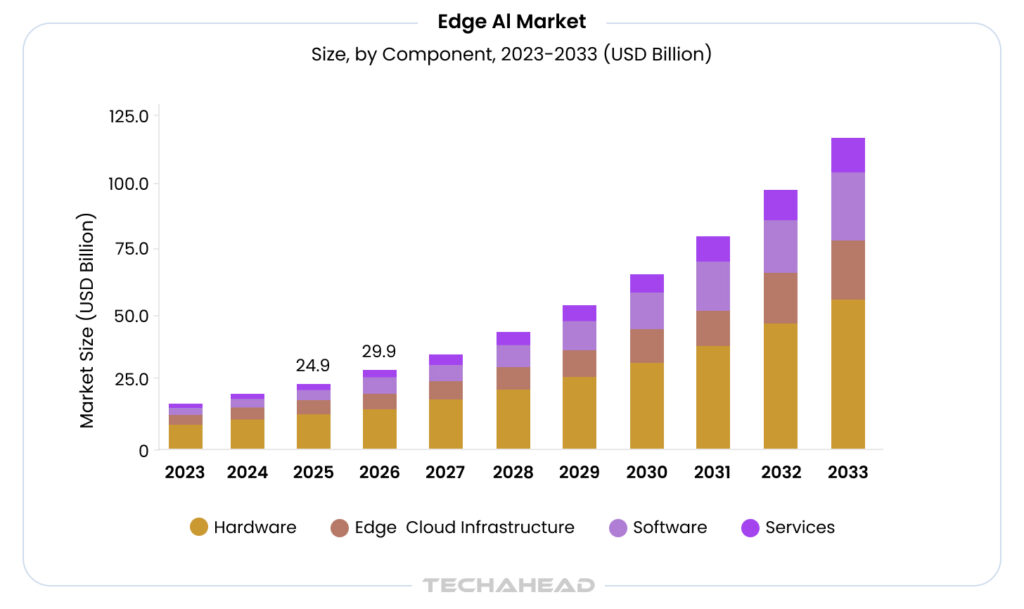
- Global edge AI market projected to reach $118.69 billion by 2033, growing at 21.7% CAGR annually.
- Neural Processing Units consume 10-20x less power than GPUs while delivering faster AI inference times for manufacturers.
- Secure edge data lakes keep sensitive production data on-premises maintaining powerful AI analysis capabilities locally.
- Hybrid edge-cloud architectures strategically split workloads: edge handles real-time decisions, cloud manages long-term analytics effectively.
What are the Key Edge AI Trends Shaping Manufacturing in 2026?
Every manufacturing enterprise faces the same question: which Edge AI trends matter? According to Grand View Research, the global edge AI market is anticipated to grow from USD 24.91 billion in 2025 and is projected to reach USD 118.69 billion by 2033, growing at a CAGR of 21.7% from 2026 to 2033.
Here are the developments delivering real ROI & transforming production floors.
Neural Processing Units (NPUs)
Think of NPUs as your factory floor’s specialized brain cells. While traditional processors juggle multiple tasks, NPUs do one thing exceptionally well: run AI models fast. Here is what matters to your bottom line: they consume 10-20x less power than GPUs that also deliver faster inference times.
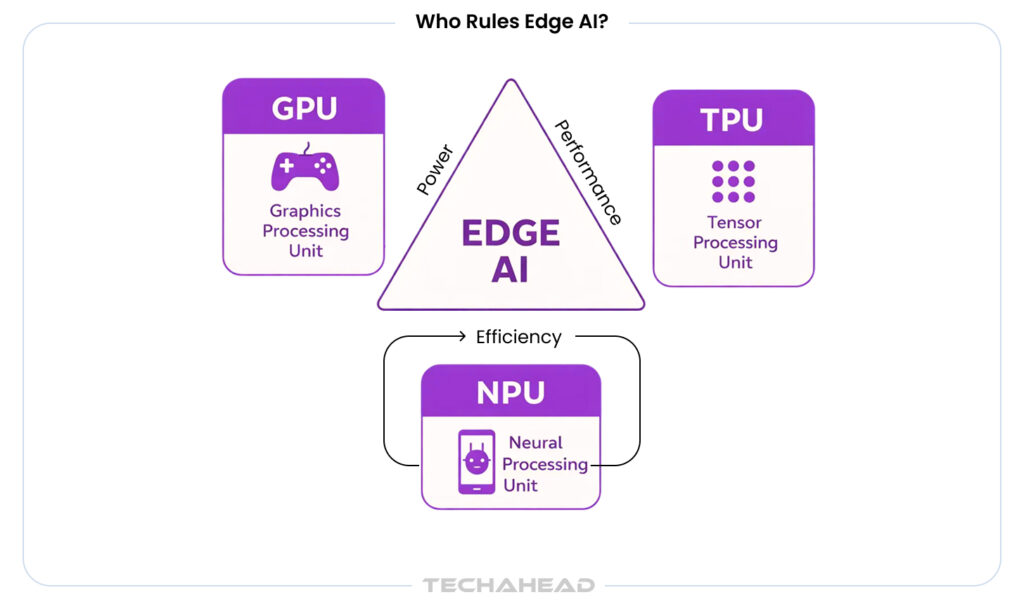
It translates to deploying vision inspection systems, predictive maintenance sensors without worrying about power constraints or cooling costs. Major chip manufacturers like Intel, AMD are embedding NPUs directly into industrial-grade hardware.

For manufacturing operations running hundreds of edge devices, the energy savings alone can justify the investment within 18 months. NPUs handle real-time decision-making locally that eliminates the latency issues that plague cloud-dependent systems.
Hybrid Edge-Cloud Architectures
Stop thinking it is edge versus cloud; smart manufacturers are using both, strategically. Your production line needs split-second decisions: defect detection, robot coordination, safety monitoring. That happens at the edge.
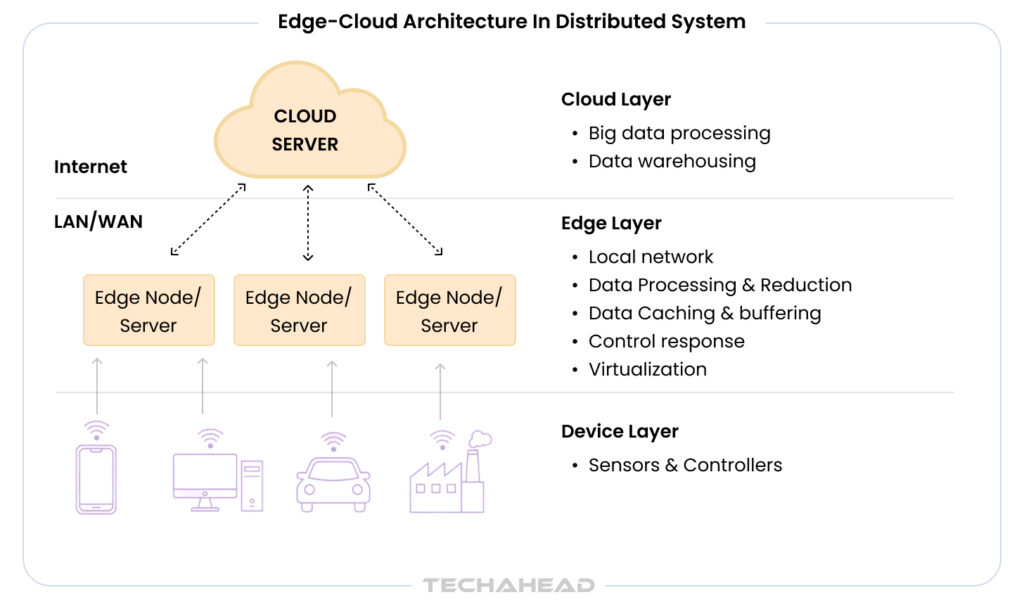
However, training models, analyzing long-term trends, optimizing across multiple facilities? That is where cloud computing plays a vital role. The hybrid edge cloud AI approach lets you keep sensitive production data on-premise and cloud helps in scalability.
Companies adopting this architecture report 40% faster response times for crucial operations that cut cloud costs by 30-50%. The key is determining which workloads need millisecond response times (edge) versus which benefit from massive processing power. Done right? You get performance & cost-efficiency.
Neuromorphic Computing
Neuromorphic chips mimic how human brains process information. They are more practical for manufacturing. Unlike conventional processors that consume watts, neuromorphic systems run on milliwatts.
These chips excel at pattern recognition/anomaly detection, which make them perfect for predictive maintenance in ‘hard-to-reach’ areas. Though these are still emerging, popular brands like Intel,IBM are commercializing neuromorphic hardware specifically for industrial applications.
Early adopters especially in automotive and electronics manufacturing report 90% energy reductions compared to traditional edge AI deployments. For enterprises managing large industrial campuses, neuromorphic computing solves the “last mile” problem of monitoring remote assets.
Energy-Efficient Edge Devices
Your factory floor is about to get a lot smarter without blowing up your power bill. The new generation of edge devices is running complex AI models on a fraction of the energy older systems needed. Neuromorphic chips that mimic how human brains work, processing data while sipping power like a smartphone.
For manufacturers with hundreds or thousands of sensors, this is not just about being green, it is about real savings. You can deploy AI in remote locations that would have been impractical before, as a result, you can reduce the operational costs. Battery-powered edge devices can now run for months, not days.

Industrial AI Agents
Industrial AI agents are autonomous decision-makers that handle complex manufacturing workflows without constant human oversight . Think of them as your most reliable shift supervisor.
These agents coordinate between machines, adjust parameters in real time, and even negotiate with other agents to optimize entire production lines. Through Agentic AI Development Services, businesses can design and deploy intelligent manufacturing ecosystems where AI agents continuously monitor production performance, automate decision-making, and improve operational efficiency.
When an issue appears, they reroute work; when quality drifts, they catch it instantly. The difference between traditional automation and these agents? Traditional systems follow your rules. AI agents understand your goals and figure out how to achieve them.
Secure Edge Data Lakes
You have got data everywhere: machines, sensors, quality systems, but it is trapped in silos. Secure edge data lakes solve this by creating localized data repositories right on your factory floor.
Your sensitive production data stays on-premises, meeting compliance requirements while still being accessible for AI analysis. The security layer only authorizes systems and personnel to access specific data sets, with encryption happening at the edge before anything moves.
This architecture gives you the best of both worlds: the control and security of on-premises storage with the analytical power of modern data platforms.And when you need to aggregate data across multiple facilities, you control exactly what leaves your premises.
Edge AI Security Frameworks
Edge AI creates new attack surfaces that did not exist before. Every smart sensor, every edge processor is potentially a way in for bad actors. The frameworks emerging now treat security as architecture, not an afterthought.
They include hardware-based root of trust, where security starts at the chip level. Model encryption makes sure your proprietary AI models cannot be stolen or tampered with.
Anomaly detection watches for unusual behavior that might indicate a breach.And critically, these frameworks assume zero trust; nothing is automatically trusted just because it is inside your network.
For enterprise owners, you can deploy edge AI without lying awake at night worrying about ransomware or IP theft. In short, this framework handles threats automatically.
Swarm Robotics Coordination
Instead of programming each robot individually, swarm robotics lets dozens or hundreds of robots coordinate like a flock of birds. Each robot makes local decisions based on what its neighbors are doing and what it senses around them. The result? Flexible & adaptive automation that handles chaos better than rigid systems.
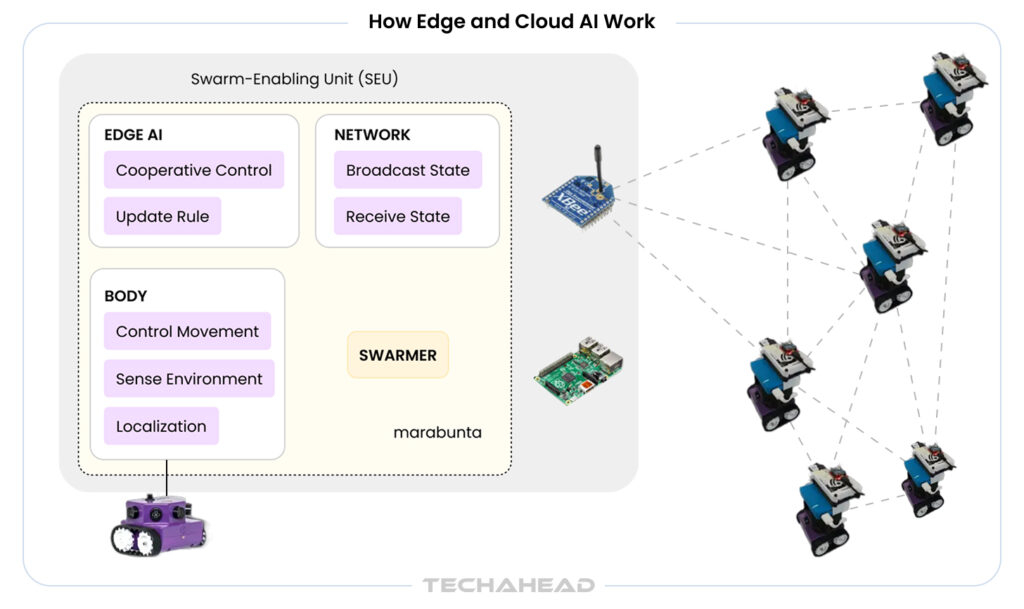
In a warehouse, swarm robots automatically route around obstacles, rebalance workloads when one robot fails or optimize paths collectively without any central controller.
The result is resilience; losing one robot does not break the system because the swarm adapts instantly. For manufacturers dealing with variable production demands or complex logistics, swarms handle unpredictability far better than traditional fixed automation.
Which Manufacturing Processes Should We Prioritize for Edge AI Deployment?
Enterprise owners in manufacturing face mounting pressures to cut costs, boost throughput amid volatile supply chains. Edge AI addresses these by processing data on-site, slashing latency from seconds to milliseconds.
Prioritization hinges on processes with high data volumes, safety risks or downtime costs; you need to start with pilots yielding quick ROI before scaling plant-wide.
High-Volume Assembly Lines
Assembly lines process thousands of components hourly. Cameras embedded with neural processing units detect defects like scratches or misalignments in real-time. Automotive/ electronics firms report 25% throughput increases as AI flags issues before packing. It eliminates cloud upload delays. For owners, this delivers immediate quality control ROI, with payback in 6-9 months via lower rework costs.
Predictive Maintenance on Crucial Equipment
Rotating equipment like CNC machines, pumps fail unpredictably. Edge AI sensors analyze vibration, temperature, acoustics locally which predicts failures 48-72 hours ahead with 95% accuracy.
Chemical & heavy industry plants cut unplanned outages by 40%, extending asset life 25% through proactive part swaps. Owners prioritize these for their high CapEx for minimal disruption, achieving 3x faster alerts than cloud systems.
Robotic Welding & Material Handling
Cobots, AGVs in welding, picking, palletizing demand split-second decisions amid dynamic environments. Edge AI optimizes paths, avoids collisions. Moreover, warehouses handling variable SKUs see 35% less errors via swarm coordination over local meshes.
Enterprises target these for flexibility: retool lines for new models without downtime. Start with 10-20 unit pilots, using hybrid edge-cloud for complex training, then go fully autonomous.
End-of-Line Quality Inspection
Final inspection gates for pharma, food, consumer goods require 100% traceability under strict regs like FDA or ISO. Edge AI vision flags contaminants or packaging flaws at 1,000+ items/min. Unlike cloud-dependent systems prone to outages, local inference ensures unbroken lines, with models updating via on-site data loops.
Intra-Factory Logistics Hubs
Logistics hubs linking assembly to shipping suffer from issues during peak demand. Edge AI coordinates forklifts and conveyors via real-time inventory tracking. AI agents reroute dynamically amid disruptions. For global plants, it builds resilience, prioritizing high-throughput sites first, with ROI from labor savings alone. Full deployment spans 200-500 nodes, managed via zero-touch platforms for seamless scaling.
What Cybersecurity Measures are Essential for Protecting Edge AI Deployments?
Edge AI creates new vulnerabilities that traditional factory security never had to address. Every smart sensor, edge processor becomes a potential entry point for cyberattacks; unlike cloud systems, these devices sit on your factory floor where physical tampering is possible.
The essential measures are not optional add-ons; they are foundational requirements that should be negotiated into every vendor contract, built into your deployment architecture from day one.
Critical security measures you need:
- Hardware-based security with TPM chips that create a root of trust starting at the device level.
- Zero-trust network architecture where every device must authenticate continuously.
- End-to-end encryption for data both in transit and at rest, including AI model encryption to protect your proprietary algorithms from theft.
- Automated anomaly detection that monitors Edge AI behavior patterns or flags unusual activity that might indicate breach attempts.
- Secure boot processes that verify device firmware have not been tampered with before allowing systems to start.
- Regular security updates with a clear vendor commitment to long-term support, devices can’t be “set and forget”.
- Network segmentation that isolates Edge AI systems from your core business networks, limiting damage if one device is compromised.
The manufacturers getting breached are not the ones overspending on security, they are the ones who assumed their factory network was already secure enough.
Conclusion
Security is not just about protecting what you have; it is about protecting the competitive advantage Edge AI will deliver. The enterprises thriving in 2026 are not the ones with the biggest budgets or the most advanced factories. They are the ones who started strategically and scaled intelligently. The question is not whether to adopt Edge AI, but how quickly you can deploy it without compromising your operations. Ready to explore how Edge AI can transform your manufacturing operations without the security headaches? TechAhead specializes in building secure, scalable Edge AI solutions for manufacturing enterprises. Our team understands both the technology and the operational realities you face every day. Let’s discuss your specific challenges and map out a deployment strategy that works for your business. Schedule your free consultation with TechAhead’s Edge AI experts today.

What is the ROI timeline for Edge AI in manufacturing?
Quality inspection and predictive maintenance projects show positive ROI within 6-12 months, while complex multi-process implementations may require 18-24 months.
How much should we budget for an initial Edge AI pilot project?
Expect $50,000-$250,000 for a focused pilot covering 5-10 machines, including hardware, software licenses, integration work, and vendor support services.
Is Edge AI more cost-effective than cloud-based AI solutions for manufacturing?
Edge AI has higher upfront costs but lower ongoing expenses. Cloud AI costs less initially but accumulates subscription and data transfer fees indefinitely.
Edge AI vs. Cloud AI: which is better for manufacturing?
Edge AI wins for real-time decisions and data privacy; cloud AI handles complex analytics better. Most manufacturers need both in hybrid architectures.