

Staff Augmentation
Access top-tier talent on demand: Dedicated, Hourly, or Flexible.


 Copy Link
 Share on X
 Share on Facebook
 Share on LinkedIn
Replace ServiceNow Modules with Internal Workflow Ownership
Service Now is a popular platform to streamline enterprise workflows.
But there is an issue: Their licensing expenses go berserk with team growth, customizations cost extra, and vendor limits stifle AI innovation.
The enterprise reality of 2026 reveals that organizations investing heavily in services like ServiceNow modules face escalating per-user fees that transform modest IT investments into seven-figure annual commitments.
What began as streamlined incident management evolves into complex licensing sprawls across IT, HR, and operations teams, each requiring separate module purchases that vendor pricing strategies deliberately fragment.
Key Takeaways
- ServiceNow licensing escalates 15-25% annually with module sprawl
- Custom platforms break even within 12-24 months typically
- AI automation requires organizational data for competitive advantages
- Three investment bands serve different IT complexity requirements
- Integration depth drives 20-40% of total development scope
- Phased implementation reduces risk while delivering progressive value
- TechAhead delivers proven ServiceNow alternatives with measurable ROI
The fundamental constraint isn’t cost alone: It’s strategic control.
Service Now’s architecture limits organizational agility through vendor-controlled roadmaps that prioritize broad market appeal over specific enterprise requirements.
Custom workflows demand AI agents, predictive automation, and integration patterns that ServiceNow’s standardized approach cannot accommodate. Internal processes require intelligent routing, contextual decision-making, and proprietary business logic that generic platforms inherently cannot deliver.
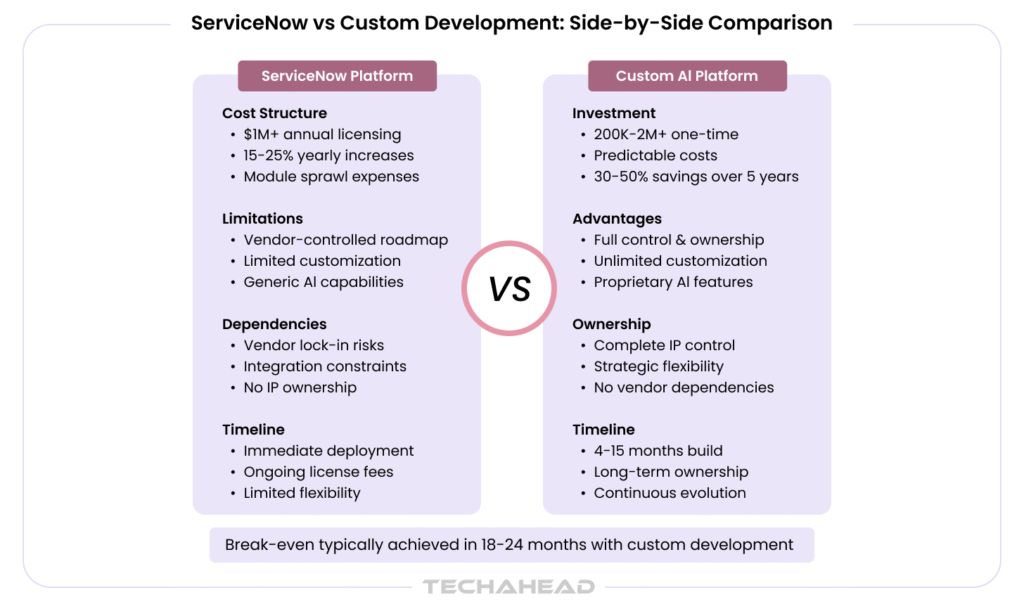
Building custom IT platforms delivers full operational control, predictive automation capabilities, and demonstrated TCO savings ranging from 30-50% over five-year periods. Organizations implementing custom alternatives report substantial productivity improvements through workflows optimized for specific business requirements rather than vendor-imposed limitations.
Quick Investment Snapshot: MVP implementations range from $200K-$500K, comprehensive core platforms require $600K-$1.5M investment, while enterprise-grade transformations begin at $2M+. Phased delivery approaches enable 4-15 month implementation timelines with progressive value realization and risk management
When to Replace ServiceNow with Custom IT Workflows
Understanding specific triggers that indicate ServiceNow replacement viability helps organizations time their transition strategically while maximizing economic and operational benefits from custom development investments.
Licensing & Cost Escalation
ServiceNow’s pricing structure exemplifies vendor dependency risks through per-user licensing models that scale unpredictably with organizational growth.
Mid-enterprise deployments routinely exceed $1M+ annually when accounting for core platform licensing, module additions, integration packages, and professional services requirements. The vendor’s strategy deliberately fragments functionality across multiple modules, such as ITSM, HRSD, SecOps, CMDB, and more, each requiring separate licensing that compounds total cost of ownership.
Annual price increases ranging from 15-25% ensure that initial “affordable” implementations become substantial budget commitments within 3-5 years. Organizations report license sprawl as teams discover additional workflow requirements that demand new module purchases or expensive customization services. Meanwhile, custom development costs have decreased dramatically through cloud infrastructure commoditization and open-source framework maturation.
Customization Limits
Enterprise IT operations involve unique processes that reflect organizational structure, regulatory requirements, and strategic priorities that standardized platforms cannot accommodate effectively. ServiceNow’s configuration options excel at common workflows but struggle with edge cases, complex approval hierarchies, or industry-specific requirements that demand custom logic implementation.
Hybrid cloud environments require routing decisions based on workload characteristics, cost optimization, and compliance frameworks that ServiceNow’s generic automation cannot handle intelligently. Multi-vendor infrastructure management demands integration patterns and decision trees that exceed platform customization capabilities without expensive professional services engagements that often cost more than custom development.
AI Gaps
The transformative potential of AI in IT operations extends far beyond ServiceNow’s basic automation features. Leading enterprises require agentic automation systems that understand organizational context, historical patterns, and business impact in ways that generic AI implementations cannot provide.
Custom AI capabilities include predictive ticket routing, automated resolution suggestions, and intelligent escalation based on institutional knowledge unavailable to vendor platforms.
ServiceNow’s AI operates on generic models trained across all customer data, limiting effectiveness for organization-specific use cases while potentially exposing proprietary operational data to shared learning systems. Custom implementations enable AI agents that understand internal terminology, business processes, and stakeholder relationships through training on organizational data repositories.
Integration Friction
Modern IT environments encompass dozens of specialized tools that require seamless coordination for efficient operations. ServiceNow integration capabilities, while extensive, often require costly middleware, custom development, or architectural compromises that limit functionality.
Organizations report integration challenges with identity providers, cloud platforms, monitoring tools, and security systems that demand specialized API development.
Active Directory synchronization, AWS resource management, Splunk log analysis, and Jira project coordination require real-time data flows and business rule implementations that ServiceNow’s standard connectors cannot provide without additional licensing or professional services. Custom platforms enable native integration architectures optimized for specific technology stacks and operational requirements.
Scale Fatigue
Multi-departmental ServiceNow deployments create governance challenges as different teams require conflicting configurations, approval workflows, and reporting requirements within shared platform instances. Organizations struggle with role management, data isolation, and process standardization across diverse business functions that vendor platforms address through expensive multi-instance architectures.
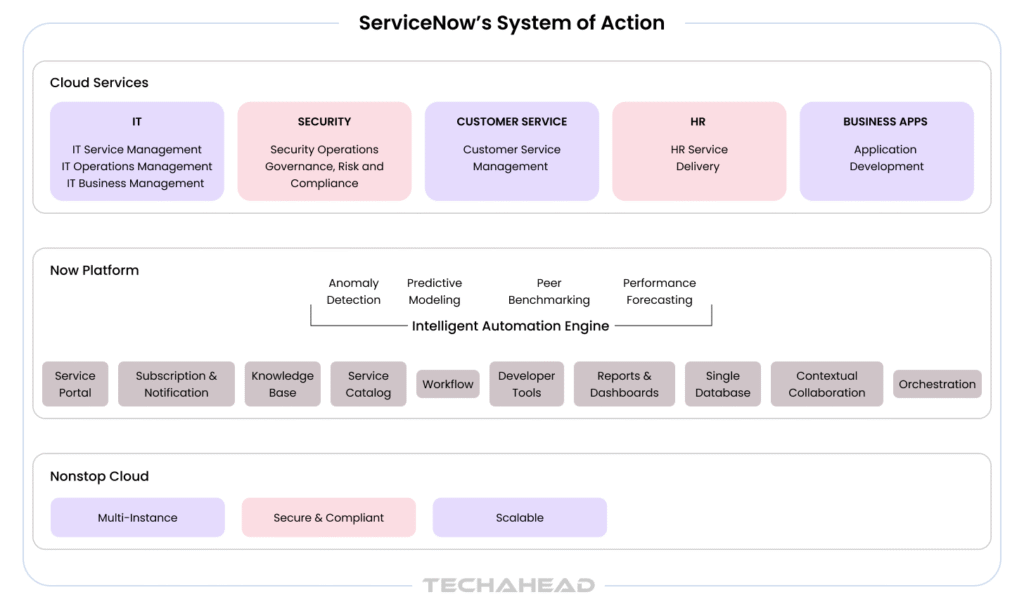
Custom internal ownership enables unified governance frameworks that align with organizational structure while providing departmental flexibility for unique requirements. Single-platform approaches reduce administrative overhead, improve cross-functional coordination, and eliminate vendor dependency for strategic business process evolution.
Investment Bands for ServiceNow Replacements
Understanding the three primary investment tiers helps organizations align development scope with business requirements while establishing realistic budget expectations for custom IT platform implementation.
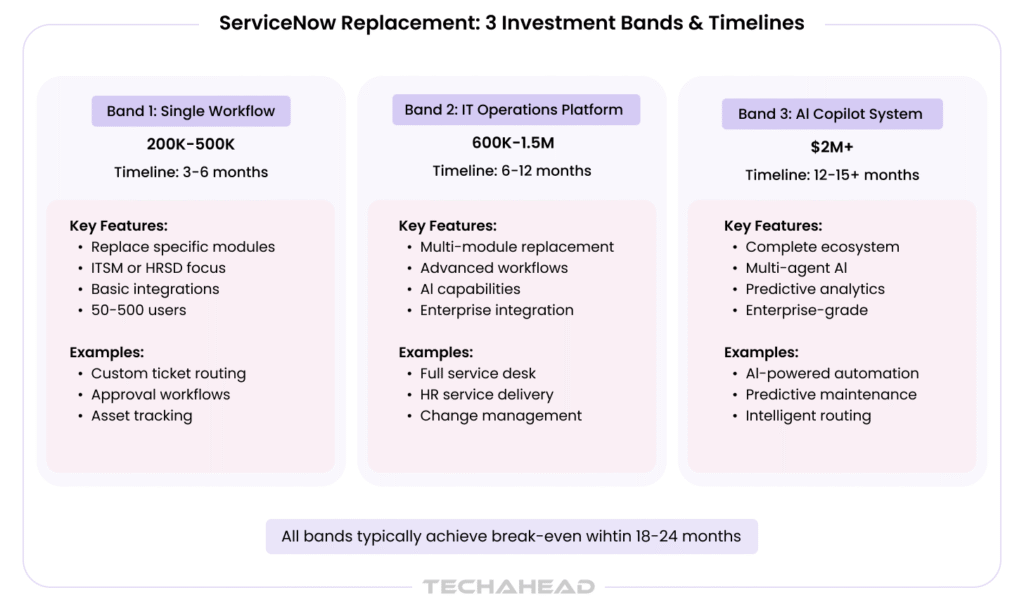
Band 1: Single Workflow Replacement ($200K-$500K)
Scope and Implementation: Focused builds target specific ServiceNow modules with custom alternatives that address particular pain points without comprehensive platform transformation. Organizations choosing this approach typically want to replace expensive module licensing for specific workflows like incident management, change approval, or asset tracking with tailored solutions.
Common implementations include custom ticket routing systems that replace ITSM modules, approval workflow platforms that eliminate HRSD dependencies, or asset management tools that provide superior functionality at predictable costs.
These solutions typically support 50-500 users with straightforward integration requirements and minimal cross-departmental complexity.
Technical architecture emphasizes rapid development using proven frameworks, standard database systems, and cloud-native deployment patterns. Integration capabilities focus on essential business systems without comprehensive enterprise architecture requirements. Security implementations include role-based access controls, audit logging, and standard compliance frameworks adequate for departmental usage.
Timeline and ROI: Development timelines range from 3-6 months depending on workflow complexity and integration requirements. Organizations typically achieve cost parity within 12-18 months while gaining workflow ownership and customization capabilities unavailable in ServiceNow modules. Quick ROI realization enables proof-of-concept validation for broader platform replacement initiatives.
Band 2: Internal IT Operations Platform ($600K-$1.5M)
Scope and Implementation: Comprehensive platforms encompass multiple ServiceNow modules with unified governance, advanced workflow automation, and extensive integration capabilities. This tier represents full IT service management replacement with custom features that provide competitive advantages beyond simple module substitution.
Platform capabilities include IT service desk functionality, HR service delivery, asset lifecycle management, change management workflows, and knowledge base systems with intelligent search capabilities. Advanced workflow engines support complex approval hierarchies, conditional routing, and exception handling that exceed ServiceNow’s configuration options.
Integration architecture extends beyond basic APIs to include bi-directional synchronization with identity providers, cloud platforms, monitoring systems, and business applications. Real-time data flows enable automated provisioning, intelligent alerting, and predictive analytics that provide operational insights unavailable in commercial platforms.
AI Integration: Custom AI capabilities leverage Large Language Models, vector databases for semantic search, and machine learning models trained on organizational data. These features enable natural language interfaces, intelligent ticket classification, automated resolution suggestions, and predictive maintenance capabilities that provide substantial productivity improvements.
Timeline and Implementation: Development timelines extend to 6-12 months with phased delivery that enables progressive feature rollout and risk management. Organizations report 40-60% efficiency improvements in IT operations while gaining proprietary capabilities that provide strategic advantages over competitors using commercial platforms.
Band 3: AI-Enabled IT Copilot + Automation ($2M+)
Scope and Implementation: Enterprise-grade transformations replace entire ServiceNow ecosystems with intelligent platforms that provide unified experiences, comprehensive automation, and advanced AI operations across multiple business functions. These implementations serve thousands of users with complex integration requirements and strategic technology infrastructure needs.
Comprehensive capabilities include multi-agent systems for automated problem resolution, predictive analytics for infrastructure optimization, intelligent resource allocation, and automated compliance monitoring. AI copilots understand organizational context, historical patterns, and business impact to provide decision support that exceeds human capabilities for routine operational tasks.
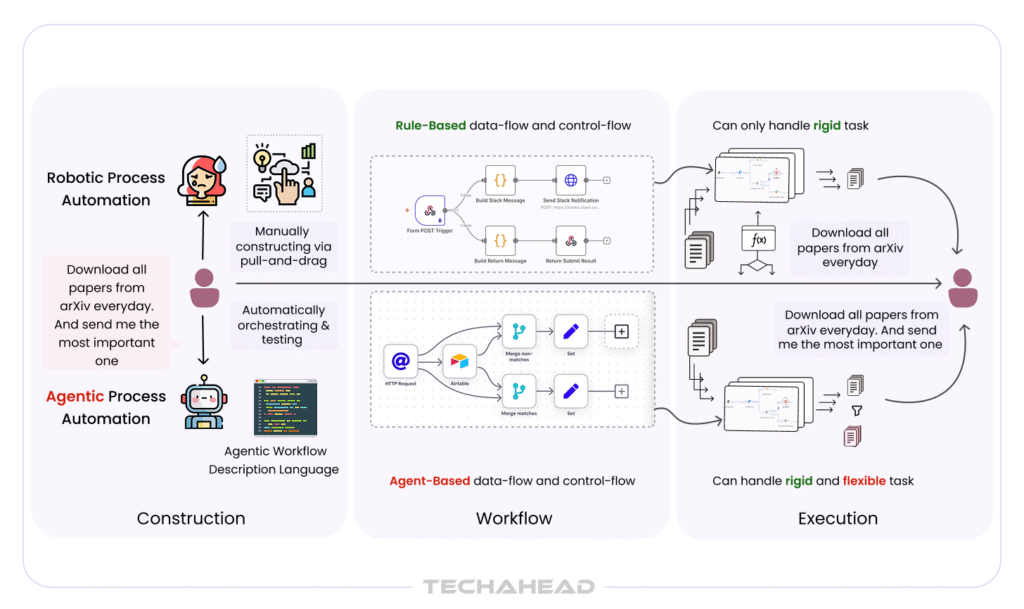
Agentic AI Automation Workflow: Source
Technical architectures require enterprise-grade infrastructure including distributed systems design, advanced security implementations, compliance framework integration, and sophisticated AI operations that support real-time decision making across complex business processes.
Advanced AI Capabilities: Platform implementations include Retrieval-Augmented Generation architectures for intelligent knowledge management, computer vision for infrastructure monitoring, natural language processing for automated documentation, and predictive analytics for capacity planning and resource optimization.
Timeline and Strategic Impact: Implementation requires 12-15+ months with sophisticated project management and change management strategies. These investments create owned intellectual property that provides foundation for ongoing innovation, competitive differentiation, and strategic agility while delivering substantial cost savings compared to equivalent ServiceNow licensing.
What Drives Scope and Investment in Custom IT Platforms?
Understanding specific variables that influence development complexity enables accurate project planning and realistic investment expectations for ServiceNow replacement initiatives.
Workflow Volume and Complexity
The sophistication and quantity of existing IT processes represent the primary driver of development scope and timeline requirements. Organizations with simple linear workflows require minimal custom logic, while complex multi-path processes demand sophisticated workflow engines capable of managing conditional routing, parallel approvals, and exception handling.
ServiceNow environments typically encompass 10-50+ distinct workflow types across incident management, change control, asset lifecycle, user provisioning, and knowledge management functions. Each workflow type requires analysis, optimization, and custom implementation that accounts for organizational requirements beyond ServiceNow’s standardized approaches.
Multi-departmental workflows add significant complexity through cross-functional coordination requirements, data sharing, and approval dependencies that span organizational boundaries. IT-to-HR integration for user onboarding, IT-to-finance coordination for asset management, and IT-to-security alignment for compliance workflows require sophisticated business rule implementation and data synchronization.
Impact: Workflow complexity typically accounts for 30-40% of total development effort. Organizations with well-documented processes and standard operating procedures can reduce development timelines, while companies with ad-hoc workflows may require extensive business analysis phases.
Integration Depth and Enterprise Connectivity
Modern IT environments encompass dozens of specialized systems requiring seamless coordination for efficient operations. Custom platform success depends on comprehensive integration architectures that enable real-time data flow, process coordination, and unified user experiences across diverse technology ecosystems.
Identity and Infrastructure Integration: Okta integration represents common enterprise requirements involving user provisioning, role management, single sign-on implementation, and lifecycle automation that maintains security while providing seamless user experiences. AWS and Azure integration demands resource monitoring, automated scaling, cost optimization, and compliance management that ServiceNow handles through expensive add-on modules.
Splunk integration requires log aggregation, alert correlation, and incident creation workflows that custom platforms can optimize for specific organizational requirements. Jira connectivity enables development-operations coordination through automated ticket creation, status synchronization, and escalation procedures tailored to development methodologies.
Legacy System Challenges: Enterprise environments often include legacy monitoring systems, proprietary databases, and custom applications with limited API capabilities. These systems may require custom middleware development, direct database integration, or data transformation pipelines that introduce additional complexity while enabling comprehensive operational visibility.
Impact: Integration complexity typically adds 20-40% to base development costs while extending timelines by 2-3 months for comprehensive testing and validation.
AI Goals and Automation Requirements
AI implementation represents significant value drivers for custom IT platforms while adding substantial technical complexity that requires specialized expertise and extended development timelines.
RAG Implementation for Knowledge Management: Modern AI capabilities center on Retrieval-Augmented Generation architectures that enable natural language querying across organizational knowledge bases, intelligent documentation search, and contextual problem resolution guidance. Vector database implementation involves architectural decisions around embedding models, search algorithms, and performance optimization for enterprise-scale knowledge repositories.
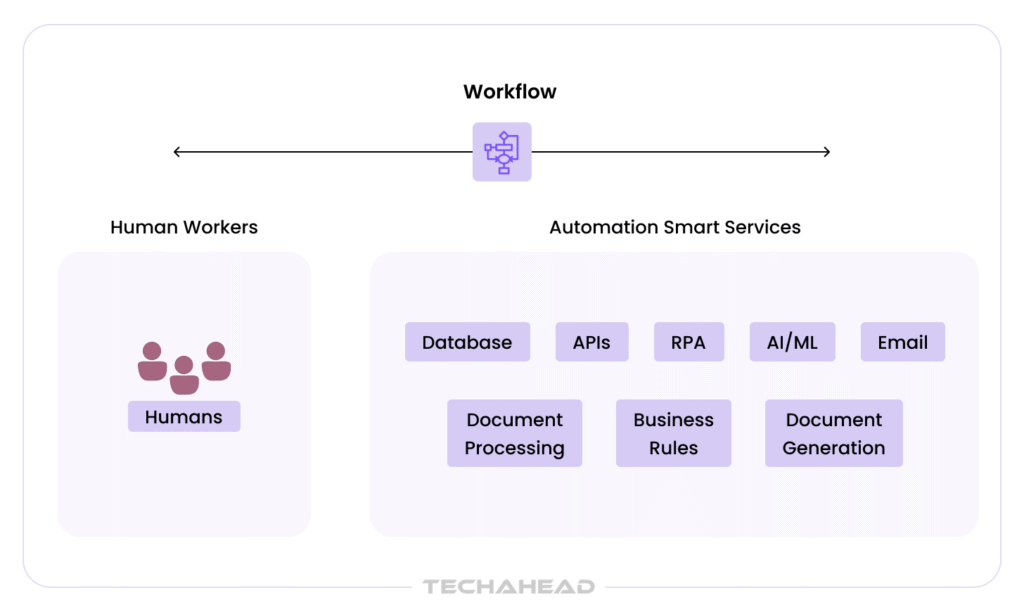
AI Enabled Workflow design: Source
Agent Execution and Predictive Analytics: Advanced AI capabilities include multi-agent systems for automated ticket routing, predictive failure analysis, and intelligent resource allocation based on historical patterns and business impact assessment. These systems require custom model training, validation frameworks, and human oversight capabilities that ensure accuracy while building organizational confidence.
MCP Orchestration: Model Context Protocol implementation enables sophisticated agent coordination for complex problem resolution that spans multiple systems and requires sequential decision-making. Custom implementations provide competitive advantages through superior accuracy and organizational context understanding.
Impact: AI feature implementation typically adds 25-40% to development costs while extending timelines by 3-5 months for model development, training, and validation procedures.
Security and Compliance Requirements
Enterprise IT platforms must provide security capabilities that meet or exceed ServiceNow alternatives while supporting organizational compliance obligations and regulatory requirements.
Role-Based Access Controls: Custom platforms require comprehensive security architectures including advanced authentication systems, granular permission management, and audit logging capabilities that provide enterprise-grade protection. SOC 2 compliance demands specific control implementations, monitoring procedures, and reporting capabilities that custom development can optimize for organizational requirements.
HIPAA and Industry Standards: Healthcare organizations, financial services firms, and government agencies require compliance frameworks that extend beyond ServiceNow’s generic security features. Custom implementations enable organization-specific controls, data handling procedures, and audit trails that exceed commercial platform capabilities.
Data Migration and Integrity: ServiceNow replacement requires careful extraction of historical data, workflow configurations, and user information while maintaining audit trails and compliance requirements. Migration complexity depends on data quality, custom field implementations, and integration patterns that may require extensive cleanup and standardization efforts.
Impact: Security and compliance requirements typically account for 15-25% of development effort while requiring specialized expertise and extended validation procedures.
Phased Timeline for ServiceNow-to-Custom Builds
Successful ServiceNow replacement requires structured implementation approaches that manage risks while delivering value progressively through clearly defined phases.
Phase 1: Discovery Sprint (2-4 weeks)
Comprehensive Requirements Analysis: Discovery activities include stakeholder interviews across IT, HR, and operations teams to document existing workflows, pain points, and improvement opportunities. Technical assessments evaluate current ServiceNow configurations, customizations, and integration patterns that impact migration strategies.
ServiceNow usage analysis includes module utilization, workflow complexity, user adoption patterns, and cost breakdowns that validate economic justification for custom development. Risk assessment identifies technical challenges, organizational change management requirements, and mitigation strategies.
Fixed-Fee Deliverables: Discovery outputs include detailed project scope, technical architecture recommendations, implementation timeline, resource requirements, and total investment estimate with ROI projections based on ServiceNow cost elimination and productivity improvements.
Phase 2: Core MVP (2-5 months)
Primary Module Replacement: MVP development focuses on replacing ServiceNow’s most critical modules—typically ITSM for ticket management, basic workflow automation, and essential reporting capabilities. User interface development prioritizes intuitive navigation and feature parity with existing ServiceNow functionality while providing foundation for custom enhancements.
Database schema design accommodates ServiceNow data migration while optimizing for performance and future feature development. Security implementation includes role-based access controls, audit logging, and integration capabilities that meet organizational requirements for initial deployment.
Progressive Adoption: Agile development methodologies enable regular stakeholder review and requirement refinement. Pilot deployment with limited user groups provides real-world validation while identifying optimization opportunities before broader organizational rollout.
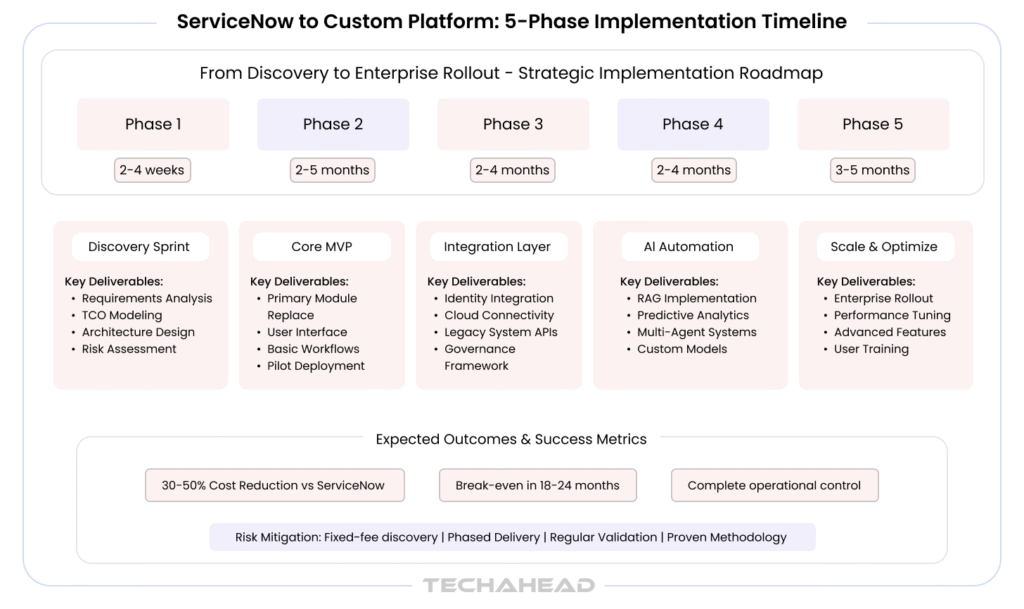
Phase 3: Integrations + Governance (2-4 months)
Infrastructure Integration: Integration development includes identity provider synchronization, cloud platform connectivity, and monitoring system coordination that enables unified operational visibility. API development for legacy systems ensures comprehensive data flow while maintaining security and performance standards.
Governance framework implementation includes approval workflows, escalation procedures, and reporting capabilities that align with organizational structure and compliance requirements. Advanced user management and role assignments provide administrative control that exceeds ServiceNow’s standard capabilities.
Phase 4: AI Automation Layer (2-4 months)
Intelligent Operations: AI pipeline development includes natural language interfaces, predictive analytics, and automated decision-making capabilities that provide competitive advantages over commercial platforms. RAG implementation enables intelligent knowledge search while custom model training delivers organization-specific insights and recommendations.
Automated workflow optimization includes intelligent ticket routing, predictive problem identification, and resource allocation recommendations based on historical patterns and business impact analysis. Human oversight systems ensure accuracy while building organizational confidence in automated decision-making.
Phase 5: Scale & Optimize (3-6 months)
Enterprise Rollout: Organization-wide deployment requires capacity planning, performance optimization, and user training coordination. Change management support ensures successful adoption while comprehensive monitoring validates system performance and user satisfaction.
Advanced feature development includes additional AI capabilities, workflow enhancements, and integration expansions based on operational experience and user feedback. Continuous improvement processes ensure platform evolution aligned with changing business requirements.
Timeline Risk Management: Common risks include data migration complexity (+15% timeline extension), integration challenges with legacy systems (+20%), and user adoption resistance (+10%). TechAhead’s AI-accelerated development approaches and proven methodologies minimize these risks while ensuring predictable delivery schedules.
Why TechAhead Builds the Best ServiceNow Alternatives
Selecting the right development partner represents a critical success factor for ServiceNow replacement initiatives requiring deep IT operations expertise, enterprise experience, and proven delivery capabilities.
IT Workflow Expertise
TechAhead’s technical foundation centers on enterprise IT operations understanding gained through delivering 5+ custom platforms that successfully replaced ServiceNow ITSM, HRSD, and specialized modules for Fortune 500 organizations. Our development teams understand the nuances of IT service management, change control processes, and asset lifecycle management that generic software developers often overlook.
Recent implementations include comprehensive IT service platforms that exceed ServiceNow capabilities through custom workflow engines, intelligent automation, and integration architectures optimized for specific organizational requirements. These platforms serve thousands of users while providing superior performance and functionality at predictable costs.
AI IT Automation Capabilities
Advanced AI Implementation: Our AI expertise encompasses RAG-enabled knowledge management systems, multi-agent workflow automation, and predictive analytics platforms that provide competitive advantages unavailable in commercial alternatives. Custom model training using organizational data delivers accuracy improvements of 40-60% compared to generic AI implementations.
MCP agent development enables sophisticated automated problem resolution, intelligent resource allocation, and predictive maintenance capabilities that reduce manual effort while improving service quality and user satisfaction. These AI capabilities provide strategic advantages that justify custom development investments through measurable productivity improvements.
Proven TCO and Migration Success
Economic Results: Client organizations typically achieve 40%+ cost savings over five-year periods through ServiceNow replacement while gaining proprietary capabilities that provide ongoing competitive advantages. Seamless migration strategies minimize business disruption while ensuring data integrity and user adoption success.
Comprehensive economic modeling validates investment justification while identifying optimization opportunities that enhance project value. Risk-managed implementation approaches ensure predictable outcomes through regular milestone validation and stakeholder feedback integration.
Enterprise Integration Excellence
Technical Capabilities: Proven integration experience includes Okta implementations with complex role management, AWS connectivity across diverse services, and Splunk coordination for comprehensive operational visibility. HIPAA and SOC 2 compliance expertise ensures custom platforms meet regulatory requirements while providing superior security controls.
Advanced integration patterns enable real-time data synchronization, intelligent alerting, and automated workflow coordination across enterprise technology stacks. Performance optimization and scalability planning ensure platforms support organizational growth without architectural constraints.
Complete Ownership and Partnership
End-to-End Service Model: TechAhead provides comprehensive project lifecycle management from initial discovery through ongoing operational support, ensuring continuity and expertise throughout platform development and maintenance phases. Our service model eliminates vendor handoff risks while maintaining consistent quality and strategic alignment.
Long-term partnership approaches enable continuous platform evolution aligned with changing business requirements, technology advances, and organizational growth. Knowledge transfer programs and internal capability building support organizational independence while maintaining access to specialized expertise when needed.
Ditch ServiceNow Sprawl: Own Your IT Workflows with AI Power
The enterprise software landscape of 2026 presents unprecedented opportunities for organizations ready to transition from expensive ServiceNow dependencies to strategic IT platform ownership through custom AI-enabled solutions. ServiceNow’s escalating licensing costs, customization limitations, and vendor-controlled roadmaps create operational constraints that custom development eliminates while providing competitive advantages.
Organizations implementing ServiceNow alternatives report substantial cost savings, improved operational efficiency, and strategic agility that commercial platforms inherently cannot deliver. Custom AI capabilities, optimized workflows, and enterprise-grade security provide foundation for ongoing innovation while eliminating vendor dependencies that constrain business growth.
Success requires comprehensive planning, experienced implementation partners, and realistic investment expectations, but organizations meeting these criteria achieve substantial returns through reduced licensing costs, improved productivity, and proprietary technology capabilities that drive competitive advantage.
Ready to explore ServiceNow replacement opportunities? Start with a comprehensive workshop that includes TCO analysis, scope estimation, and migration planning tailored to your specific IT requirements and organizational objectives.
Frequently Asked Questions
What ServiceNow modules are most commonly replaced with custom solutions?
ITSM, HRSD, and CMDB modules represent the highest-value replacement opportunities for cost savings.
How long does ServiceNow data migration take in custom platform implementations?
Data migration typically requires 4-8 weeks depending on customization complexity and data quality.
Can custom IT platforms achieve the same security standards as ServiceNow?
Custom implementations often exceed ServiceNow security through organization-specific controls and compliance frameworks.
What’s the biggest risk factor in ServiceNow replacement projects?
User adoption challenges typically cause the most implementation delays without proper change management.
How do custom ServiceNow alternatives handle enterprise scalability requirements?
Cloud-native architectures enable unlimited scalability with predictable performance and cost characteristics.