

Staff Augmentation
Access top-tier talent on demand: Dedicated, Hourly, or Flexible.


 Copy Link
 Share on X
 Share on Facebook
 Share on LinkedIn
Almost every industry now depends on software to operate seamlessly. Whether to manage data, streamline logistics, or serve customers, software is no longer a support function, but a backbone of competition.
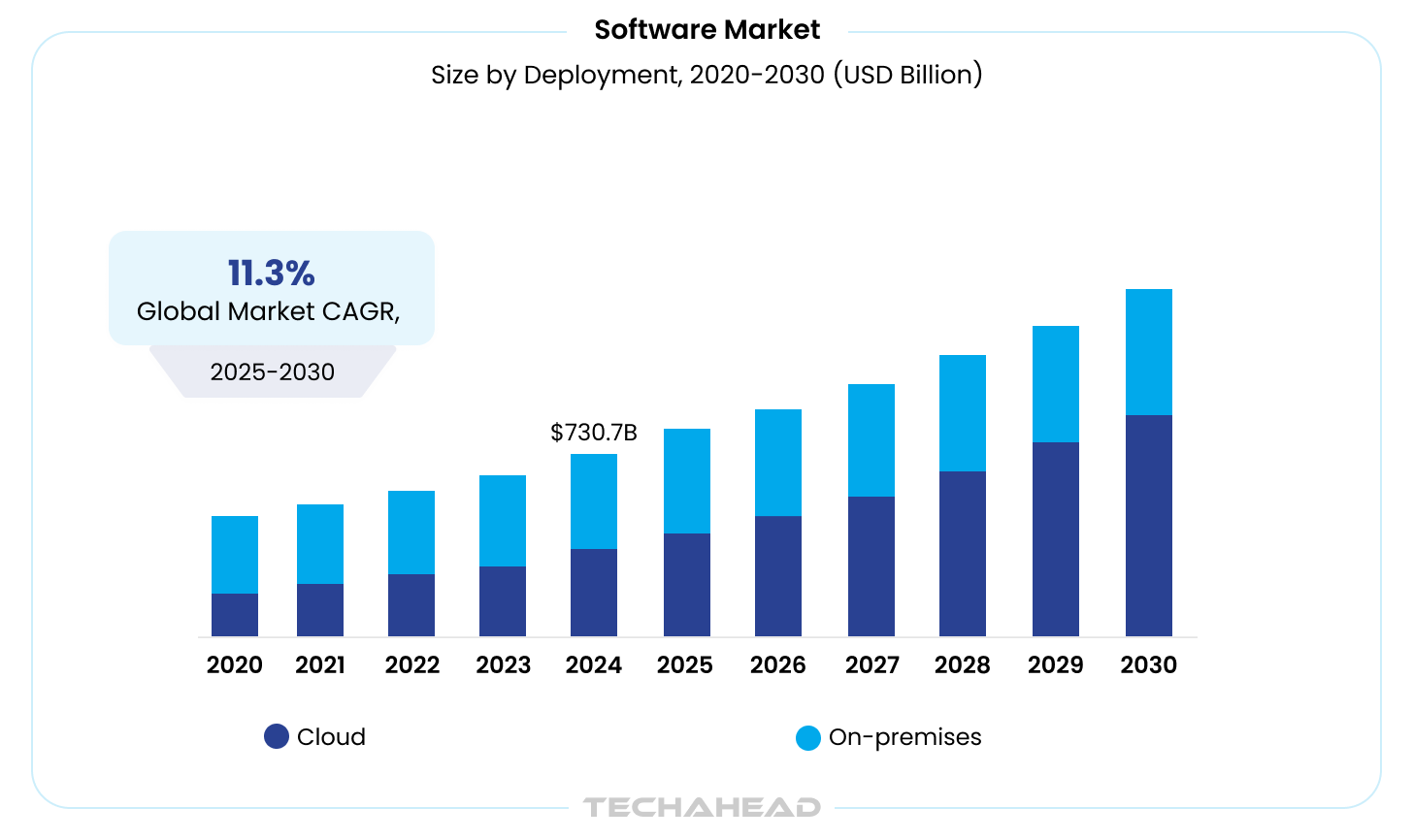
The global business software market crossed $730.70 billion in 2024 and is expected to reach over $1,397.31 billion by 2030, projecting a CAGR of 11.3% in the forecasting period.
This growth represents a clear shift: technology is embedded in core processes. And developing software that scales your operations is how you respond to market change.
Key Takeaways
- The right software development company is defined by engineering depth, delivery discipline, and measurable outcomes.
- Technical architecture and scalability planning determine success more than initial build speed.
- Security and compliance maturity are critical risk indicators and must be validated through documentation.
- Case studies with quantifiable impact carry more weight than generic portfolios.
- Third-party reviews on platforms like Clutch, G2, and Gartner Peer Insights provide valuable buyer validation.
- Structured discovery and governance reduce execution risk and prevent scope drift.
- Partnership capability matters more than short-term project execution.
Consequently, you may be searching for a software development company that can design, build, deploy, and manage solutions that adapt as your business evolves. There are approximately 585,000 software and IT service companies in the USA. And you need to find a reliable partner among them that can offer predictable delivery, transparent governance, and measurable outcomes.
Hence, the challenge is not the lack of options. It is an overload of claims. That is why we created this guide where we shortlisted the top 10 software development companies based on the analysis of offerings, ratings, portfolios, and reviews.
This blog is a structured effort to help you evaluate the market with clarity. When you make a technology decision, you need visibility into multiple providers, their strengths, and their limitations. An informed comparison helps you choose the partner that fits your priorities, budget, and technical direction.
Selection Criteria for the Top Software Development Companies
Choosing a software development partner is a risk decision as much as a technology decision. To build this list, we applied evaluation criteria aligned with what matters when you are committing budget, timelines, and business-critical systems.
Technical Expertise & Engineering Depth
We assessed demonstrated capability across modern stacks, including cloud-native architecture, DevOps maturity, AI/ML integration, and secure coding practices.
Indicators considered:
- Public case studies with technical architecture details
- Engineering blogs or thought leadership
- GitHub contributions (where applicable)
- Stack certifications (AWS, Azure, Google Cloud)
- Evidence of complex system builds, not just websites or apps
Software development firms that score high here show mature architectural thinking.
Project Experience & Domain Specialization
Software built for regulated or high-volume environments requires domain understanding. We evaluated:
- Experience in sectors such as fintech, healthcare, logistics, SaaS, and manufacturing
- Multi-year transformation projects
- Integration with ERP, CRM, payment systems, or legacy platforms
- Ability to handle distributed teams and large user bases
Companies with repeat domain success demonstrate lower execution risk.
Security & Compliance Standards
According to McKinsey’s State of AI 2025 survey, nearly 51% of organizations report to face at least one instance of a negative consequence. Therefore, security and governance maturity are non-negotiable.
We reviewed:
- ISO 27001, SOC 2, HIPAA, GDPR compliance (where applicable)
- Secure SDLC documentation
- Data governance practices
- Incident response frameworks
Delivery Process & Scalability
Execution consistency matters more than promises. We favored companies that showed process transparency and clear escalation mechanisms.
We evaluated:
- Agile maturity and sprint governance
- CI/CD pipelines and automation
- QA coverage and testing frameworks
- Ability to scale teams without quality drop
- SLA-backed delivery models
Case Studies with Measurable Outcomes
Claims without numbers were excluded. Preference was given to firms that showed:
- Revenue growth impact
- Cost reduction percentages
- Performance improvement metrics
- Time-to-market acceleration
- User adoption growth
Client Retention & Third-Party Validation
Firms with consistent 4.5+ average ratings across credible third-party review platforms demonstrate higher delivery trust.
We analyzed:
- Ratings and qualitative reviews on Clutch, G2, and Gartner Peer Insights
- Client tenure and repeat engagements
- Public testimonials and reference depth
Industry Recognition & Certifications
Awards alone do not determine quality, but peer recognition signals market validation.
We reviewed:
- Recognitions from reputable analyst firms
- Inclusion in industry rankings
- Technology partner statuses
Quick Comparison of the Top 10 Software Development Companies in USA (Key Factors)
A concise comparison highlighting what differentiates each company across key decision factors.
| Company | Founded | Headquarters | Employee Count | Core Services |
| TechAhead | 2009 | USA | 300+ | Custom software, mobile apps, cloud services, AI/ML |
| Fujitsu | 1935 | Kawasaki, Japan (NA HQ: Richardson, TX) | 10,001+ | Consulting, digital solutions, cloud, IT services |
| Nous Infosystems | 1996 | USA | 1,000+ | Enterprise application development, product engineering, digital transformation |
| Zymr Inc | 2012 | San Jose, CA | 400+ | Cloud software development, digital transformation, platform engineering |
| Fingent | 2003 | White Plains, NY | 500+ | Custom software, mobile app development, SaaS, cloud-native |
| IQVIS | 2013 | Milpitas, CA | 200+ | Mobile app development, blockchain, chatbot development, MVP creation |
| Wildnet Edge | 2025 | USA | 50+ | Custom software, AI-native development, cloud migration, mobile apps |
| Cleveroad | 2011 | Claymont, Delaware | 200-500 | Custom software, mobile app development, web development, IT consulting |
| Fueled | 2007 | New York City, NY | 70+ | Mobile app development, website design, backend development |
| TELUS Digital | 2005 | Vancouver, British Columbia (Canada) | 10,001+ | Digital transformation, customer experience solutions, AI/data services |
Leading 10 Software Development Companies in USA
Finding the right partner requires looking beyond claims and portfolios. The following software development firms have demonstrated consistent performance across complex, large-scale projects.
Below are the firms that stand out on measurable criteria.
TechAhead
Founded in 2009 and headquartered in California, TechAhead is a software development company in the USA focused on building scalable digital products. Over the past 16+ years, the company has delivered hundreds of mobile and web applications across healthcare, fintech, retail, media, and consumer platforms.
Company Overview
TechAhead works with both high-growth startups and global brands. Its portfolio includes collaborations with organizations such as ICC, American Express, Disney, ESPN, and Starbucks. The focus has remained consistent: build software that is production-ready, secure, and designed for scale — not experimental prototypes.
Core Capabilities
- Custom Software & Mobile Engineering: Full-cycle development for iOS, Android, and cross-platform frameworks such as React Native and Flutter. Architecture is designed for performance, maintainability, and scale.
- AI & Intelligent Systems: Integration of machine learning models, predictive analytics, recommendation engines, and automation workflows into consumer and business applications.
- Cloud & DevOps Engineering: Cloud-native deployments across AWS, Azure, and Google Cloud. CI/CD pipelines, containerization, and infrastructure automation to ensure stable releases.
- IoT & Connected Platforms: Development of applications that integrate with smart devices, wearables, and industrial IoT ecosystems.
- Healthcare & Regulated Solutions: HIPAA-aligned application development, remote patient monitoring systems, EHR integrations, and secure data management workflows.
Delivery Approach
TechAhead emphasizes structured execution. Engagements typically include:
- Product discovery and UX validation
- Architecture planning
- Agile development sprints
- Automated testing and QA
- Continuous deployment
- Post-launch optimization
What Differentiates TechAhead
- 16+ years of product engineering experience
- Proven portfolio with globally recognized brands
- Strong mobile-first expertise combined with AI integration
- Cross-industry execution capability
- Balance of technical depth and business alignment
Fujitsu
Company Overview
Fujitsu is a century-old global IT services and technology company that combines software, consulting, and infrastructure services to support digital transformation. With approximately 130,000 employees operating in over 100 countries, Fujitsu focuses on helping organizations integrate new technology with existing systems and achieve measurable business outcomes.
Expertise
- End-to-end digital transformation and enterprise software solutions
- Custom application development and systems integration
- Cloud services and hybrid infrastructure
- Managed services and IT optimization
- Co-creation of solutions that balance innovation with legacy systems support
Nous Infosystems
Company Overview
Nous Infosystems is a US-based software and digital engineering company headquartered in New Jersey. It focuses on product engineering and transformation services, helping clients create future-proof software that supports evolving business needs. They operate via global delivery centers and Centers of Excellence, supporting 2,000+ enterprise applications with a mission for competitive solutions.
Expertise
- Digital product engineering and application development
- Cloud enablement and modernization
- Testing, QA, and support services
- UI/UX design and agile delivery
- Custom software solutions for medium to large organizations
Zymr Inc
Company Overview
Zymr is a full-stack, Silicon Valley-based software development company based in San Jose, California. It specializes in building scalable SaaS platforms and custom solutions for a range of clients, including enterprises and independent software vendors. They emphasize cyber-secure development and collaborative risk-based strategies for emerging technologies.
Expertise
- SaaS and cloud platform engineering
- MVP development and iterative product builds
- UI/UX design and DevOps/CI-CD enablement
- Mobile and web application development
- Platform modernization and scalability solutions

Fingent
Company Overview
Fingent is a US-based, ISO 27001:2013-certified IT services and software development company headquartered in New York. It provides full-cycle engineering and consulting, helping organizations tackle complex problems with tailored technology solutions. By focusing on intelligent, governed AI adoption, they have built their strength in AI-engineered processes for custom software.
Expertise
- End-to-end software development
- Technology re-engineering and process automation
- Digital transformation initiatives
- Web and mobile application development
- Ongoing support and product lifecycle management
IQVIS
Company Overview
IQVIS offers next-gen technology services, focused on building secure, custom products from concept to market. It serves startups, SMBs, and growing tech organizations with engineering expertise aligned with their business requirements. With 10+ years of experience, they transform ideas into revenue-boosting solutions for startups and enterprises.
Expertise
- Custom software and product development
- MVP and prototype engineering
- Application modernization and re-engineering
- Full-stack development across web and mobile platforms
Wildnet Edge
Company Overview
Wildnet Edge is an AI-first software development firm known for custom software solutions. Its deep product engineering expertise places it among promising development partners. They emphasize innovation in AI-driven services for modern business needs. It is a fairly new division launched in June 2025 of Wildnet Technologies, carrying a legacy of 19+ years.
Expertise
- Custom software engineering
- Web and mobile application development
- Agile delivery engagements
Cleveroad
Company Overview
Cleveroad is one of the well-known software development companies, established in Claymont, Delaware. With 15+ years of experience, it provides tailored engineering services across platforms. Its offerings traditionally span mobile, web, and enterprise applications, combining technology skills with thoughtful design.
Expertise
- Mobile app development (native and cross-platform)
- Web application engineering
- UI/UX design and ongoing support
- Cloud-ready backend systems
Fueled
Company Overview
Fueled is a digital product development agency based in New York. Known for its strong design sensibilities coupled with robust engineering, Fueled builds mobile and web platforms for consumer-facing and internal business applications.
Expertise
- Mobile and web development
- UX/UI strategy and product design
- Growth-oriented digital experiences
- Long-term platform support and iteration
TELUS Digital
Company Overview
TELUS Digital is the digital solutions arm of TELUS, a major Canadian telecom and technology group. It combines software engineering with data, analytics, and platform services to build modern digital systems.
Expertise
- Digital platform engineering
- Data and analytics solutions
- Cloud and mobile application development
- Customer experience platforms and digital transformation
Common Mistakes to Avoid When Hiring a Software Development Company
Shortlisting vendors is not the hard part. Avoiding preventable risk is. Below are the most common mistakes companies make when selecting a software development company — supported by industry data and third-party validation signals.
Choosing Based on Hourly Rate Alone
Lower hourly cost rarely equals lower total cost. Rework, missed deadlines, and architectural flaws increase long-term spend.
- Studies show poor software quality in the U.S. cost businesses at least $2.41 trillion in 2022. (CISQ report).
- Clutch reviews frequently cite “communication gaps” and “unclear scope” as drivers of budget overruns.
Ignoring Compliance and Security Posture
Security failures are no longer rare incidents. They are operational risks. IBM’s Cost of a Data Breach Report consistently shows that the average breach cost exceeds $4 million globally. If a vendor cannot clearly document ISO 27001, SOC 2, HIPAA, or secure SDLC practices where applicable, treat it as a red flag.
Overlooking Scalability
Many systems fail not at launch, but at growth. 70% of digital transformation initiatives fail to meet objectives (McKinsey reports).
Poor architectural planning is a recurring cause. Consider:
- Asking for architecture diagrams.
- Reviewing the load-handling strategy.
- Validating DevOps maturity.
Skipping Technical Due Diligence
A polished sales deck is not proof of engineering depth. High-rated vendors on Clutch and G2 typically show detailed case studies with metrics — revenue impact, latency reduction, automation gains.
Request:
- Code samples or technical walkthroughs
- Architecture review sessions
- Reference calls with technical stakeholders
- A short-paid pilot before commitment
Weak Contract Governance
Ambiguity creates disputes. Scope creep is one of the most cited concerns in software vendor reviews across Clutch and G2. Lack of SLA clarity leads to performance conflicts post-deployment.
Your agreement should clearly define:
- Change management process
- Milestone acceptance criteria
- IP ownership
- Escalation framework
- Exit and transition clauses
Start With the Right Software Development Partner
Selecting a software development company is not just about delivery capacity. It’s about choosing a team that understands your business model, technical landscape, and objectives.
At TechAhead, we approach every engagement with clarity. You get structured discovery, architectural guidance, measurable milestones, and a delivery model built for scale. No inflated promises. No vague timelines. Just disciplined execution and transparent communication.
If you are evaluating development partners, start with a focused discussion.
Schedule a 30-minute strategy call to review:
- Your current technical landscape
- Scalability and integration requirements
- Security and compliance considerations
- Delivery roadmap and estimated timelines
Whether you decide to work with us or not, you’ll leave with a clearer direction for your next software initiative.
Build with confidence. Start with the right partner.
How much does it cost to develop a software in the USA?
Software development cost depends on complexity, integrations, compliance needs, and scalability requirements. A simple MVP with limited features and minimal integrations range from $50,000 to $100,000. On the other hand, an application with custom backend, APIs, user roles, and dashboards can cost between $100,000 and $250,000.
Ongoing costs should also be considered, including cloud hosting, security monitoring, and compliance audits. Additionally, maintenance and updates typically cost 15–25% of initial build annually.
What is the timeline for custom software development?
Timelines vary based on scope clarity and system complexity. Discovery & architecture planning can take 2–6 weeks, MVP development can take 3–6 months, and mid-scale platforms can take 6–12 months. Whereas a complex enterprise-grade system can take more than 12 months to develop.
Projects that skip structured discovery often experience delays later. A phased roadmap with milestone reviews reduces timeline risk.
How do I compare hourly rates across software development companies?
Hourly rate alone is not a reliable comparison metric. Instead, you need to evaluate seniority level included in the rate, delivery model, automation maturity (CI/CD, testing coverage), and architectural depth
For example, a $60/hour team requiring heavy oversight may cost more overall than a $110/hour senior team that delivers with fewer iterations.
How do I validate a company’s security claims?
Security maturity should be demonstrable. Ask for documentation. Verify ISO 27001 or SOC 2 reports, HIPAA compliance evidence, secure SDLC documentation, data encryption standards, and incident response framework. You can also request a third-party security audit summary and conduct a technical security review.
How do I choose a custom software development company?
Use a structured evaluation framework. Evaluate technical fit, domain experience, security & compliance readiness, delivery governance, outcomes, and reference validation. Shortlist 2–3 vendors. Run a small paid pilot if possible. The right partner will welcome technical scrutiny.