

Staff Augmentation
Access top-tier talent on demand: Dedicated, Hourly, or Flexible.





 Copy Link
 Share on X
 Share on Facebook
 Share on LinkedIn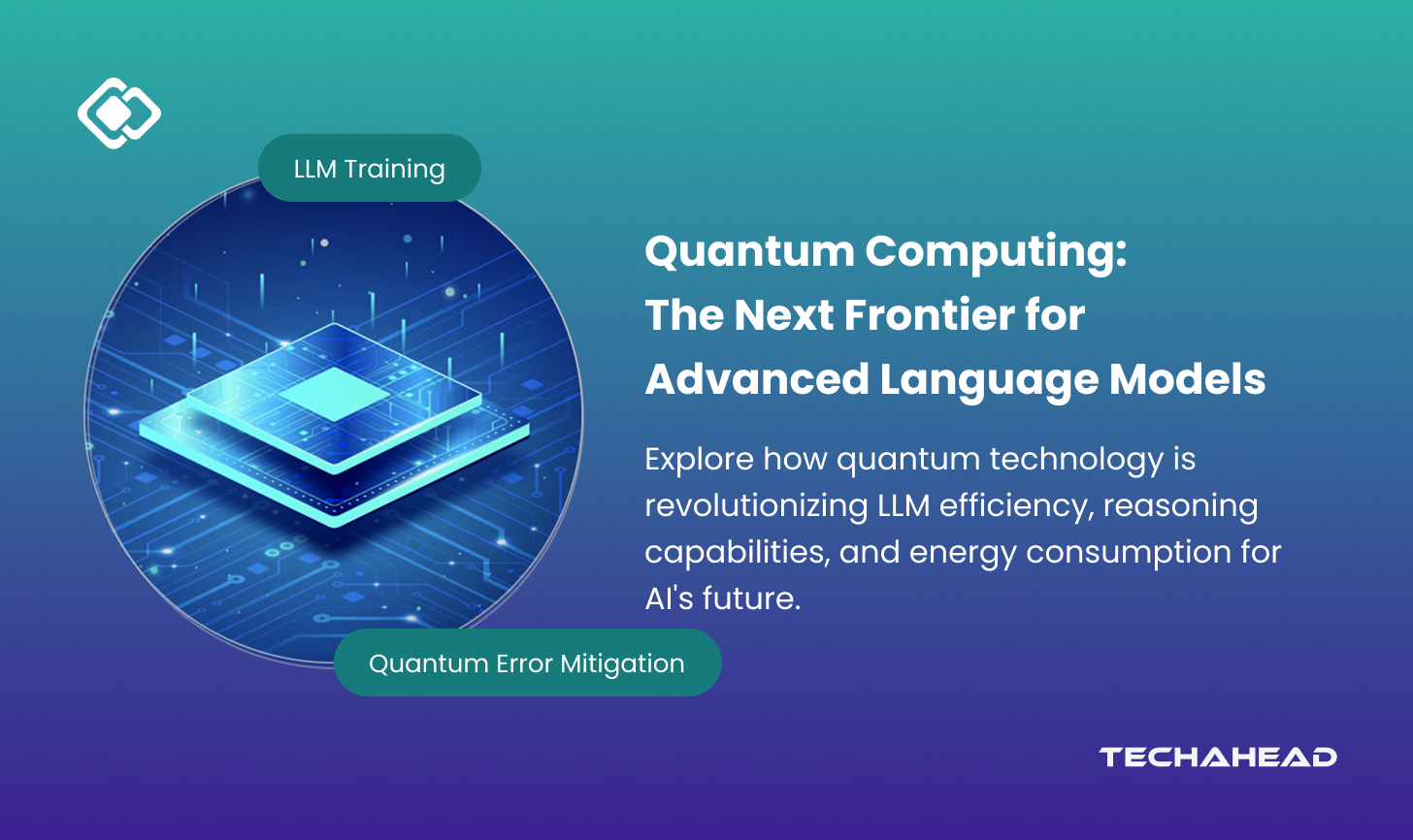
The artificial intelligence revolution has reached an inflection point. Large language models (LLMs) like GPT-4, Claude, and Gemini have demonstrated unprecedented capabilities in natural language understanding, reasoning, and content generation. Yet as these models grow increasingly sophisticated, with parameter counts reaching hundreds of billions, they demand computational resources that push classical hardware to its limits.
Enter quantum computing: a transformative technology that could fundamentally reshape how we build, train, and deploy the next generation of language models.
Key Takeaways
- Quantum computing companies raised $677.2 million in Q1 2025, signaling massive industry momentum.
- IonQ’s hybrid quantum-classical architecture outperformed traditional methods in LLM fine-tuning with measurable accuracy gains.
- Multiverse Computing achieved 60% parameter reduction with 84% energy efficiency gains without sacrificing accuracy.
- Google’s Willow chip performs calculations in minutes that would take classical supercomputers 10 septillion years.
- IBM projects quantum advantage by 2026, making practical quantum-enhanced LLMs commercially viable within years.
- Hybrid architectures combining quantum circuits with classical transformers deliver immediate value in NISQ era.
- Quantum NLP frameworks like DisCoCirc offer interpretable reasoning, addressing AI transparency and explainability challenges.
According to recent market analysis, quantum computing companies worldwide raised $677.2 million in Q1 2025 alone, up from $426.1 million in the same quarter of 2024, a clear signal that industry and investors recognize quantum’s potential to solve problems beyond classical computing’s reach.
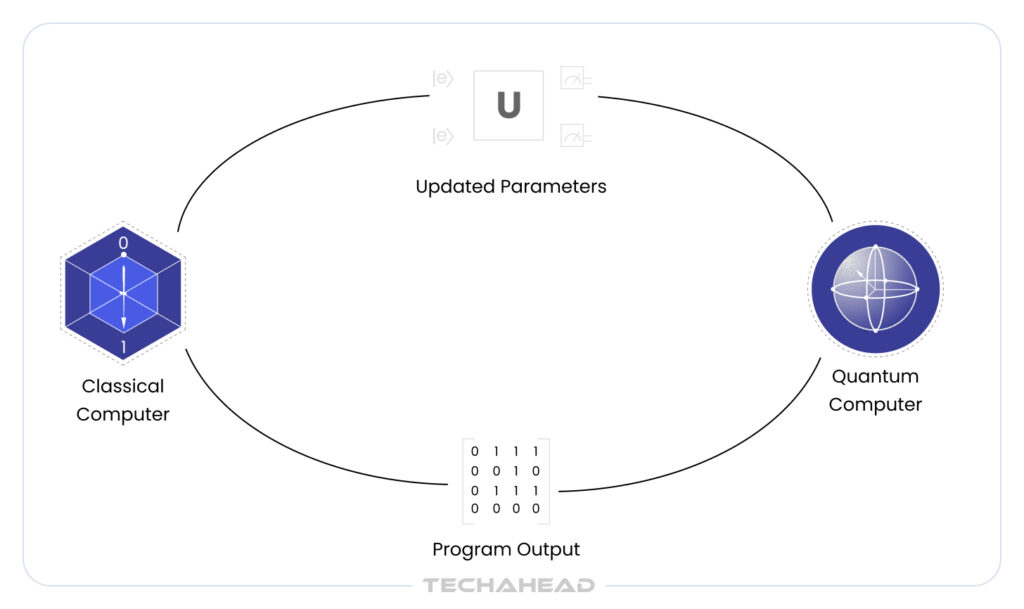
What Is Quantum Computing
IBM believes quantum advantage, where quantum computers perform calculations of practical importance faster and more cost-effectively than classical systems, is arriving by 2026.
Google Quantum AI’s latest Willow chip demonstrates computational power that would take classical supercomputers 10 septillion years to match, completed in just five minutes. These aren’t distant promises; they’re current realities pointing toward quantum computing’s imminent role in advancing AI capabilities.

This convergence of quantum computing and LLMs represents more than incremental improvement. It promises to address fundamental challenges: the unsustainable energy consumption of training massive models, the opacity of how these systems reach conclusions, and the computational bottlenecks limiting further scaling.
For AI researchers, enterprise strategists, and ML engineers, understanding quantum computing’s role in future LLMs has shifted from theoretical curiosity to strategic imperative.
Foundations of Quantum Computing for LLMs
Quantum Basics: A Primer for AI Practitioners
Classical computers process information using bits, binary units that exist as either 0 or 1. Quantum computers leverage qubits (quantum bits), which exploit quantum mechanical phenomena to exist in superposition: simultaneously representing both 0 and 1 until measured. This fundamental difference unlocks exponential computational possibilities.
Key Quantum Principles Relevant to LLMs
Superposition allows a quantum system to explore multiple computational paths simultaneously. Where a classical computer tests solutions sequentially, quantum systems evaluate possibilities in parallel, potentially accelerating the massive hyperparameter searches required for LLM optimization.
Entanglement creates correlations between qubits that classical systems cannot replicate. When qubits become entangled, measuring one instantly affects the others, regardless of distance. This phenomenon could enable quantum LLMs to capture non-local correlations in language data, subtle relationships between distant parts of text that current models struggle to detect.
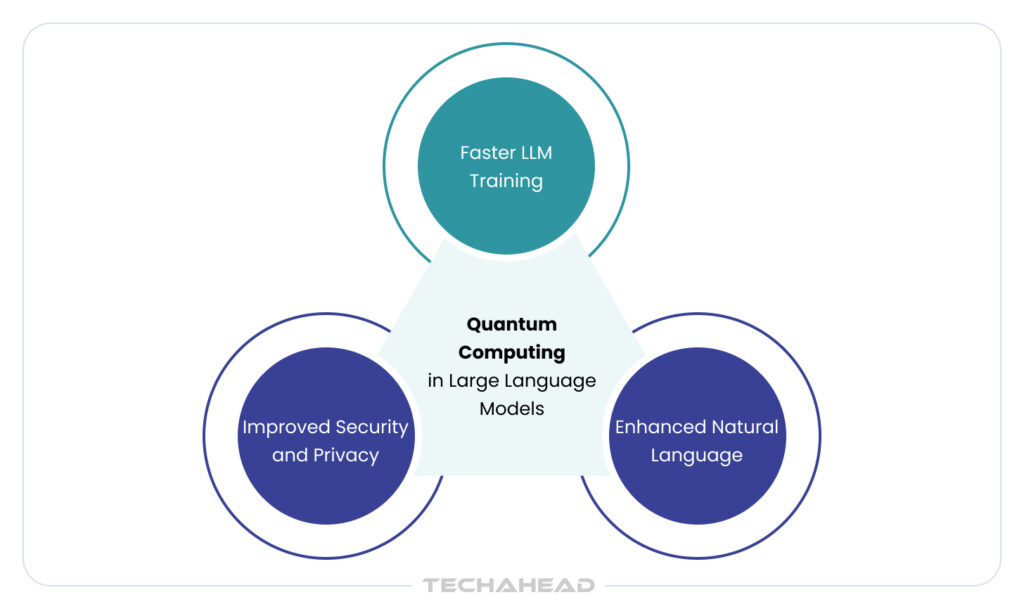
Role Of Quantum Computing In LLMs
Quantum gates manipulate qubit states to perform computations. Unlike classical logic gates (AND, OR, NOT), quantum gates leverage superposition and entanglement to process information in fundamentally different ways. Algorithms like QAOA (Quantum Approximate Optimization Algorithm) and quantum circuit-based approaches can tackle optimization problems central to LLM training.
How Quantum Differs from Classical AI Hardware
Classical LLM training relies on GPUs and TPUs, specialized processors optimized for the matrix multiplications and parallel operations required by neural networks. These systems excel at their designed tasks but face fundamental limitations.
Energy Consumption: Training large models consumes vast resources. Estimates suggest training GPT-3 (175 billion parameters) required approximately 1,287 MWh of electricity, which is enough to power an average American home for 120 years. As models scale toward trillions of parameters, energy demands become economically and environmentally unsustainable.
Sequential Bottlenecks: Despite parallelization, classical systems ultimately process computations sequentially. Each training iteration requires propagating gradients backward through billions of parameters, creating bottlenecks that extend training times to weeks or months.
Memory Constraints: Storing model parameters, activation states, and training data requires enormous memory bandwidth. The largest models already strain available hardware, forcing researchers to implement complex distributed training schemes.
Quantum computing addresses these challenges through different computational paradigms. Quantum systems don’t replace classical hardware but augment it through hybrid architectures that leverage each system’s strengths.
Quantum-Enhanced Architectures for LLMs
Hybrid Quantum-Classical Models
The most promising near-term approach combines classical and quantum computing in hybrid architectures. Rather than replacing entire LLM systems, quantum circuits enhance specific components where they offer advantages.
IonQ’s Quantum LLM Fine-Tuning: In breakthrough research published in 2025, IonQ demonstrated a hybrid quantum-classical architecture for enhancing LLM fine-tuning. The team integrated a parameterized quantum circuit as a classification head into pre-trained language models, testing performance on sentiment analysis tasks using the SST-2 benchmark (Stanford Sentiment Treebank).
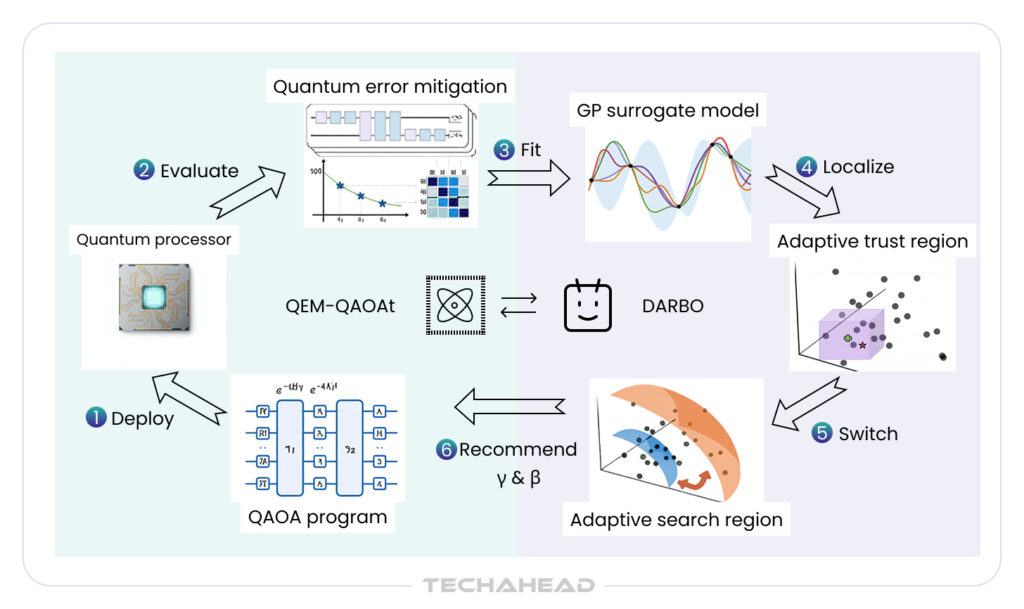
Quantum approximate optimization via learning-based adaptive optimization
Key Results:
- The quantum-enhanced model outperformed classical-only methods with similar parameter counts by a meaningful margin
- Classification accuracy increased with the number of qubits used in the quantum layer
- Projected significant energy savings for inference as problem size scales beyond 46 qubits
- Successfully ran on IonQ’s trapped-ion quantum hardware, not just simulations
Architecture Design: A classical sentence transformer (which understands sentence meanings for chatbots and search engines) processes input text conventionally. The quantum layer, implemented as a parameterized quantum circuit with adjustable parameters acting like neural network weights, enhances the model’s representational power, particularly valuable when training data is limited or subtle relationships are hard to extract.
This approach proves particularly powerful for domain-specific fine-tuning: adapting a general-purpose model for specialized tasks like legal reasoning, medical diagnosis, or code generation where labeled training data is scarce.
Quantum-Based Attention Mechanisms
Attention mechanisms, the core innovation enabling transformer architectures, determine which parts of input text matter most for generating output. Current implementations require computing attention scores across all token pairs, scaling quadratically with sequence length (O(n²)). For documents with thousands of tokens, this becomes computationally prohibitive.
Quantum Natural Language Processing (QNLP): Researchers at Quantinuum developed a quantum NLP framework called DisCoCirc that maps text into quantum circuits rather than traditional vector embeddings. This approach represents how entities in text interact and evolve using two-dimensional circuit structures that quantum computers can process efficiently.

Their research suggests quantum NLP could eventually surpass classical methods like ChatGPT in reasoning tasks involving complex relationships, particularly where interpretability and energy efficiency matter. The quantum representation captures logical structure explicitly, making the model’s reasoning process transparent, addressing a critical limitation of current LLMs’ “black box” nature.
Quantum Compression for Model Efficiency
Multiverse Computing’s CompactifAI: Spanish startup Multiverse Computing, which raised $27 million in 2024, developed quantum-inspired tensor network technology to compress LLMs. In April 2025, they released compressed Llama models with remarkable characteristics:
- 60% fewer parameters than original models
- 84% greater energy efficiency during inference
- 40% faster inference speed
- 50% cost reduction for deployment
- No accuracy loss compared to full-size models
The compression uses quantum-inspired tensor networks, mathematical structures originally developed for quantum physics, to identify and eliminate redundancy in neural network parameters. This enables deploying powerful language models on edge devices or reducing cloud infrastructure costs dramatically.
Multiverse plans to release compressed versions of the top 20 LLMs, with major customers including Moody’s Analytics, Bosch, BASF, and financial institutions seeking more efficient AI deployment.
Quantum Algorithms Accelerating LLM Reasoning
Current LLMs struggle with multi-step logical reasoning, causal understanding, and disambiguation, tasks requiring structured thinking rather than pattern matching. Quantum optimization algorithms offer potential solutions.
Quantum Combinatorial Reasoning
Research into quantum reasoning frameworks addresses chain-of-thought and complex inference challenges. By formulating reasoning tasks as optimization problems, finding the best logical path through many possibilities, quantum algorithms can explore solution spaces more efficiently than classical approaches.
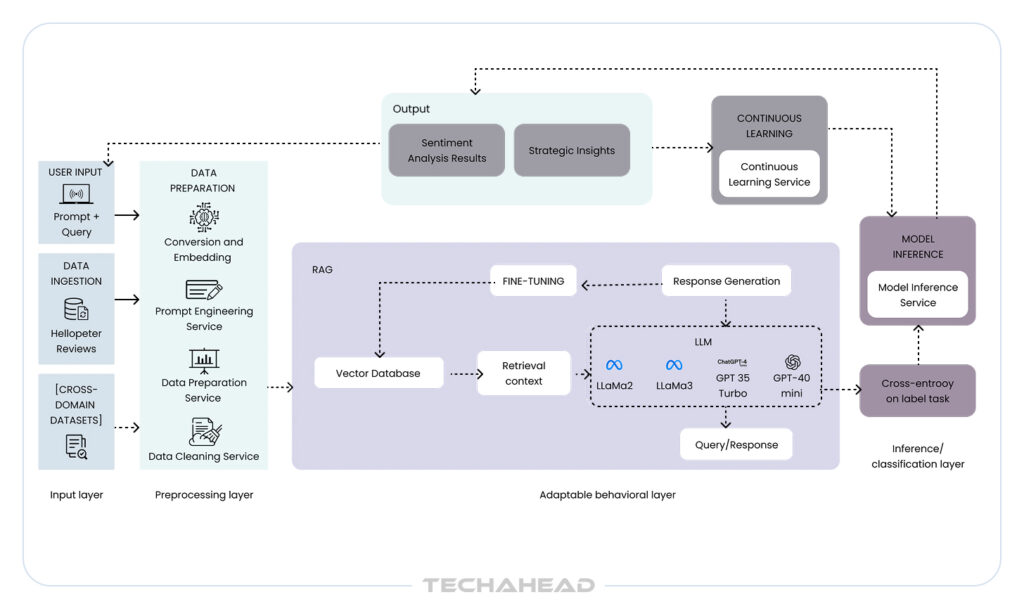
Fine-Tuning Retrieval-Augmented Generation with an Auto-Regressive Language Model
HUBO Formulations: Higher-order Unconstrained Binary Optimization (HUBO) problems map logical reasoning tasks into forms solvable by quantum annealers and gate-based quantum computers. Early research suggests quantum optimization could improve reasoning accuracy in tasks like:
- Causal relationship inference (+4.9% improvement in preliminary studies)
- Ambiguity resolution and disambiguation (+8.7% improvement)
- Multi-hop question answering requiring information synthesis
- Constraint satisfaction for factual consistency
While these improvements seem modest, they address exactly the failure modes where current LLMs struggle most, producing confident but incorrect reasoning, missing logical contradictions, or failing to maintain consistency across long contexts.
Quantum Natural Gradients for Training Efficiency
Training neural networks requires computing gradients, the direction parameters should change to minimize error. Quantum natural gradients leverage quantum information geometry to find more efficient optimization paths, potentially reducing training iterations required for convergence.
Research groups are exploring PEPS (Projected Entangled Pair States) tensor networks for representing larger quantum LLMs with improved scaling properties. These advanced techniques remain largely theoretical but point toward future architectures that could train models orders of magnitude more efficiently than current methods.
Real-World Quantum LLM Applications and Industry Impact
Financial Services: Risk Analysis and Fraud Detection
Quantum-enhanced LLMs offer advantages for financial institutions processing complex, high-dimensional data where subtle correlations matter.
Portfolio Optimization: Multiverse Computing’s toolkit runs on IonQ hardware to perform quantum simulations and analysis including fair price calculations, portfolio creation and optimization, ETF replication, and risk valuation. Early deployments with clients like BBVA and Crédit Agricole demonstrate quantum computing’s ability to analyze market data patterns that classical systems miss.
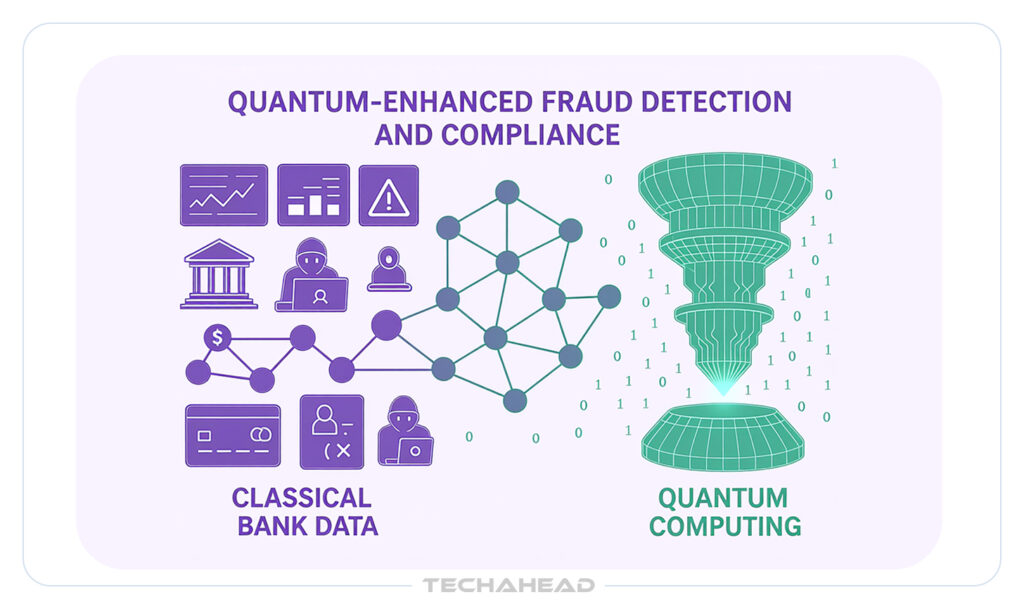
Quantum Ready Financial Processes and Banking
Fraud Detection: Quantum algorithms can identify anomalous patterns in transaction data more effectively than classical approaches, particularly for sophisticated fraud schemes that exploit subtle correlations across multiple accounts and time periods.
Pharmaceutical Research: Molecular Data Interpretation
Drug discovery requires understanding molecular interactions, predicting how potential drug compounds will behave in biological systems. Quantum computers naturally simulate quantum mechanical systems like molecules, making them ideally suited for this domain.
Quantum LLMs for Chemistry: Researchers are developing language models trained on molecular data, enhanced with quantum circuits that better capture quantum mechanical properties. These hybrid systems could accelerate:
- Protein structure prediction and drug target identification
- Compound property prediction for lead optimization
- Adverse reaction prediction through biological pathway analysis
- Personalized medicine insights from genomic data
Duke University demonstrated simulating water molecules on quantum computers with precision far higher than classical approaches, a benchmark suggesting quantum systems’ advantage for chemistry applications.
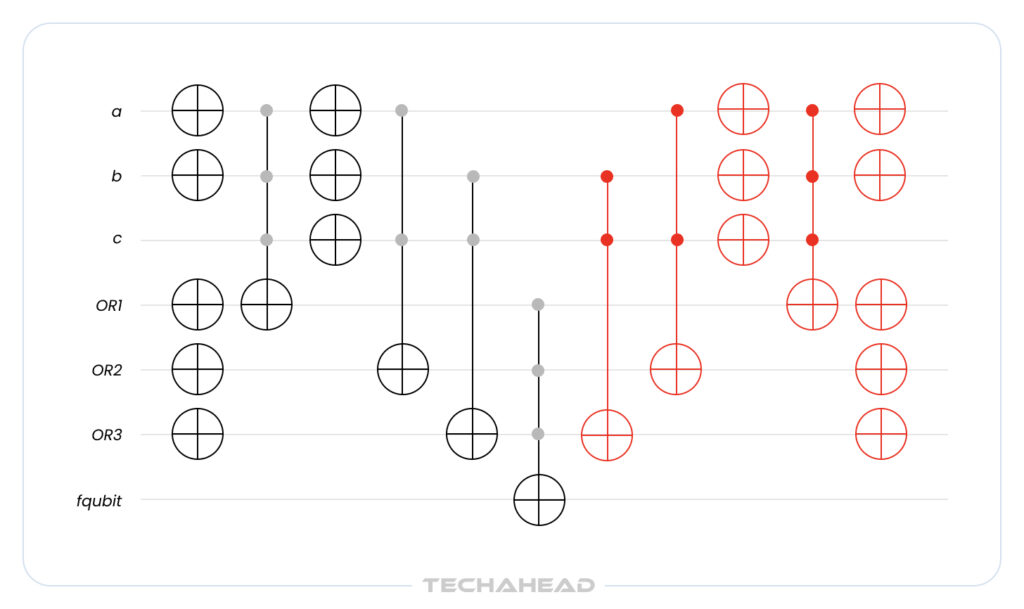
Generalization of Quantum Approximate Optimization Algorithm to Solve Arbitrary Boolean Problems as Hamiltonians
Enterprise NLP: Chatbots and Semantic Processing (H3)
Energy Efficiency: As enterprises deploy conversational AI across customer service, internal support, and knowledge management, energy consumption becomes a critical concern. Quantum-enhanced inference could reduce data center energy requirements substantially.
IonQ CEO Peter Chapman stated their goal is “to offload significant workloads from GPUs and significantly reduce energy requirements for data centers and LLMs”, a vision becoming viable as quantum hardware matures.
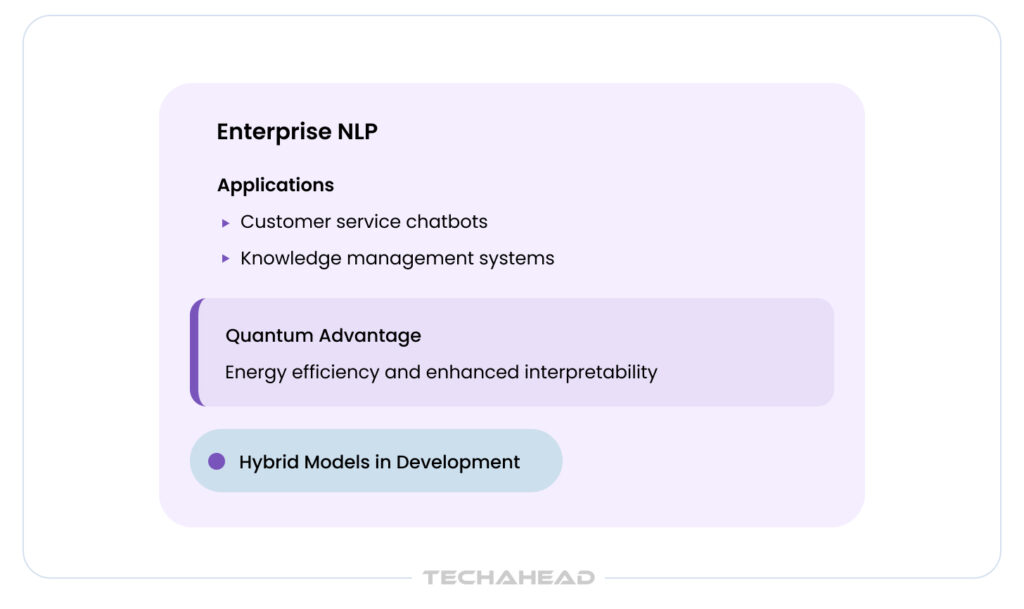
Interpretability: Quantum NLP approaches like Quantinuum’s DisCoCirc offer inherently interpretable reasoning. Unlike classical neural networks where decision-making processes remain opaque, quantum circuit representations make logical steps explicit, crucial for regulated industries requiring AI explainability.
Challenges and Roadmaps for Adoption
Current Hardware Limitations
Despite remarkable progress, quantum computing faces substantial challenges before achieving widespread LLM integration:
Qubit Count and Quality: Google’s latest Willow chip features 105 qubits with best-in-class fidelities: 99.97% for single-qubit gates, 99.88% for entangling gates, and 99.5% for readout. While impressive, practical quantum advantage for complex LLM tasks may require thousands or millions of qubits.
Error Correction: Quantum systems are inherently noisy. Google’s breakthrough demonstration that increasing qubit numbers can reduce errors (breaking the quantum error correction threshold) proves fault-tolerant quantum computing is achievable, but implementing it at scale remains an engineering challenge requiring years of development.
Coherence Time: Qubits maintain quantum states for limited durations before decoherence, when quantum properties collapse due to environmental interference. Ion qubits achieve the longest coherence times of any quantum technology, but running complex algorithms still requires completing computations within tight time windows.
Google’s Five-Stage Roadmap Toward Quantum Advantage
Google Quantum AI outlined a five-stage framework guiding quantum computing’s path from theory to real-world utility:
Stage I: Algorithmic Speedup (Theoretical) – Prove quantum algorithms can theoretically outperform classical ones for specific problems. Status: Achieved for many algorithm families.
Stage II: Problem Instance Identification – Identify concrete problem instances where quantum advantage is expected, even contrived ones. Status: Partially complete; this stage is often overlooked but crucial for bridging theory to practice.
Stage III: Real-World Application Quantum Advantage – Demonstrate quantum advantage in commercially or scientifically meaningful applications. Status: Limited success outside cryptanalysis and quantum simulation; this is the critical bottleneck.
Stage IV: Commercial Viability – Achieve cost-effectiveness and reliability for production deployment. Status: Early pilot deployments underway in finance and chemistry.
Stage V: Widespread Adoption – Quantum computing becomes routine tool for appropriate problems. Status: Projected 2027-2030 for initial applications; broader adoption beyond 2030.
Google’s recent “Quantum Echoes” algorithm running on Willow represents movement toward Stage III, demonstrating verifiable quantum advantage on a practical problem (understanding molecular interactions) with scientific value.
Enterprise Recommendations for Quantum LLM Adoption
For 2025-2026: Monitor developments in hybrid quantum-classical architectures. Begin experimenting with quantum computing platforms (IBM Quantum, IonQ, Google Quantum AI) to build internal expertise. Identify use cases where model efficiency, reasoning quality, or interpretability matter most.
For 2027-2028: Pilot quantum-enhanced LLM fine-tuning for domain-specific applications with limited training data. Evaluate cost-benefit for quantum-compressed models in production deployment. Establish partnerships with quantum computing providers for early access to advancing hardware.
For 2029-2030: Prepare for commercial quantum advantage in select LLM applications. Design AI architectures that accommodate quantum co-processors. Train teams on quantum algorithm development and hybrid system optimization.
Future Outlook and Research Directions
The convergence of quantum computing and large language models is accelerating faster than many predicted. IBM’s confidence in achieving quantum advantage by 2026, IonQ’s demonstrated quantum-enhanced LLM fine-tuning, and Multiverse’s practical model compression represent more than incremental progress, they signal an approaching inflection point.
Emerging Technologies on the Horizon
Quantum-Classical Supercomputing: IQM’s integration with one of the world’s fastest supercomputers in Bologna, Italy, creates hybrid systems where quantum computers, HPC, and AI work together. This “quantum supercomputer” paradigm could accelerate LLM training, inference, and optimization by orders of magnitude.
Fault-Tolerant Quantum LLMs: As quantum error correction matures through 2025-2030, researchers will develop LLM architectures specifically designed for fault-tolerant quantum computers, potentially surpassing classical neural networks in reasoning quality, energy efficiency, and interpretability.
Quantum Memory for Context: Quantum systems could store and process much longer contexts than classical architectures, enabling LLMs to maintain coherent understanding across book-length documents or multi-hour conversations without the quadratic attention scaling penalties.
Potential for Surpassing Human-Level Reasoning: While speculative, quantum computing’s ability to capture complex correlations and explore vast solution spaces simultaneously could enable AI systems to achieve reasoning capabilities qualitatively beyond current LLMs, not just faster pattern matching but genuine logical inference and causal understanding.
The path forward requires collaboration between quantum physicists, AI researchers, software engineers, and domain experts. As quantum hardware improves and hybrid algorithms mature, the distinction between “classical AI” and “quantum AI” may fade: Quantum computing becoming simply another tool in the AI practitioner’s toolkit, deployed where it offers clear advantages.
Conclusion
Quantum computing’s role in future LLMs extends beyond incremental improvements to existing architectures. It represents a fundamental shift in how we approach the computational challenges limiting AI’s continued advancement: the unsustainable energy consumption of training ever-larger models, the opacity of neural network decision-making, and the reasoning limitations that prevent current systems from reliable multi-step logical inference.
The convergence is already underway. IonQ’s quantum-enhanced fine-tuning demonstrates measurable accuracy improvements on real hardware. Multiverse’s quantum-compressed models reduce parameters by 60% without accuracy loss while cutting energy consumption by 84%. Google’s Willow chip performs computations in minutes that would take classical supercomputers 10 septillion years. IBM projects quantum advantage by 2026, less than 1 year away.
For AI researchers, this signals new opportunities to explore hybrid architectures that leverage quantum advantages for optimization, reasoning, and efficient inference. For enterprise strategists, it means evaluating how quantum-enhanced LLMs could reduce infrastructure costs, improve model interpretability for regulated industries, and enable applications previously computationally infeasible. For ML engineers, it requires building expertise in quantum computing platforms and hybrid algorithm development.
The quantum-AI convergence won’t replace classical machine learning overnight. Instead, quantum computing will augment specific LLM components where it offers clear advantages, creating hybrid systems that combine each paradigm’s strengths. As hardware matures through the late 2020s and into the 2030s, these hybrid approaches will evolve toward fully quantum-native language models designed from the ground up for quantum architectures.
The “ChatGPT moment” in 2022 took the world by surprise, demonstrating AI capabilities most experts didn’t expect for years. We may be approaching a similar inflection point with quantum computing, not distant science fiction, but imminent reality reshaping the future of language models and artificial intelligence broadly.
The quantum era of LLMs is beginning. The question isn’t whether quantum computing will transform language models, but how quickly, and which organizations will lead the transformation.
The future of language models is quantum-enhanced. Join the community building it.

How will quantum computing improve large language models?
Quantum computing enhances LLM fine-tuning, reduces energy consumption by 84%, improves reasoning accuracy, and enables efficient processing of complex correlations classical systems miss.
When will quantum-enhanced LLMs become commercially available?
IBM projects quantum advantage by 2026. Hybrid quantum-classical LLM applications are already piloting in finance and chemistry, with broader adoption expected 2027-2030.
What are the main challenges facing quantum computing adoption for AI?
Current challenges include limited qubit counts, error correction complexity, short coherence times, and high hardware costs requiring continued research and engineering breakthroughs.
Can quantum computing reduce AI training costs and energy consumption?
Yes. Multiverse’s quantum compression achieves 84% energy efficiency gains, and quantum optimization algorithms promise significantly reduced training times and computational resource requirements.
Which industries will benefit first from quantum-enhanced language models?
Financial services for risk analysis, pharmaceutical research for drug discovery, and enterprise NLP for interpretable chatbots will see earliest quantum LLM applications.