

Staff Augmentation
Access top-tier talent on demand: Dedicated, Hourly, or Flexible.


 Copy Link
 Share on X
 Share on Facebook
 Share on LinkedIn
The architectural decision between single and multi-agent AI systems will define your product’s scalability, costs, and competitive edge. Consider two real-world scenarios: Intercom uses a unified agent for customer support queries, routing questions through one intelligent system (single, unified Fin AI Agent) that maintains context and delivers consistent responses across helpdesk automation.
However, Salesforce orchestrates multiple specialized agents in its Agentforce platform; one handling sales lead qualification, another customer service routing, another data analysis; each excelling at its specific domain while collaborating seamlessly through a central supervisor. Both approaches work brilliantly, but for fundamentally different problems.
The difference? Understanding when complexity adds value versus when it creates unnecessary overhead. As AI agents move from experimentation to production, you need to choose single-agent simplicity for a problem requiring specialized coordination that leads to a monolithic nightmare.
Conversely, deploying multi-agent complexity for simple tasks burns budget. Read on to discover the framework that prevents costly architectural mistakes and helps you match your agent design to your actual problem before investing development resources.
Key Takeaways
- Single agents excel in low-latency, sequential workflows like customer support automation.
- Multi agents scale horizontally by adding specialists, ideal for high-volume enterprise tasks.
- Single agents offer simpler debugging but risk total workflow outages.
- Multi-agent systems enable model flexibility across providers
- Start with single agents to validate ROI before evolving to multi.
What are Single Agent Systems?
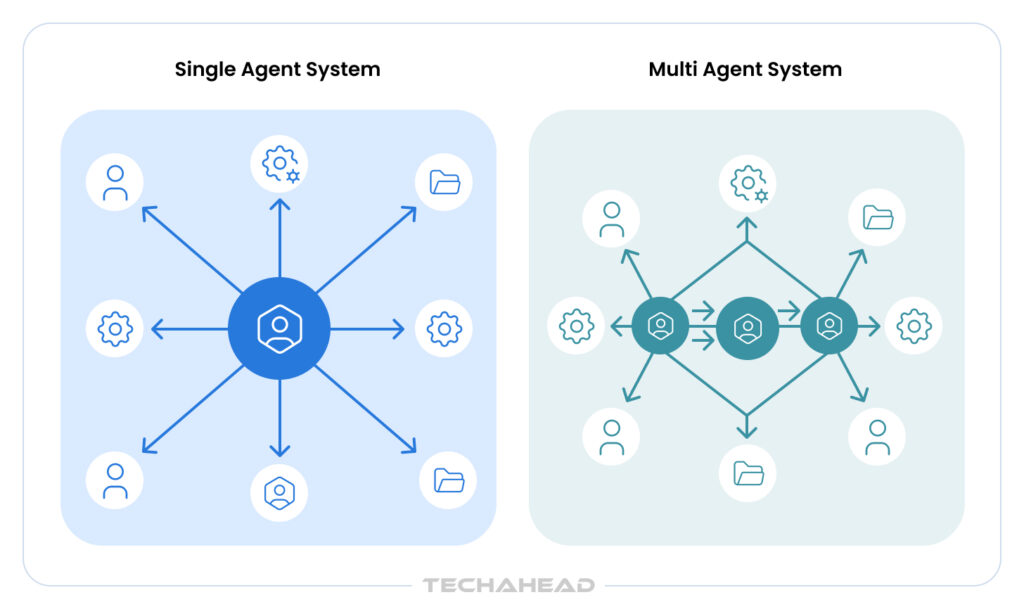
At its core, a single agent system is an autonomous AI entity that handles tasks from start to finish within a defined scope. Think of it as hiring one highly capable specialist who owns the entire workflow. Unlike traditional rule-based automation, single agent systems use large language models (LLMs) to reason, make decisions, execute actions independently. They maintain context throughout a conversation or task.
Key Features That Matter to Your Business
Unified Context Management
Your single agent maintains an understanding of the entire task. When a customer asks a complex question, the agent does not hand off context between different systems; it retains everything from the initial query through to resolution.
Simplified Orchestration
Here you are dealing with one decision-making entity, not coordinating multiple agents. It means fewer integration points, clearer logic flows, and dramatically reduced architectural complexity.
Deterministic Behavior Patterns
Single agents follow more predictable execution paths, making them easier to test, and validate against your compliance requirements.
The Advantages: Why CTOs Choose Single Agents?
- Teams can deploy single agent systems faster than multi-agent architectures. Why? Because you are building one agent instead of orchestrating several specialized ones.
- Your total cost of ownership starts lower. You need fewer API calls, simpler infrastructure, and less sophisticated monitoring. That is why many enterprises start with initial AI implementation with a single agent approach.
- When something breaks at 2 AM, do you want to trace issues across five different agents or debug one system? Single agents offer clear audit trails and simpler error isolation.
- Without inter-agent communication overhead, single agents respond 30-50% faster when you are serving enterprise customers who expect instant responses.
Challenges You Need to Consider
Single agents offer simplicity, but these limitations can quietly undermine performance and scalability as your operations expand.
Scalability Ceilings
As task complexity grows, single agents create issues. If you are processing highly specialized workflows across different domains, one agent might struggle with the cognitive load.
Specialization Limitations
Your single agent is a generalist. While capable, it may not match the depth of expertise that specialized agents bring to specific domains like legal analysis, financial modeling, or technical troubleshooting.
Context Window Constraints
Single agents hit token limits faster when handling extensive documentation or long-running conversations; you may need more expensive models or architectural workarounds.
Monolithic Risk
If your single agent fails, your entire workflow stops. There is no graceful degradation; you are either fully operational or completely down.
What are Multi-Agent Systems?
Multi-agent systems represent a paradigm shift in how enterprises architect intelligent automation. A multi-agent system consists of multiple autonomous AI agents working collaboratively toward shared objectives. Think of it like your organization itself. Here instead of one person handling everything, you have specialists in sales, engineering, finance, and operations. It means each brings domain expertise for common goals.
In technical terms, each agent maintains its own reasoning loop, memory, and toolset. A customer service multi-agent system might include a triage agent, a knowledge retrieval agent, a sentiment analysis agent; all orchestrated through a central coordination layer.
Key Features That Define Multi-Agent Systems
- Each agent focuses on specific tasks or domains. Your data analysis agent is not distracted by customer communication tasks.
- Agents exchange information through defined protocols; message queues, APIs, or shared memory.
- A supervisor agent or coordination framework manages task delegation, monitors progress, and handles failures.
- When agents collaborate, they can tackle complex problems no single agent could handle alone.
- According to recent benchmarks, multi-agent systems achieve up to 23% higher accuracy on reasoning tasks compared to single-agent approaches.
The Advantages: Why CTOs Choose Multi-Agent Systems
Scalability That Matches Growth
Can your current system handle 10x the workload? Multi-agent architectures scale horizontally; add more specialized agents as demands increase. With a multi-agent system, you can reduce the processing time by 64% after transitioning.
Enhanced Reliability Through Redundancy
With a multi agent system, when one agent fails, others continue operating. Your business processes do not grind to a halt because of a single point of failure.
Maintainability and Iteration Speed
Need to improve your invoice processing logic? Update the invoice agent without touching your contract analysis agent. This modularity reduces deployment risk and accelerates innovation cycles.
Superior Performance on Complex Tasks
Research from Stanford and MIT shows multi-agent systems outperform single agents that need multiple reasoning steps, such as financial analysis, legal document review or supply chain optimization.
The Challenges: What You Need to Consider?
Increased Architectural Complexity
Multi-agent systems need advanced orchestration, monitoring, debugging infrastructure. Your team needs expertise in distributed systems, not just AI.
Higher Initial Development Costs
Expect 2-3x longer implementation timelines compared to single-agent solutions. You are building an ecosystem, not deploying a model.
Coordination Overhead
Agents communicating add latency. Inter-agent messages, context sharing, and consensus mechanisms consume resources.
Observability Gaps
When something breaks, can you trace it? Debugging distributed agent interactions needs advanced logging and monitoring tools your team might not have.
The question is not whether multi-agent systems are powerful—they are. The question is whether your organization’s complexity and technical maturity justify the investment.
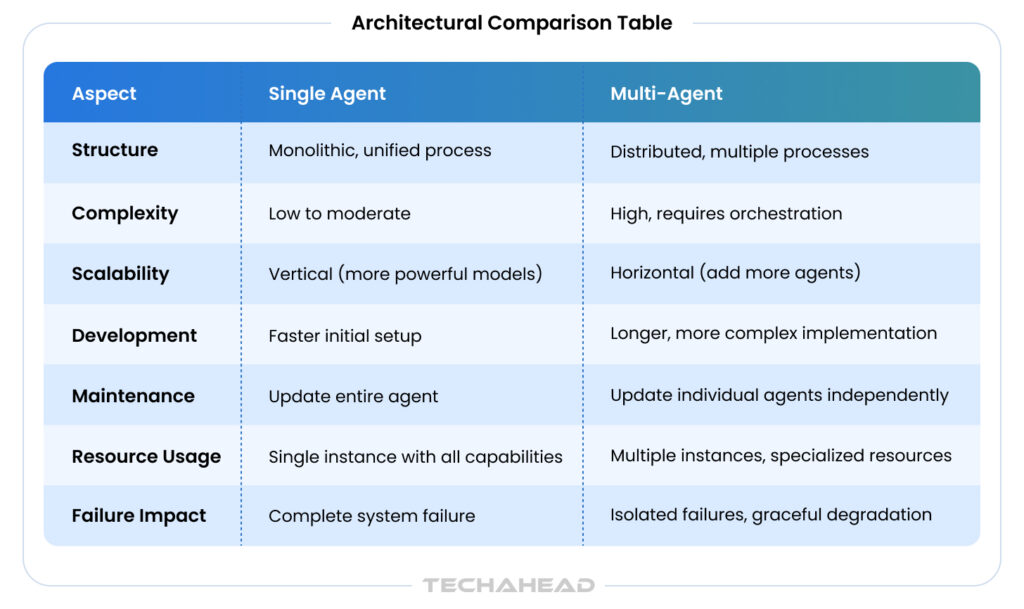
Single Agent System vs Multi Agent System: Key Differences in Architecture
Are you assembling a specialized toolkit? This question captures the core architectural difference between single and multi-agent systems.
Monolithic Approach of Single Agent Architecture
Single agent systems operate as unified, self-contained units. One AI agent manages all tasks within a single execution context, maintaining:
- Unified reasoning engine that processes all requests sequentially
- Single context window holding conversation history and relevant data
- Integrated tool access where all capabilities exist within one agent’s scope
- Linear execution flow from input to output without external dependencies
Think of it as one highly capable executive assistant handling your entire workflow. The architecture is simple, you send a request, the agent reasons through it using available tools, and returns a result.
The Distributed Approach of Multi-Agent Architecture
Multi-agent systems distribute intelligence across specialized components working collaboratively:
- Multiple autonomous agents, each with dedicated responsibilities and expertise
- Orchestration layer coordinating task allocation and workflow management
- Message-passing infrastructure for agent-to-agent communication
- Shared or distributed memory that allows agents to access common knowledge
- Parallel processing capabilities where multiple agents work simultaneously
Your architecture now resembles a department with specialists and all coordinated by a supervisor agent.
Single Agent System vs Multi Agent System: Key Differences in Communication
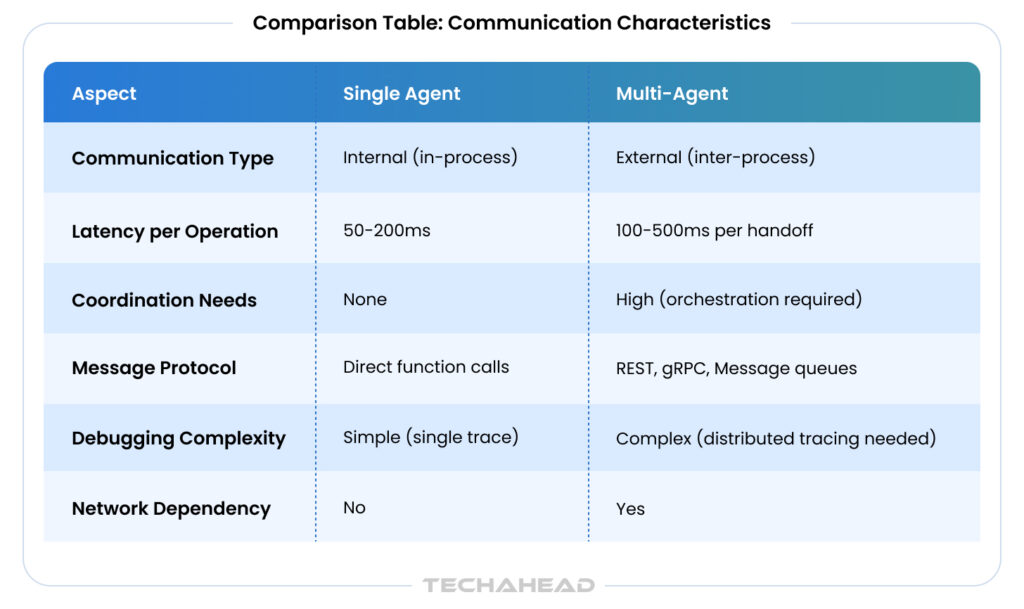
Have you considered how your AI agents actually talk to each other? Communication architecture determines your system’s latency and operational overhead.
Single Agent Communication: Internal Processing
Single agent systems operate through internal communication. Everything happens within one execution context, one memory space, one reasoning loop.
Key Characteristics:
- In-memory processing: No network calls, no serialization, no message queues
- Sequential reasoning: The agent follows chain-of-thought processes internally
- Tool invocation: Functions and APIs are called directly within the agent’s context
- Synchronous execution: Tasks complete before moving to the next step
- Latency: Usually 50-200ms for complete task execution
When your single agent needs to retrieve customer data, analyze sentiment, and draft a response, it executes these steps internally with minimal overhead. And truly, there is no coordination protocol because there is nothing to coordinate.
Multi-Agent Communication: Distributed Messaging
Multi-agent systems need explicit inter-agent communication protocols. Each agent is an independent process that must coordinate with others.
Communication Methods:
- Message passing: Agents exchange structured messages via queues (RabbitMQ, Kafka)
- API calls: RESTful or gRPC endpoints enable agent-to-agent requests
- Shared memory: Distributed caches or databases for state synchronization
- Event-driven: Agents react to events published by other agents
- Latency: 100-500ms per agent handoff, depending on infrastructure
Multi Agent System vs Single Agent System: Key Differences in Fault Tolerance
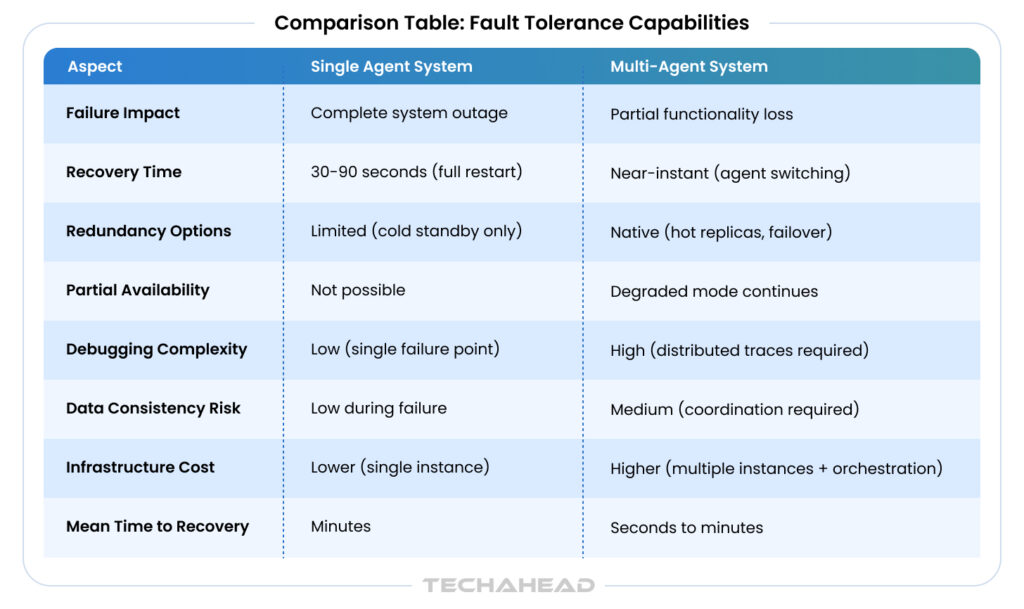
Your fault tolerance strategy determines whether you experience a complete outage or graceful degradation. Let’s examine how single and multi-agent systems handle failures differently.
Single Agent System: Single Point of Failure
The All-or-Nothing Approach
In single agent architectures, your entire system depends on one execution process. When that agent encounters an error (memory overflow, API timeout, or unexpected input) everything stops.
Failure Characteristics:
- Complete system unavailability during agent downtime
- No partial functionality available to users
- Recovery requires full system restart
- All in-progress tasks are lost unless checkpointed
Recovery Mechanisms
Your options are simple but limited:
- Automatic restarts: Container orchestration (Kubernetes) restarts failed agents within 30-60 seconds
- Checkpointing: Save state periodically to resume interrupted tasks
- Request queuing: Buffer incoming requests during downtime, process when agent recovers
The advantage? Simpler debugging. When something breaks, there is only one place to look.
Multi-Agent System: Distributed Resilience
Built-in Redundancy
Multi-agent architectures distribute risk across multiple processes. When your invoice processing agent fails, your contract analysis agent continues operating. It means:
- Isolated failures contained to specific agents
- Partial system functionality maintained during outages
- Redundant agents can handle critical workflows
- Graceful degradation instead of complete failure
Fault Tolerance Strategies
Multi-agent systems employ advanced recovery patterns:
- Agent replication: Deploy 2-3 instances of critical agents with load balancing
- Circuit breakers: Automatically route around failing agents
- Fallback chains: Secondary agents take over when primary agents fail
- Health monitoring: Proactive detection and replacement of degraded agents
However, the truth is that this resilience comes at a cost. You are managing distributed system complexity, network partitions, split-brain scenarios, and coordination failures that single agent systems never encounter.
Which Approach Matches Your Risk Tolerance?
Ask yourself: can your business tolerate complete system unavailability? If you are processing financial transactions or managing critical operations, multi-agent fault tolerance might justify the added complexity. For internal tools or non-critical workflows, single agent simplicity often wins.
Single Agent or Multi-Agent: Which Architecture Fits Your Enterprise Requirements?
Discover which agent system aligns with your operational scale, technical constraints, and strategic goals to avoid expensive architectural mistakes later.
Step 1: Assess Workload Complexity
Understanding Task Modularity and Parallelism
Can your workflow be broken into independent, specialized tasks? This is the foundational question that determines whether multi-agent architecture makes sense for your use case.
Measuring Task Modularity
Start by mapping your current workflow. Does your process involve distinct stages with clear handoffs? For example, a claims processing system might include document intake, verification, fraud detection, approval logic, notification; each a candidate for agent specialization.
Key Metrics to Evaluate:
- Task Independence Score: Can tasks execute without constant cross-communication? If Task A requires real-time data from Task B every 30 seconds, you are looking at tight coupling that favors single-agent architecture.
- Decision Boundary Clarity: Are decision points well-defined? Multi-agent systems thrive when you can clearly specify “Agent A handles X, Agent B handles Y.”
- Context Sharing Requirements: How much information must be shared between tasks? High context dependency suggests single-agent efficiency.
Parallelism Potential Analysis
Does your workload benefit from concurrent processing? If you are processing 10,000 invoices daily, can they be handled simultaneously by different agents?
Parallelism Indicators:
- Batch processing opportunities where tasks do not depend on each other
- Multiple data streams requiring simultaneous analysis
- User requests that can be served independently
Multi-agent systems excel on workloads with high parallelism potential, such as batch processing or independent data streams, often delivering significant throughput gains over single-agent sequential processing.

Step 2: Evaluate Scalability Needs
Vertical vs. Horizontal Scaling in Enterprise Environments
How will your system handle growth? Your scaling strategy should align with business projections, not just current demand.
Understanding Your Scaling Options
Vertical Scaling (Single Agent Approach): Single agents scale by adding more computational resources: faster CPUs, additional RAM, larger context windows. It works until you hit hardware limits or cost curves become prohibitive.
You can scale a single agent processing 1,000 documents daily to 5,000 by upgrading to a more powerful model or instance. But what happens to 50,000 documents? You have hit the ceiling.
Horizontal Scaling (Multi-Agent Strength)
Multi-agent systems scale by adding more agent instances. Need to handle 10x volume? Deploy 10x agents across your enterprise AI infrastructure to support high-performance, distributed AI operations.
Critical Scalability Metrics
Growth Velocity: Are you expecting 2x growth annually or 10x growth quarterly? Rapid scaling demands horizontal architecture.
Load Variability: Do you experience 5x traffic spikes during month-end, quarter-end, or seasonal peaks? Multi-agent systems allow elastic scaling; means spin up additional agents during peak periods.
Geographic Distribution: Serving global customers? Multi-agent architectures deploy regional agents closer to users, which reduces latency. Single agents create issues when serving requests from Singapore, London, and New York simultaneously.
When Single Agent Scaling Works? If your current volume is under 10,000 operations daily with predictable growth annually, vertical scaling often provides better ROI with lower operational complexity.
Step 3: Analyze Cost and ROI
What is the total cost of ownership over three years? Many CTOs underestimate the complete financial picture.
Initial Development Investment
Single Agent Systems
- Development time: 4-8 weeks for enterprise use cases
- Team size: 2-3 engineers (AI/ML expertise required)
- Infrastructure setup: Minimal, standard API deployment
- Initial cost range: $20K-$80K
Multi-Agent Systems
- Development time: 6-12 weeks (orchestration complexity adds overhead)
- Team size: 4-6 engineers (distributed systems expertise critical)
- Infrastructure setup: Message queues, service mesh, monitoring stack
- Initial cost range: $80K-$250K
Ongoing Operational Costs
This is where assumptions often break down. Are you calculating the full operational burden?
Compute Costs
Multi-agent systems consume more compute resources due to coordination overhead, redundant agents, inter-agent communication. However, they allow cost optimization through selective scaling; upgrade only your bottleneck agents rather than the entire system.
Maintenance and Evolution
Single agents need complete redeployment for updates. One agent handles everything, so changes cascade across all functionality. Multi-agent systems allow incremental updates; modify your fraud detection agent without touching payment processing. Enterprise clients report faster feature iteration with multi-agent architectures after the initial 12-month learning curve.
ROI Calculation Framework
Multi-agent systems achieve ROI break-even 8-14 months later than single-agent systems, but it depends on automation value. The long-term value curve favors multi-agent for complex use cases. Calculate your break-even based on automation value, error reduction, throughput improvements.
Step 4: Risk and Reliability Check
What is your acceptable downtime? Your risk tolerance should drive architectural decisions.
Single Agent Risk Profile
Single agents create binary outcomes: complete availability or total outage. When your agent fails, every dependent process stops. No customer inquiries processed, no documents analyzed, no decisions made.
Is this acceptable for your use case? For internal analytics tools, probably yes. For customer-facing transaction systems, probably not.
Multi-Agent Reliability Advantages
Distributed Risk Mitigation: When Agent A fails, Agents B, C, and D continue operating. Your system degrades gracefully rather than collapsing entirely. Customer-facing features might slow down, but they do not disappear.
Real-World Reliability Metrics: Enterprise multi-agent deployments achieve 99.9-99.95% availability through redundancy and failover mechanisms.
The Coordination Trade-off
However, multi-agent systems introduce new failure modes you have never encountered with single agents:
Coordination Failures:
- Split-brain scenarios: Two agents believe they are authoritative for the same task
- Message loss: Communication failures between agents create inconsistent states
- Deadlocks: Agents waiting for each other indefinitely
- Cascading failures: One agent’s slowdown impacts all downstream agents
Step 5: Integration & Ecosystem Fit
Legacy Systems, APIs, and Vendor Lock-in
How does your agent architecture integrate with existing enterprise infrastructure? This practical reality often determines success or failure.
Legacy System Compatibility
Single Agent Integration: Single agents connect through standard APIs and webhooks, simple integration with your ERP, CRM, or custom applications. Your agent acts as a unified interface, simplifying authentication, rate limiting, and error handling.
If you are integrating with 3-5 legacy systems, single-agent architecture reduces integration complexity. One authentication flow, one error handling pattern, one deployment to manage.
Multi-Agent Integration Patterns
Distributed Integration Challenges: Multi-agent systems need each agent to potentially connect with multiple backend systems. Your invoice agent needs ERP access, your compliance agent needs document storage access, your notification agent needs email service access. It creates integration sprawl—dozens of connection points, multiple authentication mechanisms, and complex dependency chains.
When Multi-Agent Integration Wins: If you are building a modern, API-first architecture with microservices, multi-agent systems align perfectly. Each agent integrates with specific microservices, creating clean separation of concerns. Enterprises with service mesh infrastructure find multi-agent integration actually simpler than monolithic single-agent approaches.
Vendor Lock-in Considerations
Model Portability: Are you committed to OpenAI, Anthropic, or building model-agnostic systems? Single agents lock you into one model provider, but switching requires complete system redesign. Multi-agent systems allow hybrid approaches: use GPT-4 for complex reasoning agents, Claude for analysis agents, and open-source models for simple classification agents.
Exit Strategy: Multi-agent architectures provide flexibility. Unhappy with one agent’s performance? Replace it without touching the others. This modularity reduces vendor leverage and allows competitive bidding for different system components.
Conclusion
The single agent versus multi-agent decision is not about choosing the “better” technology, it is about aligning architecture with your business reality. Your current scale, team capabilities, risk tolerance, and growth trajectory should drive this choice.
You are not locked into your initial choice forever. Many successful enterprises start with focused single-agent implementations, validate ROI, then strategically evolve toward multi-agent architectures as complexity demands.
Ready to build AI agent systems that align with your business goals? TechAhead’s enterprise AI team helps you navigate these architectural decisions. From proof-of-concept to production-scale deployments, we deliver agent solutions that drive measurable ROI. Schedule a consultation with our AI architects today and get a customized assessment for your specific use case.

How do multi-agent systems impact cloud costs?
Multi-agent systems increase cloud costs by 30-50%. Mainly due to coordination overhead, message queuing, redundant instances. However, selective scaling of agents can optimize long-term spending compared to upgrading entire single-agent systems.
Which architecture works better for regulated industries?
Both work, but considerations differ. Single agents simplify audit trails and compliance documentation. Multi-agent systems provide better fault isolation and audit granularity per function. Financial services often prefer multi-agent for separation of duties, but healthcare varies by use case complexity.
What is the ROI timeline for multi-agent systems?
Multi-agent systems achieve ROI break-even 8-14 months later than single-agent solutions due to higher initial investment. Long-term ROI favors multi-agent for complex workflows and scaling beyond initial scope.
When should startups choose single over multi-agent?
Startups with under 10,000 daily operations, limited engineering resources and tight budgets should default to single-agent. Prove value first, scale complexity later when growth and resources justify the investment.