

Staff Augmentation
Access top-tier talent on demand: Dedicated, Hourly, or Flexible.


 Copy Link
 Share on X
 Share on Facebook
 Share on LinkedIn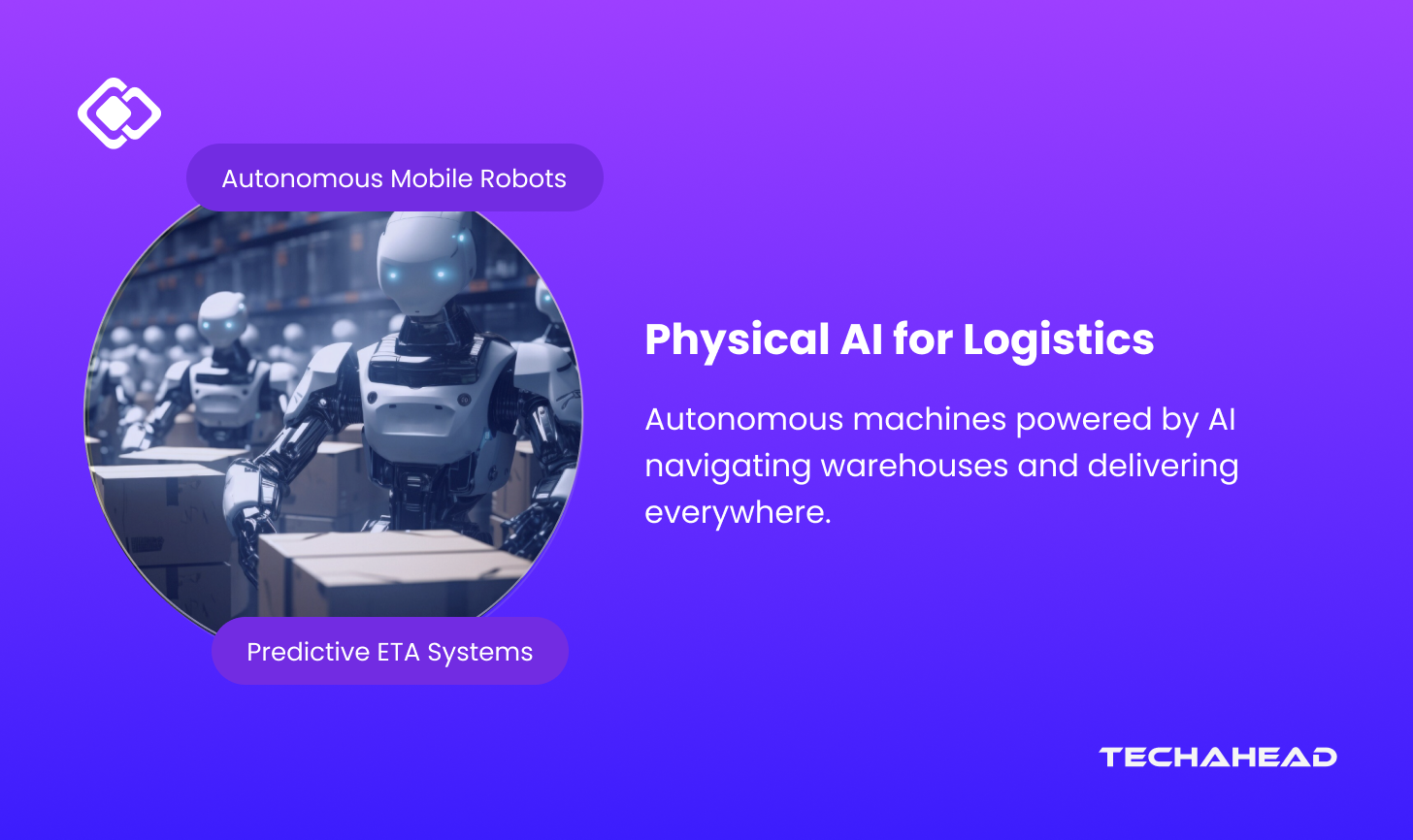
Your logistics operation has three problems: it costs too much, it fails too often, and it cannot scale fast enough to keep up with what your customers now expect as standard.
Here is the uncomfortable truth: traditional automation is not fixing any of them. It was designed for predictability. Your operation is not predictable anymore. 85% of consumers now expect next-day delivery, last-mile eats over half your shipping budget, and labour represents 50–70% of your total warehouse operating costs; costs that keep climbing every quarter.
Physical AI works differently. It does not follow a script; it reads its environment, makes real-time decisions, and improves continuously. Autonomous robots, computer vision, edge computing, and AI-powered route optimisation are already running at scale in the world’s most competitive logistics operations. This blog is a practical, data-backed guide to deploy Physical AI across your warehouse and last-mile operations. Let’s dive in:
Key Takeaways
- Physical AI bridges digital intelligence and real-world logistics execution.
- AMRs deploy in hours, AGVs take months to install.
- Computer vision cuts picking errors and quality control costs significantly.
- Human-cobot teams are 85% more productive than either alone.
- Machine learning ETAs achieve better delivery time prediction accuracy.
What is Physical AI and Why Does Logistics Need It Now?
Physical AI refers to artificial intelligence embedded into machines that operate in the real world; robots, autonomous vehicles, drones, smart warehouse systems that perceive their environment, make decisions, take physical action without human intervention.
Unlike traditional software AI that analyzes data from a screen, Physical AI moves, lifts, navigates, and delivers. It is the bridge between digital intelligence and real-world execution.
U.S. business logistics costs totaled $2.6 trillion in 2024, amounting to 8.7% of national GDP, with rising operational costs and growing consumer expectations squeezing margins.
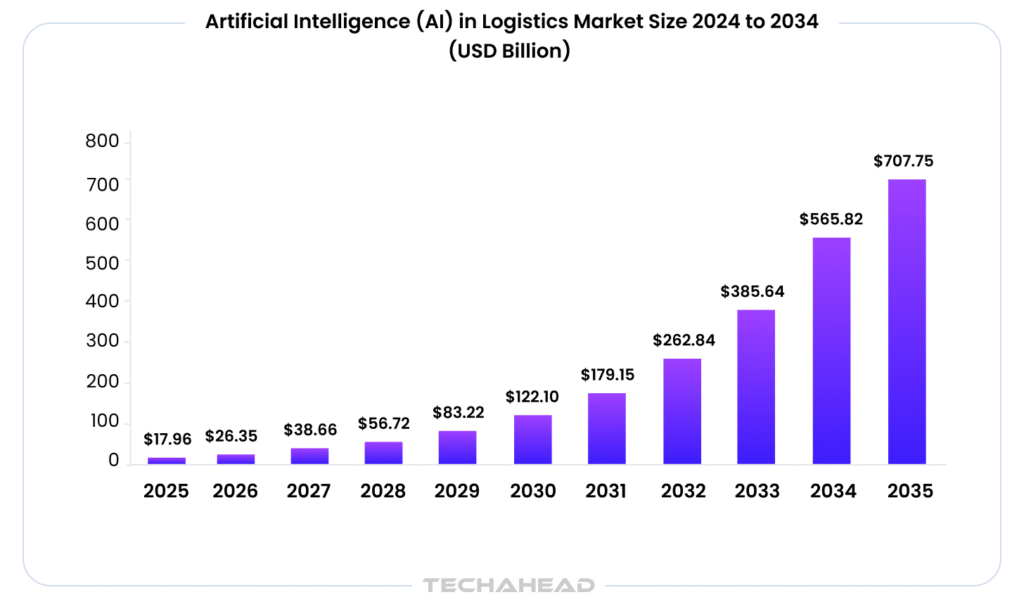
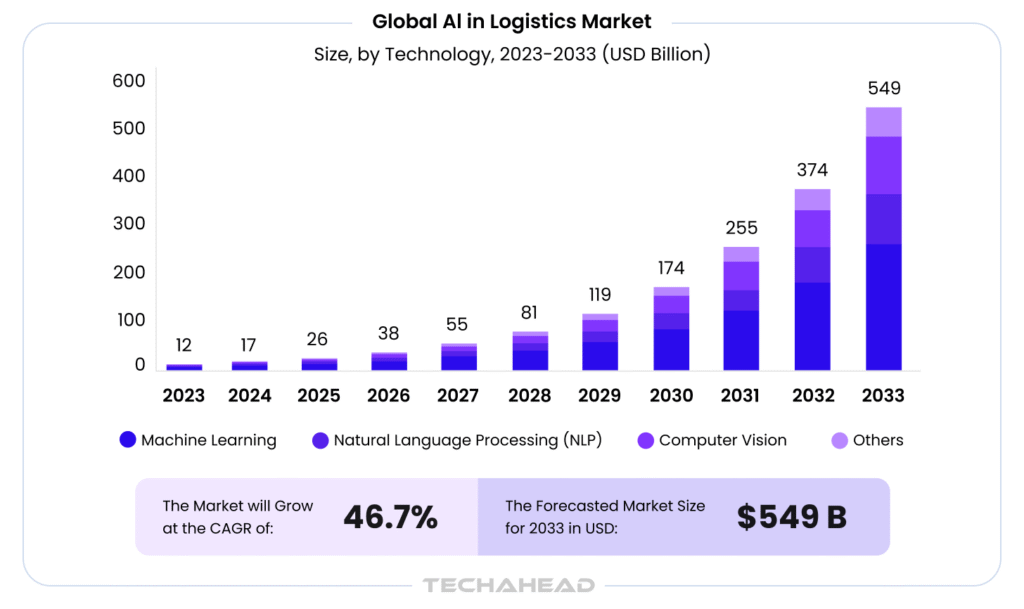
The global AI in logistics market was valued at $17.96 billion in 2024 and is projected to reach $707.75 billion by 2034, growing at a CAGR of 44.40%.
It is a clear signal that the industry is betting big on intelligent automation. However, why logistics needs Physical AI right now:
- Labour is your most expensive and least reliable variable. Autonomous systems eliminate dependency on a workforce that is harder and costlier to maintain every year.
- Speed is now a baseline, not a differentiator. Same-day and next-day delivery is what customers expect as standard. Falling short does not just cost you a sale. It costs you customer loyalty.
- The cost reduction case? AI-driven automation removes 10–25% from your logistics cost base. On 3–5% margins, that is not incremental improvement; it changes the shape of your business.
- Autonomous warehouse systems optimize space by 30% and reduce fulfilment times by 25%. Hidden inefficiencies are not just operational problems, they are financial ones.
How Physical AI is Transforming Warehouse Operations?
Your warehouse is either working for you or costing you. Right now, for most operations still running on manual processes — it is costing you.
Walk into a Physical AI-powered warehouse today. There are no workers pushing carts down long aisles. Robots are moving inventory. Vision systems are catching defects before they ship. Autonomous systems are tracking every single item in real time.
This is not a pilot programme. This is the new operational standard.

Your warehouse was built to store things. The modern warehouse is built to think! Over 60% of global warehouses are expected to run some form of robotics by 2026. They are structurally cheaper to operate than competitors still running manual processes. Legacy operations cannot close that gap by hiring more people. The only way to close it is to build smarter physical AI.
Autonomous Mobile Robots (AMRs) vs. Traditional Warehouse Automation
Choosing the right warehouse automation technology is one of the most consequential decisions a logistics operator can make. The table below breaks down how AMRs stack up against traditional systems like AGVs and manual operations across every dimension:
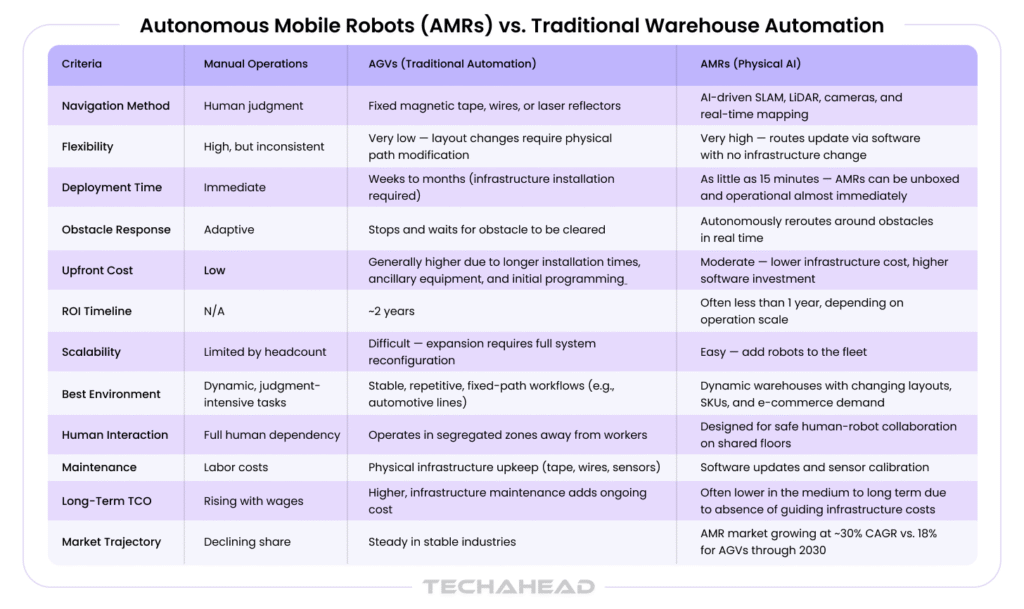
AGVs function best in stable, predictable conditions but lack the ability to adjust to immediate modifications. AMRs dynamically avoid obstacles and adapt their path in real time; which makes them the clear choice for modern e-commerce-driven warehouse environments.
Physical AI in Last-Mile Delivery
Think last-mile delivery is just a shipping problem? Think again. It is the most expensive part of your entire supply chain — and the hardest to get right.
Nearly 53% of B2C shipping costs come from last-mile and speedy deliveries alone. (P&S Intelligence) One failed drop costs retailers around $17. Multiply that across thousands of daily deliveries and the losses stack up fast.
Customer expectations are not helping either. Data shows 85-86% expect next-day (24-48 hours), but same-day is lower at ~30-50%. That kind of pressure breaks traditional delivery models.
So the industry is rebuilding.
The autonomous last-mile market was worth $1.6 billion in 2024 and is on track for $5.9 billion by 2030, growing at 24.8% annually. (Precedence Research)
Four technologies are leading that charge: ground delivery robots, drones, AI route optimisation, and predictive ETA systems.
Learn more, Physical AI in Manufacturing: Safely Connecting AI to Real-World Systems
Autonomous Delivery Robots for Urban & Suburban Routes
Ground-based autonomous delivery robots are rapidly moving from pilot programmes to real-world deployment. These AI-powered machines navigate sidewalks, cross streets, and avoid pedestrians using a combination of computer vision, LiDAR, ultrasonic sensors, neural networks, which make them particularly effective for dense urban and suburban environments.
The market numbers reflect momentum: the autonomous last-mile delivery market is expected to grow from $31.88 billion in 2026 to $213 billion by 2034 at a CAGR of 26.5%, with ground delivery bots predicted to hold the dominant market share throughout that period.
Here are the real-world deployments underline this growth:
- Starship Technologies has made over 9 million deliveries worldwide, with its robots equipped with 12 cameras, ultrasonic sensors, neural networks. They create a “bubble of awareness” to navigate safely around pedestrians.
- Serve Robotics, an Uber spinout, was on track to deploy 2,000 robots across multiple U.S. cities, partnering with Uber Eats for food delivery.
- Avride launched sidewalk delivery bots on Uber Eats in Jersey City in early 2025, which marks another step toward mainstream autonomous delivery.
Indeed, short-range deliveries under 20 kilometres dominate the autonomous market.And the business case is clear: autonomous robots do not require wages, overtime pay, or benefits.
Drone Delivery
Drone delivery is an active, regulated commercial reality in multiple markets. Besides that, the regulatory environment is rapidly evolving to match the capabilities.
Current Capabilities
Modern delivery drones are for lightweight, time-sensitive parcels. Drones are best suited for packages under 5 pounds with delivery ranges of 10–30 kilometres. A specification that fits the vast majority of e-commerce orders. Amazon’s MK30 drone, for example, has an operating range of 7.5 miles and is cleared to conduct up to 469 delivery flights per day per hub.
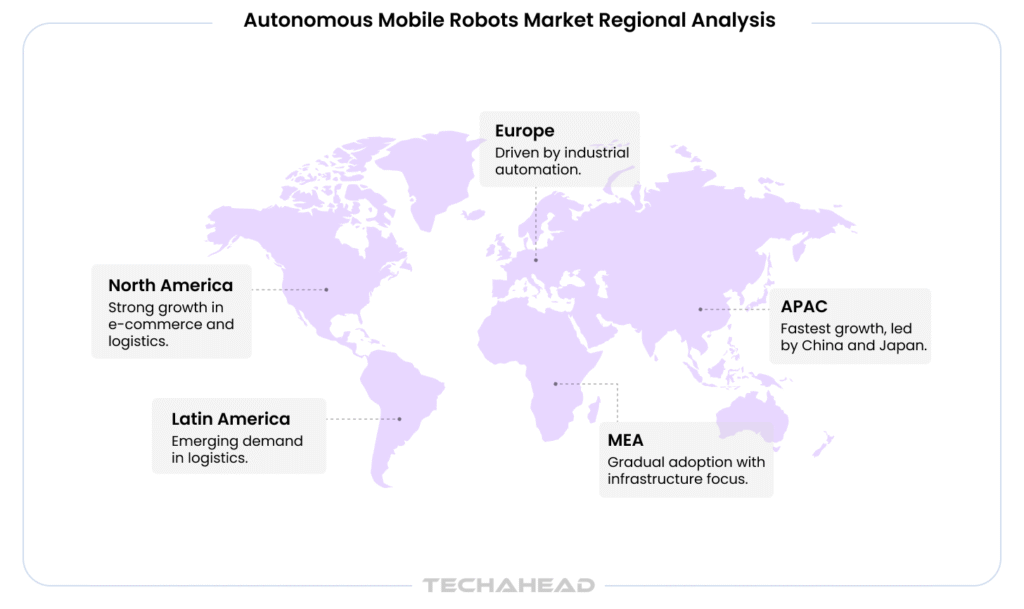
Wing (Alphabet’s drone subsidiary), Zipline, and Flytrex are operating in multiple geographies, with the drones segment holding a 49% market share of the autonomous last-mile platform market in 2025, growing at a CAGR of 22.8%.
The Regulatory Landscape
In the United States, the Federal Aviation Administration (FAA) governs drone delivery under Part 135 certification. Moreover, by November 2024, six U.S. drone operators had received Part 135 air carrier certificates (Taylor & Francis Online), with a seventh certified in April 2025. Yes, it is a slow but accelerating approval rate. The biggest regulatory milestone in recent years is the FAA’s proposed Part 108 rule published in August 2025.
Key Limitations
Despite the progress, several barriers remain:
- Weather dependency: rain, wind, and low visibility continue to limit operational windows for most commercial drones.
- Payload constraints: most delivery drones are limited to packages under 5 pounds, restricting the range of products they can carry.
- Urban airspace complexity: flying safely over densely populated areas requires advanced traffic management systems.
- Public acceptance: noise, privacy concerns, and community resistance remain real friction points in residential deployment.
The trajectory is growing, but unmistakably upward, but drone delivery remains best positioned today for suburban environments; with urban-at-scale delivery as the medium-term frontier.
Learn more, AI in FinTech: 7 Ways AI is Revolutionizing Finance Industry
AI-Powered Route Optimization
Static, once-a-day route planning is no longer adequate for modern last-mile operations. AI-powered route optimization replaces fixed schedules with continuously adaptive systems that re-plan delivery sequences in real time based on live traffic conditions, and delivery time windows, all simultaneously.
The operational gains are well-documented. Research published in the European Journal of Logistics found that AI-driven predictive route planning reduced delivery times by 20% and fuel costs by 15%, alongside improved on-time delivery rates.
At the environmental level, smart routing alone can cut fuel consumption by up to 20% and carbon emissions by approximately 25%.
However, what separates AI-powered dispatching from legacy tools is its ability to handle complexity. Where a human dispatcher might manage dozens of variables across a fleet, AI in logistics simultaneously process thousands of data points across hundreds of vehicles. The DHL reports that AI in predictive analytics can boost delivery efficiency by up to 20%, while FedEx uses predictive models to analyse internal and external data points and track packages in real time.
Predictive Delivery ETAs Using Machine Learning
Inaccurate delivery estimates are not just a customer experience problem; they are an operational/ financial one. Missed time windows trigger costly redelivery attempts, increase call centre volume, and as a result erode customer loyalty. Machine learning is addressing this directly. Moving delivery ETAs from broad estimates to precise predictions.
AI-driven tracking platforms have achieved approximately 87% accuracy in predicting delivery times in trials, with advanced systems reaching deviations of under 3% of actual arrival time for many routes Precedence Research; a level of precision that meaningfully reduces customer uncertainty.
Machine learning models achieve this by ingesting a continuous stream of inputs; historical delivery logs, GPS and telematics data, traffic feeds, weather, warehouse pick times, order characteristics.
For logistics operators, the business case extends beyond customer satisfaction. Fewer failed deliveries mean fewer wasted vehicle miles, lower fuel costs, and reduced pressure on customer service teams; all while building the kind of delivery reliability that translates directly into repeat purchases.
Key Technical Challenges in Deploying Physical AI for Logistics
Physical AI promises transformative gains for logistics, but deploying it reliably in real-world environments is an engineering challenge! Warehouses shift daily, delivery routes are unpredictable, and the physical world does not behave like a controlled test environment. Three core technical barriers are:
Unstructured Environments
In real logistics environments, robots cannot rely on pre-built maps. Over 68% of autonomous robots deployed in 2024 use SLAM algorithms for real-time localization and navigation, a technique that builds a map and determines position simultaneously.
However, SLAM has real limits in logistics: dynamic obstacles like forklifts and human workers disrupt mapping accuracy. LiDAR-based SLAM usage in robotics grew 58% from 2023 to 2024, and the next frontier is semantic SLAM, where robots do not just map space, but understand what is in it.
Edge Computing for Real-Time Decision Making
A robot that sends sensor data to the cloud and waits for a response is not autonomous; it is slow and vulnerable. True Physical AI requires decisions made locally, in milliseconds. IoT and edge computing featured in 35% of peer-reviewed smart warehouse research between 2010 and 2024, reflecting its growing centrality to logistics AI deployments.
Sensor Fusion (Combine LiDAR, Cameras, GPS for Reliable AI)
No single sensor gives a logistics robot the full situational awareness it needs. For example, LiDAR excels at 3D spatial mapping but struggles in rain or fog. Cameras capture rich visual context but falter in low light. GPS is unreliable indoors.
Sensor fusion, intelligently combining all three is what makes Physical AI better in practice. Over 82% of SLAM systems now integrate sensor fusion techniques combining LiDAR, cameras, and IMUs to enhance mapping accuracy.
Integrating GPS, IMU, and LiDAR data reduces localization error by 54% compared to single-sensor approaches; a meaningful improvement in environments where a navigation error can mean a misplaced pallet. The ongoing challenge is cost: high-grade LiDAR sensors remain expensive that can be suitable only for large-scale operators.

Real-World Use Cases: Companies Using Physical AI in Logistics
Physical AI in logistics is no longer a pilot programme; it is a proven operational reality. The companies leading this transformation are not just experimenting; they are rewriting the economics of fulfilment and last-mile delivery. Here are three examples:
Amazon Robotics for the Modern Fulfillment Center
Amazon is the most advanced large-scale deployment of Physical AI in logistics. In 2025, Amazon crossed the milestone of using more than 1 million robots across its fulfillment & logistics network.
Its robot fleet spans nine distinct systems:
- Sparrow for item picking
- Proteus for autonomous floor navigation
- Cardinal for heavy package placement
All coordinated by DeepFleet, an AI system built with internal logistics data that functions like a traffic controller.
Amazon’s most advanced robotic warehouse reduced fulfillment costs by around 25%, and the company plans to replicate the model across 40 facilities by 2027, expecting automation to generate $12.6 billion in savings between 2025 and 2027.
Starship Sidewalk Delivery Robots
While Amazon dominates the warehouse, Starship Technologies owns the sidewalk. Starship has built what no competitor can yet match in real-world scale. With over 9 million deliveries completed, Starship has amassed an unmatched dataset that continuously improves safety. In October 2025, Starship raised a $50 million Series C to scale its fleet from 2,700 robots to over 12,000 by 2027, with major U.S. city expansion planned.
FedEx, UPS & the Race to Autonomous Delivery
The traditional parcel giants are responding to the Physical AI era with significant structural transformation. FedEx is pursuing a multi-layered automation strategy: its AI-powered Shipment Eligibility Orchestrator dynamically routes packages in real time. Applies across FedEx Supply Chain’s 130+ North American warehouse and fulfillment operations, which process 475 million returns annually.
FedEx is also testing Dexterity AI’s DexR robot for autonomous trailer loading, a notoriously complex logistics task. Markets where FedEx’s Network 2.0 transformation has been deployed have already seen roughly a 10% reduction in pickup and delivery costs.
How to Get Started with Physical AI in Your Logistics Operations?
AI in logistics adoption does not begin with buying robots, it begins with a strategy. Here is a practical, phased roadmap for enterprise owners.
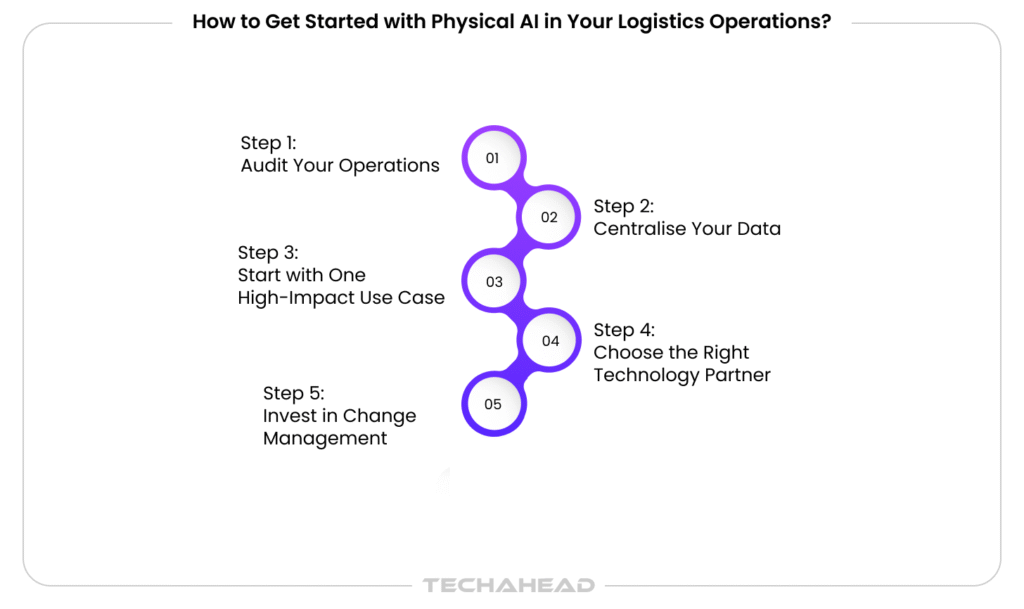
Step 1: Audit Your Operations
Identify your highest-cost, highest-friction points. Whether that is warehouse picking accuracy, last-mile delivery failure rates, or inventory visibility gaps. You cannot automate what you have not mapped.
Step 2: Centralise Your Data
Physical AI systems are only as intelligent as the data feeding them. Set a unified data infrastructure that connects your WMS, TMS, ERP, and IoT sensors into a single, clean, accessible layer.
Step 3: Start with One High-Impact Use Case
Most AI in logistics use cases reach deployment within 6 to 12 months, with high initial investments. Start with route optimisation or inventory management, proven, measurable, and lower-risk than full warehouse robotics.
Step 4: Choose the Right Technology Partner
Physical AI needs deep expertise across robotics, computer vision, edge computing. Partner with a software development company that understands both the technology stack and your operational context.
Step 5: Invest in Change Management
Companies that invested at least 15% of their AI project budgets in training and change management reported 2.8x higher adoption rates and 3.5x higher ROI. Define clear KPIs before deployment; cost per delivery, pick accuracy, fulfilment time, and first-attempt delivery rate. Use real performance data to validate ROI and then scale proven solutions across additional facilities.
Conclusion
Warehouses are getting smarter. Delivery routes are optimising themselves. And the gap between enterprises that have adopted Physical AI and those still deliberating is widening, fast. The technology is ready. The ROI is proven. What most enterprises lack is the right physical AI development partner to translate ambition into operational reality. TechAhead has spent 16 years building enterprise software for complex industries. We bring that same rigour to Physical AI, designing systems that integrate with your existing WMS, TMS, and ERP infrastructure without disruption, and scale as your operations grow.

Is Physical AI the same as warehouse automation?
Not entirely. Traditional warehouse automation follows fixed rules and pre-set paths. Physical AI adds real-time perception, autonomous decision-making, and adaptability. It is more intelligent than conventional automation systems.
What is the average ROI timeline for deploying Physical AI in a warehouse?
AMRs deliver payback in under 24 months and ROI above 250% in live deployments. Simpler deployments like AI-powered route optimisation or inventory management can achieve ROI in under 12 months.
Will Physical AI integrate with our existing WMS, TMS, or ERP systems?
Yes, we make sure all the Physical AI solutions integrate with your existing WMS, ERP, and TMS platforms.
Will Physical AI replace our warehouse and delivery workforce?
No, it reshapes roles. AI is growing, not replacing, the workforce. Companies report higher employee satisfaction and increased hiring for new roles such as automation specialists, ML engineers, and data analysts.