


Staff Augmentation
Access top-tier talent on demand: Dedicated, Hourly, or Flexible.


 Copy Link
 Share on X
 Share on Facebook
 Share on LinkedIn
Somewhere between a successful LLM proof-of-concept and full scale deployment, the fundamental challenges of the game change entirely. 3-second response time transitions from a minor inconvenience to a measurable churn risk. A prompt that runs 200 tokens longer than necessary stops being a stylistic oversight and becomes a cost liability; multiplied across millions of daily requests. A system that handles 50 concurrent users with ease can expose critical infrastructure gaps when enterprise demand scales to 500 or beyond.
Latency, throughput, and cost represent the three defining pressure points of any serious LLM deployment. What makes them particularly complex is their interdependency. Optimizing response times demands greater compute allocation, which directly escalates operational costs. Maximizing throughput through batching introduces latency trade-offs that impact user experience. Reducing expenditure by shifting to lighter models can compromise output quality precisely where it matters most. This guide breaks down exactly how to manage these, so your LLM deployment scales efficiently without compromising performance or draining your infrastructure budget.
Key Takeaways
- Scale exposes latency as major user churn risk factor.
- Excess prompt tokens multiply into massive cost liabilities daily.
- Latency, throughput, cost form interdependent optimization triangle challenges.
- Dynamic batching boosts GPU utilization in real time.
- Provider routing shifts traffic to cheapest real-time options.
Core Large Scale LLM Optimization Strategies
Running LLMs at enterprise scale is not just a technical challenge, it is a balancing act. Every deployment decision you make ripples across performance and your bottom line. The good news? With the right strategies, you do not have to sacrifice one for the other.
Understanding Latency, Throughput, and Cost Trade-offs
Think of these three levers as a triangle; pull one, and the others shift. Reducing latency often means dedicating more computers, which drives up cost. Maximizing throughput through batching can slow individual response times. Smart enterprises do not chase one metric; they define their priority based on use case, then engineer around it deliberately. Now, let’s examine each pressure point individually, starting with the one your end users feel most directly and most immediately.
Latency Optimization in Large-scale LLM Deployments
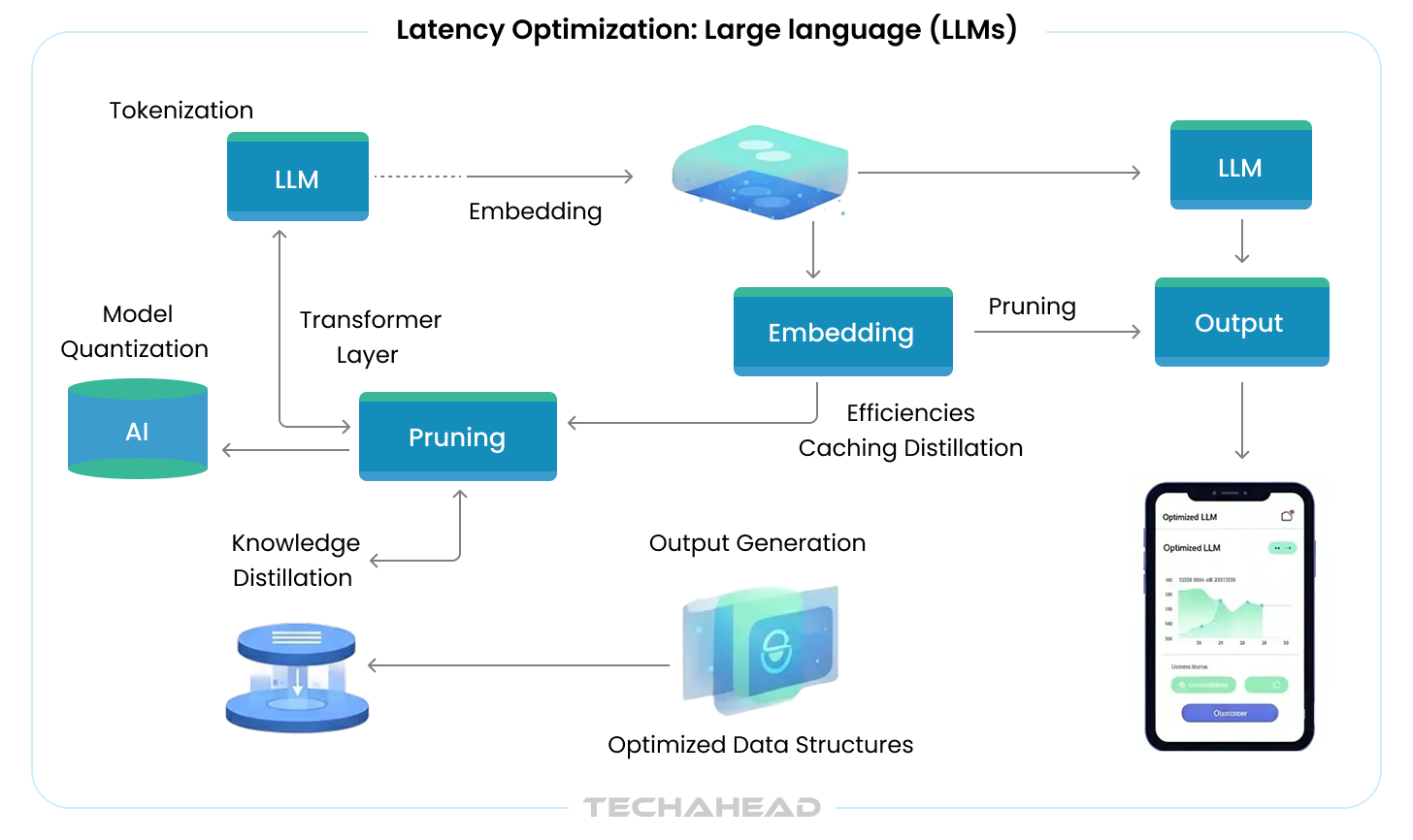
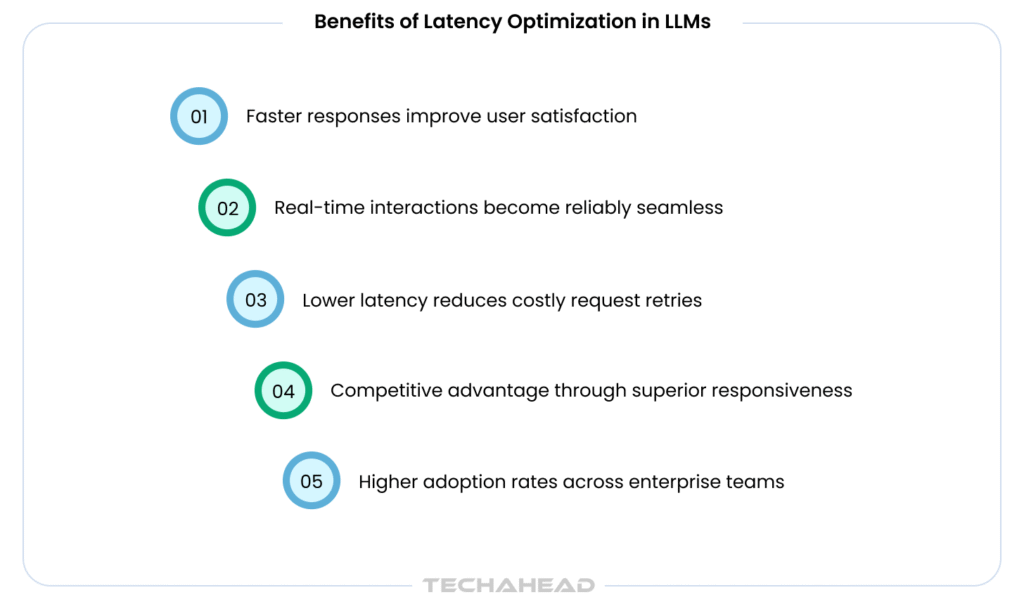
In enterprise LLM deployments, latency is not just a performance metric; it is essential for user experience. A response that takes too long kills productivity, frustrates end users, and undermines adoption. Here is how leading teams are engineering their way to faster outputs:
Model Routing Techniques
Not every query needs your most powerful model. Intelligent routing directs requests to the right model based on complexity, freeing your heavyweight models for tasks that actually need them.
- Complexity-based routing classifies incoming prompts and assigns simpler queries to smaller models
- Cascade routing starts with a lightweight model and escalates to a larger one only if confidence is low
- Latency-aware routing dynamically selects endpoints based on real-time server load and response times
Semantic Caching Strategies
Recomputing responses for semantically identical queries is pure waste. Semantic caching stores and retrieves previous responses based on meaning; not just exact text matches, using vector similarity search.
When a new query closely resembles a cached one, the stored response is returned instantly, bypassing model inference entirely. It reduces latency by up to 80% for repetitive enterprise workloads like FAQ systems, internal knowledge bases, and customer support tools.
Time-to-First-Token Improvements
Users perceive responsiveness from the moment the first token appears. Improving TTFT means optimizing prefill computation, the processing that happens before generation begins.
Techniques like prompt compression, KV cache reuse, and speculative decoding significantly cut prefill time. As a result, all these techniques make responses feel immediate even for longer outputs.
Continuous Batching Methods
Traditional static batching waits to fill a batch before processing, introducing unnecessary delays. Continuous batching, also called iteration-level scheduling processes each request dynamically as GPU capacity frees up.
It keeps hardware utilization high without making individual requests wait, striking the ideal balance between throughput efficiency and low latency for concurrent enterprise users.
Throughput Optimization in LLM Deployments
At enterprise scale, throughput is not only about speed, it is about how many requests your system can handle. Optimizing throughput means designing infrastructure that stays efficient under both steady load & sudden surges.
Dynamic Batching Approaches
One of the most powerful throughput boosters is dynamic batching; grouping multiple incoming requests and processing them together in a single model forward pass.
Unlike static batching, where you wait for a fixed batch size, dynamic batching works with what is available in real time, which dramatically improves GPU utilization without artificially inflating response times.
Key benefits include:
- Higher hardware utilization: GPUs thrive on parallel workloads; batching feeds them exactly that.
- Reduced overhead per request: Fixed costs like memory allocation and model loading are spread across multiple requests.
- Flexible batch windows: You can tune the wait window (e.g., 5–20ms) to balance latency against throughput based on your traffic patterns.
Frameworks like NVIDIA Triton Inference Server and vLLM offer built-in dynamic batching support. All these frameworks make implementation far more accessible for enterprise teams.
GPU/TPU Auto-Scaling Practices
Static infrastructure is the enemy of cost-efficiency. Auto-scaling allows your deployment to provision and deprovision accelerators in response to real-time demand. Tools like Kubernetes with custom GPU-aware metrics, or cloud-native solutions like AWS Inferentia and Google Cloud TPUs, let you scale horizontally without manual intervention.
The key is setting intelligent scaling triggers; not just CPU thresholds, but queue depth, token generation rate, and model latency percentiles.
Priority Queuing for Spikes
Traffic spikes are inevitable. Without a queuing strategy, a sudden surge can degrade performance for every user simultaneously. Priority queuing solves this by segmenting requests. Workloads like customer-facing APIs are served first, while background or batch jobs wait their turn gracefully. It keeps your SLAs intact even when demand is unpredictable.
Cost Reduction in Large-scale LLM Deployments
At enterprise scale, LLM costs can spiral fast. A model that performs beautifully in a proof of concept can become a budget nightmare when deployed across thousands of users.
Here is how leading enterprises are doing it:
Token-Efficient Prompt Engineering
Every token costs money. It sounds simple, but most enterprise prompts are far longer than they need to be, bloated with redundant context, verbose instructions, and unnecessary examples. Token-efficient prompt engineering is the discipline of saying more with less.
What this looks like in practice:
- Trim system prompts ruthlessly: Audit your prompts regularly and remove any instruction that does not meaningfully change the model’s output.
- Use structured formats: JSON or XML-structured inputs reduce ambiguity, which means fewer retries and shorter back-and-forth exchanges.
- Compress context windows: Instead of passing entire conversation histories, summarize prior turns or pass only the most relevant segments.
- Leverage few-shot examples selectively: One well-chosen example often outperforms three mediocre ones and costs 66% less in tokens.
A 20% reduction in average token count across millions of daily requests does not just save money; it also reduces latency, which makes this one of the highest-ROI optimizations available.

Model Quantization and Distillation
Not every task needs a frontier model. This is where quantization and distillation become powerful cost levers for deployments.
Model Quantization
Quantization reduces the numerical precision of a model’s weights; from 32-bit floating point down to 8-bit or even 4-bit integers. The result is a model that runs faster, consumes less memory, and costs significantly less to serve, with only a marginal drop in accuracy for most production tasks. Tools like GPTQ and AWQ have made quantization increasingly accessible without requiring deep ML expertise.
Model Distillation
Distillation takes a different approach; training a smaller “student” model to replicate the behavior of a larger “teacher” model. The distilled model handles routine, high-volume tasks at a fraction of the inference cost, while the full model is reserved for complex, high-stakes queries. For enterprises processing millions of requests daily, routing even 60–70% of traffic to a distilled model cuts compute costs dramatically.
Provider Routing and Failover
Relying on a single LLM provider is both a cost risk and a reliability risk. Intelligent provider routing allows enterprises to dynamically direct requests to the most cost-effective model or provider based on real-time pricing.
For example, simple classification tasks can be routed to a cheaper, faster model, while nuanced generation tasks go to a premium model. Failover logic ensures that if one provider experiences downtime or rate-limiting, traffic automatically shifts, which prevents costly service interruptions and SLA breaches. Platforms like LiteLLM and PortKey are suitable to manage this kind of multi-provider orchestration at scale.
Cost per Token Monitoring
You cannot optimize what you do not measure. Cost per token monitoring gives enterprises granular visibility into exactly where their LLM budget is going; broken down by model, endpoint, team, feature, or user segment.
Effective monitoring goes beyond dashboards. Set budget alerts that trigger before overruns happen. Track cost trends over time to catch prompt regressions early, a developer changing a system prompt can inadvertently double token usage overnight. Integrating cost telemetry directly into your CI/CD pipeline means that every model or prompt change is evaluated for cost impact before it hits production.
When cost is treated as the main engineering metric; not an afterthought. Enterprises consistently find 20–40% in recoverable savings hiding in plain sight.
Conclusion
At enterprise scale, the difference between a profitable LLM deployment and an expensive one rarely comes down to the model you chose; it comes down to how intelligently you operate it. Latency, throughput, and cost will always compete for priority. The enterprises winning this challenge are not the ones throwing more compute at the problem; they are the ones engineering smarter systems from the ground up. That is precisely what TechAhead does. As a custom LLM development company, we help enterprises move beyond proof-of-concept and into production-grade deployments. Your LLM investment deserves a strategy as sophisticated as the technology itself.
What is the biggest factor driving high LLM costs in enterprise deployments?
Token consumption is the single largest cost driver, so inefficient prompts, oversized context windows, and routing all tasks to premium models unnecessarily account for the majority of wasted spend in most enterprise deployments.
Can we reduce costs without sacrificing output quality?
Yes, significantly. Token-efficient prompt engineering, intelligent model routing, and quantization can cut costs by 30–50% with negligible impact on output quality for most production use cases.
What should a cost-per-token monitoring setup include?
At minimum, it should track cost broken down by model, endpoint, team, and feature. Effective setups also include budget alerts, historical trend analysis, CI/CD integration so prompt or model changes are automatically evaluated for cost impact before deployment.