


Staff Augmentation
Access top-tier talent on demand: Dedicated, Hourly, or Flexible.


 Copy Link
 Share on X
 Share on Facebook
 Share on LinkedIn
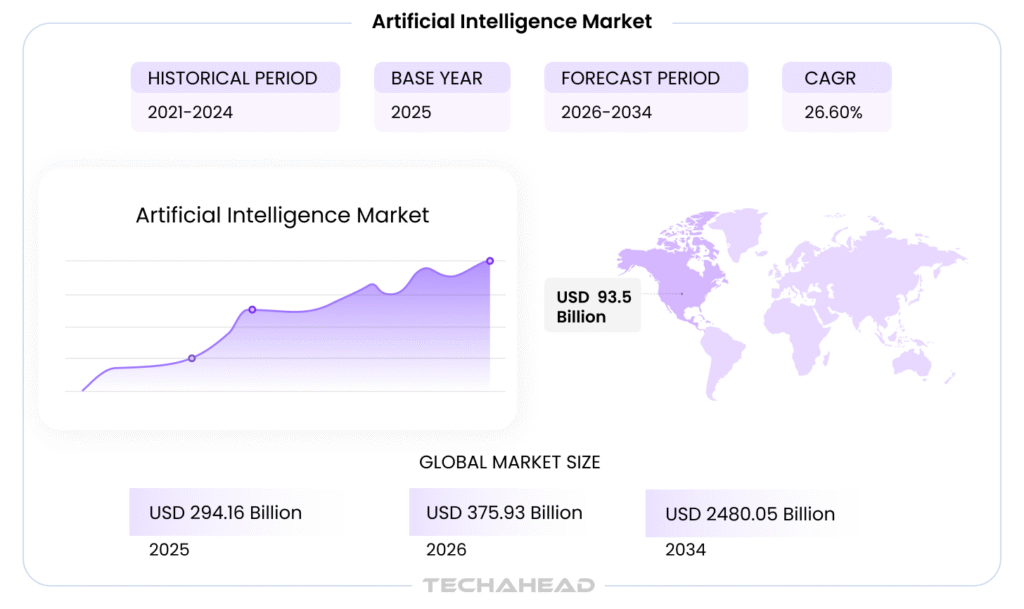
What if your AI investment became your biggest security liability? It happens more than you think. IBM reports that the average enterprise data breach now costs $4.88 million (2024), and AI systems, when poorly secured, can be an entirely new entry point into your business. At the same time, Gartner found that most AI projects fail to deliver the ROI leadership expected, almost always because budgets were guessed rather than planned. The global artificial intelligence market size is projected to grow from USD 375.93 billion in 2026 to USD 2480.05 billion by 2034, exhibiting a CAGR of 26.60% during the forecast period. So before you commit resources, you need a framework that protects your enterprise and your revenue. That is exactly what this 90-day AI roadmap gives you; financial clarity, security-first thinking, and a structured path to AI that actually delivers. Let’s dive in:
Key Takeaways
- AI initiatives fail without strategic clarity; define your business problem first.
- An AI roadmap connects every technology decision directly to business outcomes.
- Every AI initiative must trace back to a specific, measurable business objective.
- Choose an AI partner with proven enterprise experience.
- Clean, structured data is the single most crucial foundation of any AI strategy.
Why Most Enterprise AI Initiatives Fail Before They Start?
Most enterprise AI initiatives do not fail during implementation. The root cause is almost always a lack of strategic clarity, where leadership jumps into AI adoption driven by competitive pressure, not with a defined business purpose.
The most common reasons include:
- No clear problem statement: AI is chosen as the solution before the problem is fully understood
- Poor data infrastructure: AI is only as good as the data feeding it
- Unrealistic expectations: Overnight transformation rarely happens
The good news? These are all preventable.
With the right roadmap, structured planning, and leadership alignment from day one, your enterprise can avoid these pitfalls and set AI initiatives up for success.

What is an AI Roadmap and Why Does Your Enterprise Need One Now?
An AI roadmap is your enterprise’s strategic game plan for adopting artificial intelligence. It connects technology decisions directly to business outcomes.
What Does an AI Roadmap Actually Include?
Strategic Layer
- Business goals AI needs to support
- Clear problem statements tied to revenue or growth
Execution Layer
- Timeline with defined milestones
- Budget allocation and resource planning
- Risk & compliance checkpoints
Why Do You Need One Right Now?
Without a roadmap, AI spending becomes guesswork; expensive and hard to justify to your board. According to Forbes, Worldwide spending on AI is forecast to reach $2.52 trillion in 2026, a 44% year-over-year increase. However, a roadmap forces three things:
- Focus: You stop chasing every AI trend
- Accountability: Teams know who owns what
- Measurable progress: Success has a definition from day one

How to Assess Your Organization’s AI Readiness in Week One?
Before building anything, you need to know exactly where your organization stands. Week one is not about technology: it is about self-assessment. Look at your:
- Current data infrastructure
- Internal skill sets
- Existing workflows
These three areas will tell you more about your AI readiness than any tool or consultant ever could. The gaps you find here will directly shape your roadmap priorities.
Identifying High-Impact Use Cases
Not every business problem needs AI. The highest-impact use cases share one thing in common; they involve repetitive decisions, large volumes of data, or processes where speed directly affects revenue.
That is your starting point.
For example, a logistics company reduced delivery costs by 23% simply by using AI to optimize route planning.
A mid-sized bank cut loan processing time from five days to four hours using automated document verification.
It means, you need focused custom enterprise platforms to specific, painful problems.
Look for AI opportunities inside these areas first:
- Customer service: AI chatbots handling tier-one support queries around the clock
- Finance and operations: Automated invoice processing and anomaly detection in spending
- Sales: Predictive lead scoring that helps reps focus on accounts most likely to convert
- HR: Resume screening and candidate shortlisting at scale
The businesses seeing real ROI are not trying to transform everything at once. They pick one high-friction process, apply AI precisely, measure the outcome, and then scale what works.
How to Align Your AI Roadmap With Business Goals?
AI without business alignment is just expensive experimentation. Every AI initiative you pursue must trace back to a specific, measurable business objective; whether that is reducing operational costs, customer retention, or accelerating revenue growth.
If it cannot, it does not belong on your roadmap.
Start by sitting with your leadership team and listing your top three to five business priorities for the next 12 months.
Then ask a simple question for each one:
Can AI help us get there faster, cheaper, or more accurately?
The ones that get a clear yes become your roadmap anchors. Everything else waits. This discipline is what separates enterprises that see real AI returns from those that are still running pilots two years later.
Building Your Internal AI Team: Who You Need?
Start With Leadership Buy-in
Every successful AI team needs someone who connects AI initiatives to business strategy and protects resources when priorities shift.
Without this, teams stall.
The Core Roles You Actually Need
- AI Project Lead: Owns the roadmap and keeps delivery on track
- Data Engineer: Builds and maintains the pipelines AI depends on
- ML Engineer or AI Developer: Designs and trains the models
- Business Analyst: Translates business problems into technical requirements
AI adoption fails when employees resist new workflows; someone needs to own that transition from day one.
How to Choose the Right AI Partner or Vendor for Enterprise Projects?
Choosing an AI vendor is one of the highest-stakes decisions your enterprise will make. A wrong fit means wasted budget, missed deadlines, and AI systems your team cannot maintain or trust.
What to Look for in an Enterprise AI Partner?
Proven enterprise experience: Not just startups with flashy demos
End-to-end capability: Strategy, development, integration, and post-launch support
Industry-specific knowledge: Generic AI rarely solves specific business problems
Transparent communication: Clear timelines, honest constraints, no overpromising
Why Enterprises Choose TechAhead?
With over 16 years of experience and more than 2,500 AI projects delivered globally, TechAhead brings something most vendors cannot; deep institutional knowledge across industries.
AI experts solve enterprise-scale AI challenges in finance, healthcare, logistics, and retail; it means your project benefits from solutions of different industries.

Setting Realistic KPIs and Success Metrics for AI Initiatives
Before your AI project begins, define what success looks like in business language. Not technical language.
- Cost reduction: Did AI lower operational expenses by a measurable percentage?
- Speed improvement: How much faster is the process compared to before?
- Revenue impact: Did AI-assisted decisions lead to more conversions or retained customers?
- Error reduction: How did AI reduce human error in crucial workflows?
Set Baselines Before You Build
You cannot measure improvement without knowing your ‘starting point’. Document current performance across every process AI will touch before development begins.
Realistic KPIs are not just about setting expectations; they are about maintaining trust throughout the entire AI journey.
How to Build a Risk Management Plan for Enterprise AI?
Every enterprise AI initiative carries risk. The ones that succeed are not risk-free, they are risk-prepared:
Identify Risks Early
- Model bias producing unfair or inaccurate outcomes
- Data breaches exposing sensitive enterprise or customer information
- Over-reliance on AI decisions without human oversight
Build Your Mitigation Layer
- Define clear human-in-the-loop checkpoints for high-stakes decisions
- Run bias audits before and after deployment
- Set data governance policies before development begins
Plan for Failure
- Document rollback procedures for every AI system deployed
- Assign a risk owner for each initiative on your roadmap
Review Continuously
AI risk is not static; schedule quarterly risk assessments as your models and data evolve.
Navigating Security and Ethical AI in Your Roadmap
Security and ethics are not afterthoughts; they need to be architected into your AI systems from the ground up.
On the security side, it means:
- Implementing role-based access controls on training data
- Encrypting data pipelines end-to-end
- Running adversarial testing to identify model vulnerabilities before deployment.
For ethical AI, enforce fairness constraints during model training, maintain full explainability through interpretable model architectures. And your roadmap should include a dedicated AI governance framework.

Pilot vs. Full-Scale Deployment: How to Decide What Comes First?
Enterprises that rush straight to full-scale AI deployment are making a very expensive bet. According to McKinsey, only 16% of enterprises report successful large-scale AI deployment on the first attempt. The ones that succeed almost always run a controlled pilot first.
What a Pilot Actually Tells You?
About Your Technology
- Whether the model performs accurately on your real-world data
- Integration gaps your team did not anticipate during planning
- Actual infrastructure load versus estimated load
About Your People
- How quickly teams adapt to AI-assisted workflows
- Where resistance shows up and why
- Training gaps that need addressing before wider rollout
When Full-Scale Deployment Makes Sense?
Move to full-scale only when your pilot confirms three things. First, the AI is delivering measurable results against your defined KPIs. Second, your team is operationally comfortable with the new workflow. Third, your data pipelines are stable.
The Cost of Skipping the Pilot
Gartner reports that enterprises which skip pilot phases experience up to 40% higher implementation costs during full-scale rollout. So, that is not a risk worth taking!
A Simple Decision Rule
If you cannot clearly explain what success looks like for a pilot in two sentences, you are not ready for full-scale deployment either.

By day 61, strategy becomes action. This is where most enterprises either gain serious momentum or quietly lose it. The difference comes down to execution discipline. Now the work shifts to deploying, integrating, and measuring.
Getting Your Teams to Adopt AI Without Resistance
People do not resist AI. They resist uncertainty. When employees do not understand how AI will affect their role, their instinct is to protect what they already know. That is human, not irrational.
Address the Fear Directly
- Communicate early and often about what AI will automate and what it will not
- Involve team leads in the pilot phase so they become internal advocates
- Share results transparently, when people see AI making their work easier, resistance drops fast.
Build Confidence Through Training
Do not just train employees on how to use the tool. Train them on why it was built, what it is measuring, and how their input improves it over time. Ownership drives adoption faster than instruction ever will.
Integrating AI into Existing Enterprise Systems
AI does not replace your existing systems. It works inside them. It matters when planning integration.
Common Integration Points
- ERP systems: AI enhances forecasting, procurement, inventory decisions
- CRM platforms: Predictive scoring, automated follow-up triggers
- HRMS tools: Candidate screening, workforce planning automation
What Integration Actually Requires
- Clean, accessible APIs between your AI layer and existing platforms
- Data standardization across systems feeding the model
- Real-time monitoring to catch integration failures before they affect operations
Start with one system. Prove the integration works cleanly and then expand. Trying to integrate everything simultaneously is one of the most common and costly mistakes enterprises make in this phase.
Common AI Implementation Mistakes Enterprises Make
Mistake 1: Building Without a Clear Problem Statement
AI built around technology capabilities rather than business problems almost never delivers ROI. Define the problem first. Always.
Mistake 2: Underestimating Data Readiness
Enterprises consistently overestimate how ready their data is. Dirty, siloed, or inconsistent data will break even the most sophisticated model.
Mistake 3: Skipping Change Management
Deploying AI without preparing your people is like installing new machinery and expecting the team to figure it out alone. It creates friction and errors.
Mistake 4: Measuring the Wrong Outcomes
Tracking technical metrics instead of business outcomes makes it impossible to justify continued AI investment to leadership.
Avoid these four and your implementation is already ahead of most enterprise projects running today.
How to Measure ROI on Your AI Investment in the First 90 Days?
Measuring AI ROI in 90 days is absolutely possible; if you set baselines before day one.
What to Measure
- Time saved: Compare process completion times before and after AI deployment
- Cost reduction: Track operational expenses across AI-assisted workflows
- Error rates: Measure accuracy improvements in decisions AI now supports
- Revenue impact: Monitor conversion rates, retention, or upsell performance tied to AI touchpoints
What Happens After Day 90: Scaling AI Across the Enterprise
Indeed, the Day 90 is not the finish line; it is the starting point for real scale. Use what your pilot and initial deployment taught you. Double down on what worked, fix what did not, and expand AI into the next highest-impact area of your business. Scaling is not about deploying more AI. It is about deploying smarter AI with a team that now knows exactly how to do it.
Conclusion
Building an AI roadmap is not a technology project; it is a business transformation decision. The enterprises that win with AI are not necessarily the ones with the biggest budgets. They are the ones with the clearest strategy, the right team, and a structured plan that connects every AI initiative directly to business outcomes. The 90-day framework covered in this blog gives you exactly that starting point. As AI app development company, TechAhead has helped hundreds of enterprises move from AI curiosity to measurable business impact. With 16 years of experience and 2,500+ projects delivered globally, your personalized 90-day roadmap is one conversation away. Talk to our AI experts and start building today.

Can small or mid-sized enterprises build an AI roadmap or is this only for large corporations?
AI roadmaps are not exclusive to large enterprises. Mid-sized businesses often move faster. Start small, focus on one high-impact use case, and scale from there.
How do we handle regulatory compliance specific to our industry when deploying AI?
Involve your legal and compliance teams before development begins. Map every AI use case against industry regulations, build audit trails into your systems, and review compliance requirements.
How do we maintain and update AI systems after the initial deployment?
Assign a dedicated model owner, schedule regular performance reviews, monitor data drift, and retrain models as business conditions evolve. AI maintenance is ongoing; treat it like any other crucial business infrastructure.
What role does cloud infrastructure play in enterprise AI deployment?
Cloud infrastructure provides the scalable compute power, storage, and flexibility AI systems demand. It reduces upfront hardware costs, accelerates deployment timelines, and makes scaling significantly easier as your AI initiatives grow.
What happens to our AI roadmap when our core business strategy changes?
Your AI roadmap should be a living document, not a fixed plan. When business strategy shifts, revisit your use cases, realign your KPIs, and reprioritize initiatives that still support the new direction.