

Staff Augmentation
Access top-tier talent on demand: Dedicated, Hourly, or Flexible.


 Copy Link
 Share on X
 Share on Facebook
 Share on LinkedIn
The scenario of 2025 is changing for the aerospace and defense industry. Innovation isn’t just a buzzword anymore; it’s actively rewriting how nations prepare for and respond to threats. The technologies we once imagined in research labs and sci-fi movies are now actively shaping military strategies and operations across the globe.
With Generative AI becoming a core part of defense systems and the rise of fully autonomous warfare tools, we are witnessing a dramatic shift in military operations
Immersive technologies, like augmented and virtual reality, are making major waves, too. In fact, the market for immersive tech in military and defense is expected to skyrocket. It’s projected to grow from $12.8 billion in 2025 to a massive $92.17 billion by 2034. That’s a compound annual growth rate of 24.52%! Just last year, in 2024, the market was valued at $10.28 billion, so you can imagine the momentum.
In this article, we’ll examine the dominant tech trends redefining defense in 2025 and explore how innovations like Edge AI and Quantum resilience are revolutionizing modern warfare and reshaping global security as we know it.

Outlook of Aerospace and Defense Industry with Emerging Technologies
The global aerospace and defense (A&D) market is entering a phase of strategic growth. Defense budgets are increasing across nations to counter rising geopolitical tensions. Commercial aviation has fully stabilized, shifting focus from recovery to next-generation air mobility.
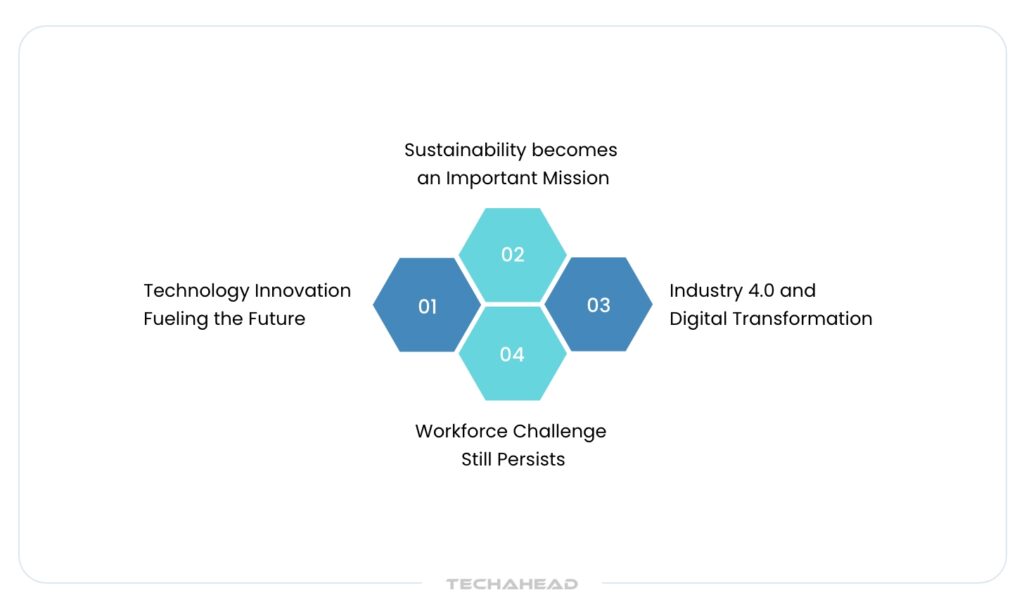
However, growth is not just about recovery; it’s driven by technology, sustainability, space, and skilled talent. Let’s explore these transformational trends:
Technology Innovation Fueling the Future
Technology is no longer just support; it’s central to defense and aerospace operations.
- AI helps military planners predict threats, automate logistics, and process battlefield data instantly.
- Additive manufacturing enables fast, cost-effective production of aircraft parts and defense equipment on demand.
- Robotics and autonomous systems reduce soldier risk in high-threat zones, enhancing mission safety.
- Digital twin technology allows real-time testing and simulation of aircraft or missile systems before production.
- Cybersecurity tech ensures critical infrastructure remains safe from cyber espionage and sabotage.
Simply put, innovation has become essential for national defense and commercial aerospace success.

Sustainability is no longer optional; it’s a strategic priority. Environmental pressure is reshaping the entire A&D sector.
- Governments now demand greener, cleaner aviation and defense systems.
- Sustainable aviation fuels (SAFs) and hydrogen propulsion are key focus areas in R&D.
- Lightweight composites reduce aircraft weight, saving fuel and boosting efficiency.
- Green manufacturing practices cut carbon emissions and reduce industrial waste.
- Even space missions are being evaluated for environmental impact and debris management.
Industry 4.0 and Digital Transformation
Smart Factory 2.0 is revolutionizing how A&D products are built. Private 5G networks improve collaboration between teams, suppliers, and machines.
IoT sensors provide real-time status on equipment health and usage. Cloud computing enables secure sharing of mission-critical data across global operations.
AI-driven analytics helps companies make faster, smarter decisions during projects and missions. Digitalization increases precision, speeds up workflows, and reduces operating costs.
Workforce Challenge Still Persists
The A&D sector faces a severe skills shortage. Demand for talent in avionics, data science, Generative AI, and quantum robotics is outpacing supply. The “retirement cliff” means aging workers are leaving faster than new engineers are joining.
Companies are launching upskilling programs to train existing employees in high-tech roles. University partnerships and military-to-civilian pipelines are also being expanded. The talent war is real, and winning it is critical for maintaining competitive advantage.
TL;DR: Defense Technology Trends
| Technology | What is it? | Key Benefits |
| Artificial Intelligence (AI) | Smart algorithms to power weapons and strategy. | Predicts equipment failures, trains soldiers, and runs autonomous vehicles. |
| Additive Manufacturing | Industrial 3D printing for military gear. | Quickly prints spare parts, bridges, and shelters on-site. |
| Advanced Equipment | Next-gen weaponry and hardware. | Includes hypersonic missiles, lasers, hybrid vehicles, and armor that repairs itself. |
| Internet of Military Things (IoMT) | A network connecting soldiers and devices. | Uses 5G/6G to share battlefield data instantly |
| Robotics & Drones | Unmanned machines for land, sea, and air. | Handles dangerous tasks, performs surveillance, and executes precise strikes. |
| Immersive Tech (AR/VR) | Virtual reality and digital overlays. | Provides risk-free combat training and gives soldiers real-time data |
| Cybersecurity | Digital shields for military networks. | Uses AI to hunt hackers, lock down data, and launch attacks. |
| Quantum Computing | Super-fast computing technology. | Breaks enemy codes, optimizes complex logistics, and detects stealth units |
Defense Industry Technology Trends for Digital Transformation

Artificial Intelligence (AI)

AI is reshaping the defense sector, expanding its impact across multiple applications. Military forces rely on artificial intelligence, especially Agentic AI, to enhance training, develop smart weapons, strengthen surveillance, and fortify cybersecurity. Below are some significant AI in defense:
- Autonomous weapons and vehicle systems: AI-powered crewless vehicles, submarines, and drones support operations. While AI-driven soldiers on battlefields remain futuristic, autonomous systems are already playing a vital role.
- Command and control system: AI processes real-time battlefield data, helping leaders make faster, informed decisions.
- Predictive maintenance: AI predicts equipment failures before they occur, ensuring mission readiness and reducing downtime.
- Cybersecurity reinforcement: AI analyzes network traffic, identifies vulnerabilities, and neutralizes cyber threats before they escalate.
- Advanced military training: AI-driven simulations and virtual environments improve combat readiness with realistic, risk-free training experiences.
- Advanced military training: AI-driven simulations and virtual environments improve combat readiness with realistic, risk-free training experiences.
- Enhanced intelligence and surveillance: AI processes vast amounts of data, improving situational awareness and response times.
- Strategic decision-making: AI aids commanders by analyzing multiple scenarios and recommending optimal courses of action.
AI’s impact on defense will only grow in 2025, streamlining operations, enhancing efficiency, and redefining modern warfare.
Additive Manufacturing
3D printing is revolutionizing defense by enabling rapid, cost-effective production of important assets. The military 3D printing market has reached $1.46 billion this year, utilizing the technology in several ways:
- Replacing outdated parts: Air forces and defense agencies use 3D printing to manufacture critical aircraft and vehicle parts. It reduces costs and accelerates production.
- Constructing essential infrastructure: Military forces build bridges, shelters, and other structures using 3D printing. This speeds up deployment and reduces labor efforts.
- Multi-Material Components: New printers can mix metals and ceramics to create lightweight and require fewer materials, making transportation and logistics more efficient.
- Enhancing supply chain resilience: On-site 3D printing eliminates reliance on long supply chains, ensuring rapid production in serious situations.
Additive manufacturing is now a key enabler of military efficiency, repairability, and operational agility.
Advanced Defense Equipment
Rapid technological advancements are producing cutting-edge military equipment. The defense sector is embracing:
- Directed energy and hypersonic weapons: With a $6.9 billion US budget allocation in 2025, these weapons offer unparalleled speed, precision, and destructive power against drone swarms
- Space militarization: Satellites and space-based defense systems enhance communication, surveillance, and security.
- Hybrid-Electric Tactical Vehicles: The military explores hybrid electric propulsion (like the eJLTV) to reduce thermal signatures and environmental impact.
- Self-healing armor: Advances in Aromatic Thermosetting Copolyesters (ATSP) enable experimental armor that repairs itself, improving soldier protection.
These innovations redefine modern warfare, enhancing defense capabilities while addressing sustainability concerns.
Internet of Military Things (IoMT)

The IoMT is transforming warfare by connecting devices, vehicles, and personnel in a unified network. Valued at over $487 billion in 2025, key applications of IoMT include.
- Real-time battlefield intelligence: Sensors on soldiers, tanks, and drones provide continuous data for superior situational awareness.
- Automated decision-making: AI-powered IoMT systems analyze data instantly, enabling rapid and effective responses.
- Enhanced coordination: Interconnected devices streamline communication and battlefield management through resilient 5G/6G mesh networks.
- Quantum-Resistant Security: IoMT networks are upgrading to post-quantum encryption to secure sensor data against future decryption threats.
As IoMT expands, real-time data-sharing and automation will redefine defense strategies and operations.

Robotics & Autonomous Systems
Robotics is revolutionizing military operations by enhancing efficiency and reducing human risk. In 2025, the focus has shifted toward human-machine teaming and swarm capabilities. Main principles include:
- Land and sea operations: Autonomous systems provide logistical support, reconnaissance, and surveillance with minimal human involvement.
- Explosive ordnance disposal: Robots integrated with precision haptic sensors safely neutralize landmines and explosive threats, protecting soldiers.
- Search and rescue missions: AI-driven robots and autonomous extraction pods locate and assist injured personnel in challenging environments.
- Underwater surveillance: Extra-Large Unmanned Underwater Vehicles (XLUUVs) conduct deep-sea reconnaissance and security operations.
Increased use of military drones. Drones are a game-changer in modern warfare. Their advantages include:
- Cost-effectiveness: Drones are cheaper to produce than traditional weapons but equally effective.
- Long-range surveillance: They gather intelligence and track enemy movements from extended distances.
- Targeted airstrikes: Armed drones execute precise attacks, minimizing collateral damage.
- Defensive capabilities: Drones counter aerial threats and disrupt enemy operations.
Military reliance on autonomous systems and drones will continue growing, improving operational success and safety.
Immersive Technologies (AR & VR)
Augmented and virtual reality technologies have evolved into Extended Reality (XR) ecosystems, providing realistic, risk-free training environments for soldiers and pilots. Their benefits include:
- Advanced combat training: VR simulations replicate battlefield conditions, improving soldier preparedness and psychological resilience.
- Enhanced pilot training: AR enables pilots to engage in simulated dogfights and tactical scenarios.
- Real-time battlefield assistance: Wearable AR devices like the IVAS headset provide soldiers with mission-critical data and biometric monitoring.
- Improved mission planning: 3D terrain mapping and simulation-based rehearsals enhance strategic planning.
As immersive technologies evolve, they will play an important role in military preparedness and decision-making.
Cybersecurity in Defense
As digital warfare escalates, cybersecurity remains a top priority. The defense sector implements:
- Advanced threat detection: AI-powered systems analyze and identify cyber threats in real time.
- Data protection strategies: Zero Trust Architecture (ZTA) combined with DevSecOps services, encryption and secure networks safeguard sensitive military data.
- Offensive cyber warfare: Defense agencies develop cyber weapons, including malware and ransomware, to counter adversaries.
- Enhanced cyber resilience: Self-healing networks deploy automated response systems to mitigate attacks before they cause damage.
With rising cyber threats, investing in advanced cybersecurity measures is crucial to maintaining military superiority.
Quantum Computing
Quantum computing is an emerging force in defense innovation. With major breakthroughs in error correction, its potential is immense. Quantum systems solve highly complex problems in record time, making them ideal for defense-specific tasks.
- Crypto transformation: The transition to Post-Quantum Cryptography (PQC) is accelerating because quantum computing can crack traditional encryption.
- Defense logistics and simulations: Quantum algorithms optimize supply chains and simulate multi-domain combat scenarios with unmatched precision.
- Accelerating data processing: Quantum systems handle large-scale datasets quickly, aiding real-time strategy planning.
- Enhanced threat detection: Quantum sensors (Q-Sensing) can identify stealth platforms and navigation-denied units faster and more accurately than classical systems.
Cybersecurity will become more critical as quantum capabilities evolve. Defense agencies must prepare for a quantum-powered threat landscape. Quantum computing is both a revolutionary tool and a new domain of cyber risk. In 2025, its growing relevance will reshape how nations protect their digital and physical frontlines.

Challenges Facing Defense Tech Companies

While innovation in defense technology is accelerating, many next-gen firms still struggle to operate at full scale. Their journey into government contracting is often slowed down by three major obstacles.
Custom Demands Vs. Scalable Products
Startups usually build scalable, one-size-fits-many products utilizing commercial software models. But national security demands are highly specific and compartmentalized.
These customers often request mission-specific capabilities from a custom software development company or bespoke integrations that solve a very narrow challenge.
Moreover, access to classified data is limited, often requiring expensive Sensitive Compartmented Information Facilities (SCIFs), making it tough to fully understand defense needs.
Without a clear picture, tech firms can’t easily customize their tools for defense use.
Even small changes to commercial products, which are often called “last-mile” adaptations, can break their business model.
Why? Because it requires manual tweaking, time, and resources, which kills scalability.
This mismatch between agile defense customization and tech’s product-first thinking makes integrating software-defined warfare tools harder to scale.
Lack of Government Sales Expertise
Startups often lack the know-how to navigate complex defense sales channels and the notorious “Valley of Death” between prototype and production.
Selling to the government isn’t like selling in the private sector. It requires a deep understanding of Federal Acquisition Regulations (FAR), bidding timelines, and legal hurdles
New companies often lack a dedicated government affairs team or partnerships with established Prime Contractors.
They also miss out on key networks and relationships that navigate the specific “color of money” budgeting distinctions.
To win major contracts, defense agencies look for proven performers with a solid delivery track record.
Unfortunately, many emerging firms have never managed programs of record, Indefinite Delivery/Indefinite Quantity (IDIQ) contracts, or long-term defense initiatives.
This creates a trust gap that delays adoption and limits contract awards.
Misaligned Revenue Expectations
Private investors seek fast returns; governments move slowly due to congressional budget cycles. Most defense programs take seven to ten years to generate consistent returns. Venture capitalists usually expect profits in three to five years. This misalignment creates tension. A startup might run out of funding during the rigorous testing and evaluation phase before contracts generate stable income
Due to this long sales cycle, many investors hesitate to bet on high-risk defense innovation. They prefer faster revenue and shorter ROI timelines. Even public markets are not a perfect fallback. Most defense investors prioritize cash flow stability and dividends, not uncertain deep-tech ventures.
Conclusion
The defense industry is leading the way in adopting groundbreaking technologies that are reshaping how great powers handle security and conflict. From agentic AI and robotics to post-quantum cyber defense and autonomous systems, these innovations are not just enhancing military capabilities. They are transforming the very nature of deterrence
As this algorithmic arms race continues, it’s essential for defense organizations to remain flexible and forward-thinking, actively incorporating agile procurement pathways into their strategic frameworks. The future battlefield will be a complex blend of human decision-making and autonomous wingmen, where success depends on how effectively the two work together in contested environments. This shift marks a pivotal moment in global defense and software-defined security, full of both opportunities for progress and challenges that demand careful navigation.

FAQs
What are the top aerospace and defense tech trends in 2025?
In 2025, key trends include AI, immersive tech, robotics, Internet of Things (IoT), blockchain, and 3D printing.
The industry will also focus on sustainable space missions, aerial mobility innovations, and advanced cybersecurity systems.
How will AI impact the aerospace and defense industry?
AI will completely reshape operations in both sectors. It will power predictive maintenance, threat detection, and mission planning. Military operations will become smarter and faster with AI support. Commercial aviation will also benefit from optimized flight paths and smarter decision-making tools.
What sustainability initiatives will aerospace and defense firms adopt in 2025?
The sustainability initiative for aerospace and defense firms is quite important because of the instruments they use. Here are some of the sustainability solutions they can implement in their firm.
– Green innovation is driving change across the board.
– Firms are switching to sustainable fuels like hydrogen and SAFs.
– They use lightweight, energy-saving materials in aircraft design.
– Manufacturing is going greener, with less waste and lower emissions.
What emerging technologies are reshaping aerospace in 2025?
Expect major progress in sustainability, air mobility, and AI integration. 3D printing speeds up aircraft part production. Immersive tech enhances pilot and crew training. More satellites will boost communication, navigation, and global surveillance efforts.