

Staff Augmentation
Access top-tier talent on demand: Dedicated, Hourly, or Flexible.


 Copy Link
 Share on X
 Share on Facebook
 Share on LinkedIn
Telecom operations are facing significant challenges as legacy systems and the high costs of reactive maintenance hinder progress. The surge in demand brought on by 5G Advanced, massive IoT, and Edge Computing has raised customer expectations to new heights. While earlier AI models relied on predefined rules, they failed to adapt to the dynamic complexity of modern telecom environments.
87% of telecom operators say legacy networks are hindering their ability to roll out new services.
That is why you need agentic AI or multi agent collaboration for autonomous, goal-driven systems that perceive real-time environments, make strategic decisions, and execute actions independently. By automating complex workflows, agentic AI can help telecoms reduce operating expenses by up to 40%.
With digital twins and sandbox environments, telecoms can now test new configurations and strategies risk-free, accelerating innovation while minimizing disruption.
The result? A future where telecom operations are not just automated, they are truly autonomous & adaptive. In this blog, we’ll explore why investing in agentic AI is essential for telecom enterprises aiming to thrive in 2025
Key Takeaways
- Agentic AI allows autonomous, context-aware decision-making, which adapts to the complex and ever-changing needs of telecom environments.
- Real-time anomaly detection and automated incident response dramatically reduce both mean time to detect (MTTD) and mean time to respond (MTTR).
- Telecom operators believe multi-agent collaboration can eliminate reactive maintenance and reduce costly emergency repairs.
- AI-driven digital twins provide risk-free sandbox environments for testing and optimizing network configurations before deployment.
- Industry leaders like Vodafone, AT&T, and Deutsche Telekom have achieved 20–40% operational cost savings using AI agents in operations.
What are AI Agents in Telecom?
Agentic AI represents a major technological shift in the telecom industry. Unlike traditional AI systems, which are limited to executing predefined tasks within narrow constraints, agentic AI offers autonomous, context-aware, and goal-driven behavior.
The Role of Agentic AI in Autonomous Operations
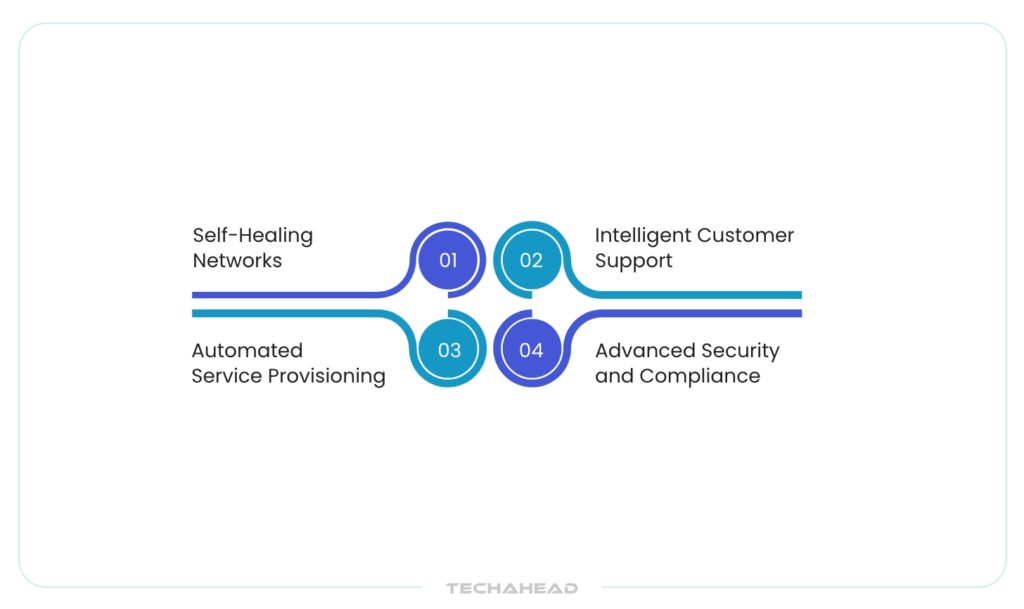
Now, if you ask what are the major roles of agentic AI in telecom operations, here is the answer in brief:
- Self-Healing Networks: Agents detect, diagnose, and remediate network faults autonomously.
- Intelligent Customer Support: AI-powered agents provide personalized, context-aware support that resolves customer issues proactively.
- Automated Service Provisioning: Agents manage the end-to-end lifecycle of network slices and services while adapting to regulatory changes.
- Advanced Security and Compliance: Agents monitor threats using behavioral analysis and respond to incidents in real time.
This new era of self-optimization is possible with a solid technical foundation, where autonomous AI agents collaborate via Large Action Models (LAMs), analyze vast data streams, and orchestrate intelligent actions across the entire telecom ecosystem.
TL;DR of the Technical Architecture
| Main Capability | What It Actually Means |
| Senses Everything | Uses sensors and data to analyze the environment and understand context. |
| Goal-Oriented | You set the mission and let agent do it for you |
| Smart Planning | Uses logic to find the best option for you. |
| Takes Action | Fixes problems on its own rather than just sending alerts. |
| Always Learning | Analyzes past results to get smarter and make fewer mistakes over time. |
| Auto-Pilot Workflows | Automates complex, multi-step task chains without needing human intervention. |
| Predicts Problems | Anticipates and resolves issues proactively before they cause system crashes. |
| Infinite Scale | Instantly deploys more power to handle heavy loads without slowdowns. |
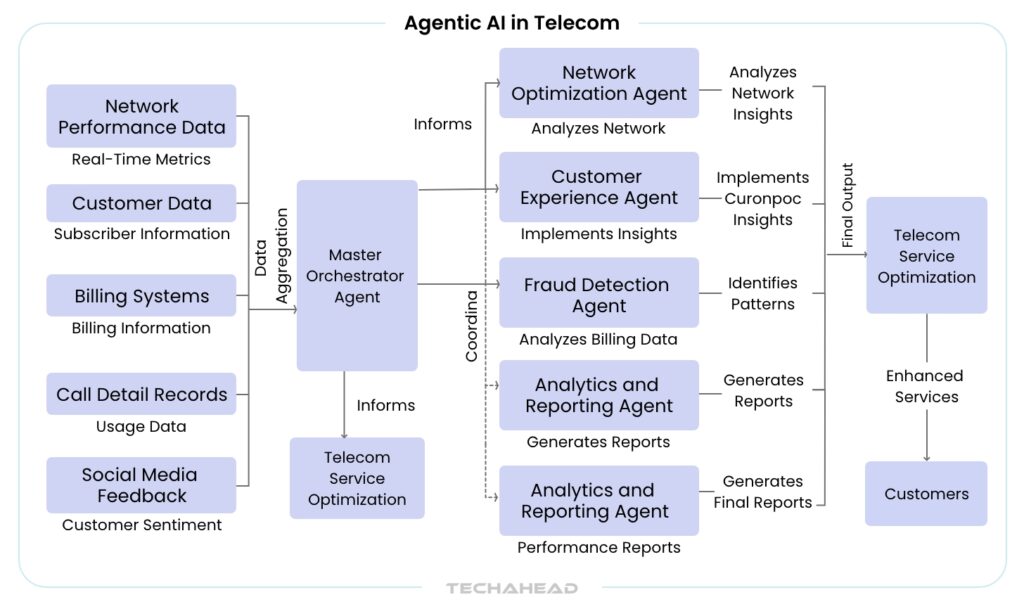
Core Technical Architecture Aspects of Agentic AI
Agentic AI systems are built upon autonomous AI agents, and these agents offer advanced capabilities such as:
Environmental Perception
APIs, sensors, telemetry pipelines, and databases are the primary sources for these AI agents. Moreover, you can expect real-time data collection via OpenTelemetry that helps you monitor the operational environment.
Besides that, you can also interpret unstructured and structured data, natural language processing (NLP) and computer vision to understand different contexts during client interactions.
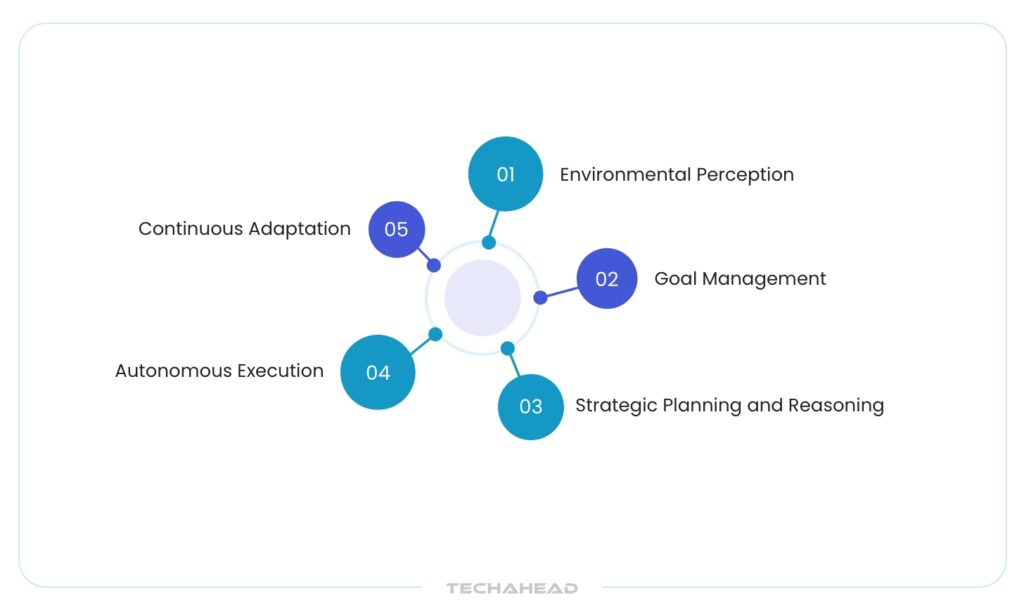
Goal Management
The best part is that you can deploy each agent to fulfill objectives. You can set goals like optimizing network performance, reducing energy consumption (Green Ops), mitigating security threats, or improving customer experience. However, each of the main goals may have subtasks that you can automate or handle manually. AI Agents can also change their focus based on real-time feedback and changing conditions
Strategic Planning and Reasoning
With Deep reinforcement learning, AI Agents can choose the best course of action that fulfills the objectives. However, with the help of Neuro-symbolic AI, it can be more transparent and logical.
Autonomous Execution
Agents take concrete actions, such as rerouting network traffic, initiating automated remediation workflows via O-RAN RICs, or updating configuration files. However, sometimes actions are dynamically selected based on Intent-Based Networking (IBN), rather than rigidly scripted.
Continuous Adaptation
Adaptation and learning make the main difference between traditional AI and agentic AI. Here, agents learn from Federated Learning loops, previous outcomes, and user interactions to refine their strategies
Technical Advantages in Autonomous Operations
Besides that, agentic AI offers you the following technical advantages:
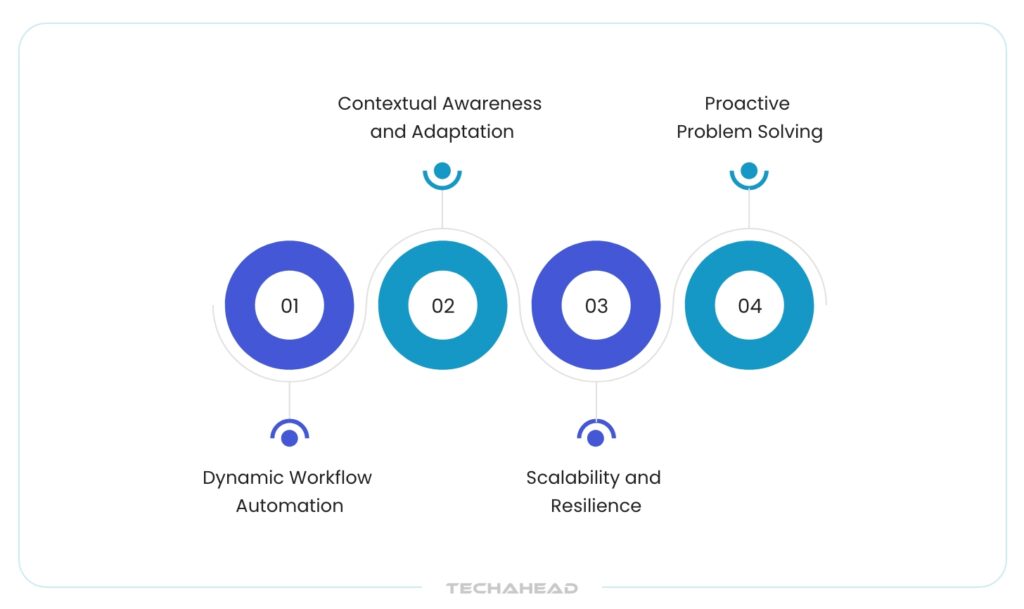
Dynamic Workflow Automation
Agentic AI enables hyperautomation for multi-step workflows without human intervention. It handles different exceptional scenarios and recovers from failures autonomously
Contextual Awareness and Adaptation
Similar to human agents, agentic AI also has situational awareness. AI-powered advanced agents continuously monitor and interpret data for quick adaptation, especially in case of network slicing demands and security incidents
Scalability and Resilience
In the case of a dynamic working environment, you can deploy multiple agents to scale the operations faster. You can enhance the transparency using decentralized decision-making for some of the workflows in your telecom business.
Proactive Problem Solving
Unlike human agents, these AIs anticipate issues before they escalate. Whether it is handling customer journey, data or hardware malfunction, these agents implement preventive measures using AIOps and optimize the resources for the best outcome.
Key Benefits of AI Agents for the Telecom Industry
Telecom industry operators are relying heavily on artificial intelligence. In 2025 alone, telecom operators are projected to spend up to $36 billion annually on AI software, hardware, and services. The goal is to achieve autonomous network functionality.
Indeed, the industry needs more efficiency and hyper personalized customer service, and AI agents are ready to bridge the gap. With the core technical benefits in mind, you can find the right gap in your business to invest in agentic AI.
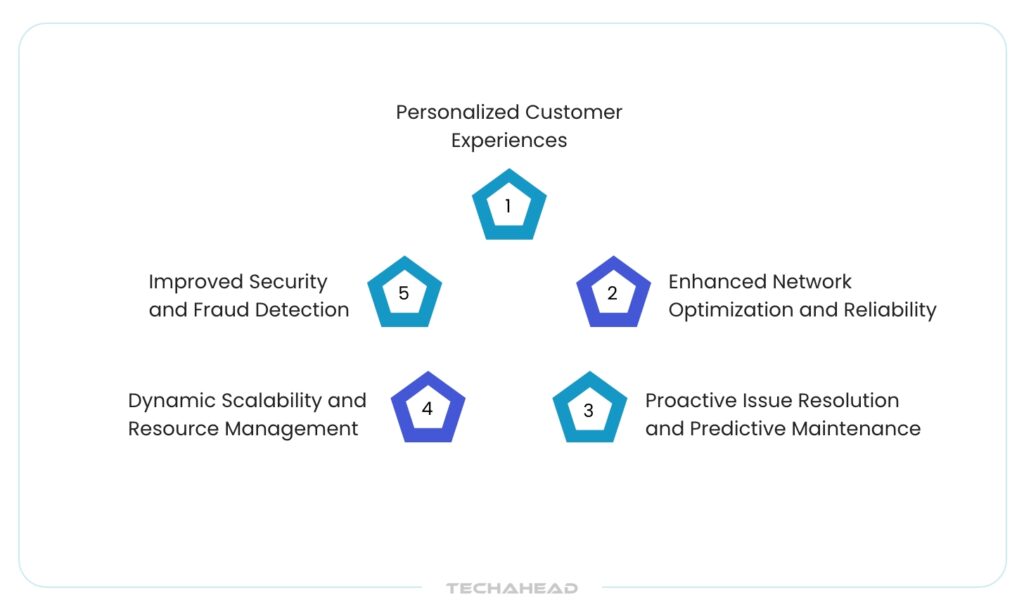
Enhanced Network Optimization and Reliability
Network optimization is the key role that AI agents play to optimize the Quality of Service (QoS). They monitor network infrastructure and ingest telemetry data such as bandwidth consumption, latency, jitter, and packet loss in real time.
For example, Cisco’s Crosswork Network Insights platform uses AI-driven telemetry and analytics to facilitate real-time network path optimization.
Moreover, multi-agent architectures further enhance optimization. Here you can deploy specialized agents to handle data monitoring, traffic management, error detection, or resource allocation. To deploy these specialized agents effectively, telecoms often collaborate with an enterprise app development company to build robust, scalable architectures that handle data monitoring and traffic management.
The result? You can expect a resilient, self-healing network capable of adapting instantly to changing conditions.
Proactive Issue Resolution and Predictive Maintenance
Traditionally, telecom maintenance is reactive, meaning it often faces costly outages or emergency repairs.
However, AI agents with predictive maintenance capabilities use historical & real-time data to forecast potential failures. Generally, it quickly identifies patterns to identify early warning signs.
Whether it is a security issue, network instability or equipment degradation, you can rely on agentic AI autonomous functionalities.
Moreover, this proactive approach (instead of traditional reactive approach) saves up to 30-40% in operational expenses. With AI-driven predictive maintenance, companies usually report improved network uptime and reduced churn rate.
Dynamic Scalability and Resource Management
With the innovation of IoT devices and 5G technologies, telecom industries need to scale quickly. AI agents are ready for this dynamic environment. They allocate bandwidth and network slices in real-time situations based on usage patterns during traffic surges
Improved Security and Fraud Detection
You can integrate powerful APIs and tools to enhance telecom security through continuous monitoring. Moreover, AI-powered agents also offer real-time anomaly detection, which prevents fraud.
For this, agents analyze the network traffic, user behavior, and device authentication patterns to identify suspicious activities, such as SIM swap fraud, unauthorized access, or DDoS attacks.
Besides that, you can integrate AI agents with Security Orchestration, Automation, and Response (SOAR) systems for automated incident response. It improves the mean time to detect (MTTD) and mean time to respond (MTTR). As telecom networks become more complex, you need advanced AI-powered solutions like XDR for better security.
Personalized Customer Experiences
Now, what is about hyper personalized customer experience? AI agents play an important role as they deliver context-aware suggestions based on chat history, customers’ interactions and many other data aspects.
Moreover, agentic AI integrated with Agentforce and CRM systems offers actionable insights for service teams
The result? Faster resolution times, higher Net Promoter Scores (NPS), and reduced churn. Fewer escalations, smoother interactions, and seamless omnichannel experience always lead to customer loyalty.
Real-World Impact and Industry Adoption of Agentic AI
Agentic AI agents address the main telecom challenges: network outages & soaring operational costs.
According to 2025 industry reports, autonomous automation and predictive maintenance have reduced network outages by up to 45% in some deployments. Simultaneously, this saves operational costs by roughly 35%.
That is why major telecom vendors, including Cisco, Juniper Networks, and Nokia, are using AI agents in their platforms. For instance, Nokia’s AVA autonomous operations use agents to orchestrate energy savings.
As the industry moves toward 5G, IoT, and edge computing, the role of AI agents will be dynamic, and companies will rely more on AI agents.
In short, they are redefining telecom operations, which are only becoming more customer-centric and reliable.
What are Digital Twins in Telecom?
AI-powered digital twins are virtual replicas of physical network infrastructure. You can expect real-world operation simulation in real time. It is mainly used to test configurations and optimize performance without risking live networks. For example:
- Vodafone uses digital twins to enhance resilience across 10,000 European mobile sites
- AT&T leverages digital twins (for data analysis) to predict and prevent network outages.
- Deutsche Telekom uses NVIDIA Omniverse-powered digital twins for 5G campus network simulations and core network optimization.
- BT Group scaled their digital twin environment to support autonomous IoT ecosystems and manage over 10 million network elements
These virtual environments act as safe testing grounds. That is why industry leaders are relying on GenAI-accelerated digital twins because they offer many benefits, including synthetic data generation and Level 4 network autonomy.
How Agentic AI Transforms the Digital Twin Sandbox?
In the telecom industry, every configuration change in your network risks service disruption and costly downtime. Here, AI-powered digital twins play an important role that serves as a sandbox for safe, risk-free experimentation.
It mirrors your live environment and helps you simulate and optimize new network configurations.
According to the Ericsson Mobility Report, November 2024, the global data traffic is projected to grow by almost 200% by 2030, which means higher operations costs.
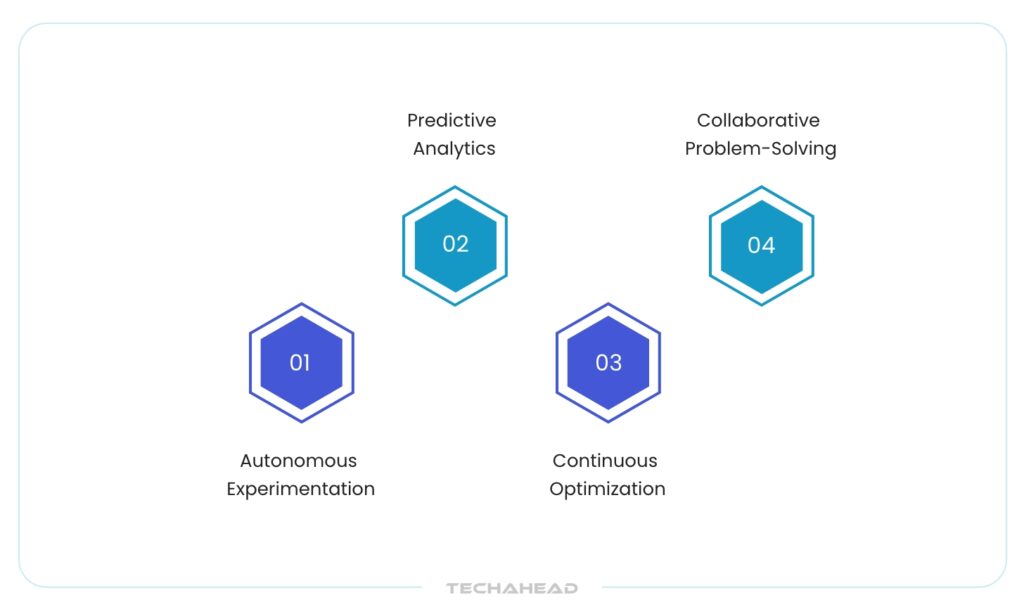
To solve these challenges, you need to find an ideal AI environment where digital twins can help you. Here is how this synergy creates a dynamic environment for your business:
Autonomous Experimentation
You can interact with the digital twin to independently test new configurations and resource allocations. They learn from each simulation to minimize latency.
For example, Vodafone has deployed digital twins powered by AI agents to simulate and optimize 5G network slicing, targeting Level 4 autonomous operations.
They run over 1,000 configuration scenarios in their digital twin environment to reduce the risk of service disruption.
Predictive Analytics
You can create various scenarios in a digital environment to test AI agents’ analytical performance. With the help of advanced data analytics services, agentic AI can sift through this big data to predict network behavior, from traffic spikes to equipment failures.
That is why AT&T leverages tools like “Geo Modeler” to predict and prevent network outages. Their system analyzes petabytes of synthetic data daily.
The outcome? According to recent industry benchmarks, they have reduced downtime by up to 40% by forecasting coverage gaps before they occur.
Continuous Optimization
You can simulate real-world scenarios to check the AI agent’s performance in terms of bandwidth allocation and load balancing. Deutsche Telekom uses AI-powered digital twins for continuous optimization of its core network.
This has resulted in a 20% increase in network efficiency by autonomously identifying up to 1,500 micro-events daily. Moreover, according to the Deutsche Telekom Annual Report, 2024, they have successfully reduced their operational costs by 25%.
Collaborative Problem-Solving
Now, in the case of multi-agent systems, many specialized agents work together to automate different telecom tasks, especially security-oriented aspects such as anomaly detection, monitoring or automated recovery.
China Mobile and ZTE employ multi-agent AI systems within digital twins to coordinate rapid response. You can also check the rapid response functionality by simulating an environment of cyberattacks or network outages. Recent trials show these agents can cut troubleshooting time by 47% through self-healing protocols.
You have learned different use cases of digital twins in the telecom industry. Now, here are the benefits in brief:
Key Benefits of AI-powered Digital Twins for Telecom Operations
The biggest benefit is that you can simulate any real world environment to check the agentic AI efficiency. Other advantages of AI powered digital twins are:
- According to recent market analysis, 72% of telecom CEOs cite risk mitigation as the top reason for adopting digital twin technology, driving the market to a projected $259 billion by 2032.
- Validate new software, security protocols, and 6G-ready network upgrades in the sandbox before the deployment.
- You can identify issues early, which avoids expensive emergency fixes and strengthens operational resilience.
- Digital twins allow you to innovate and expand without adding much operational overhead. For example, BT Group scaled its digital twin environment to manage over 10 million network elements, recently launching the “Global Fabric” NaaS platform to cut device power consumption by 16%.
These importance and benefits show the significance of Artificial Intelligence powered digital twins that boost your business efficiency in a complex environment.
How is Agentic AI Transforming Field Service Operations?
Field service operation is the tasks outside the central office, such as installing new cell towers, fiber-optic lines, and 5G small cells, and conducting routine maintenance/repairs.
In the telecom industry, field service teams also maintain seamless connectivity and high network performance. Here, agentic AI also plays a major role, such as:
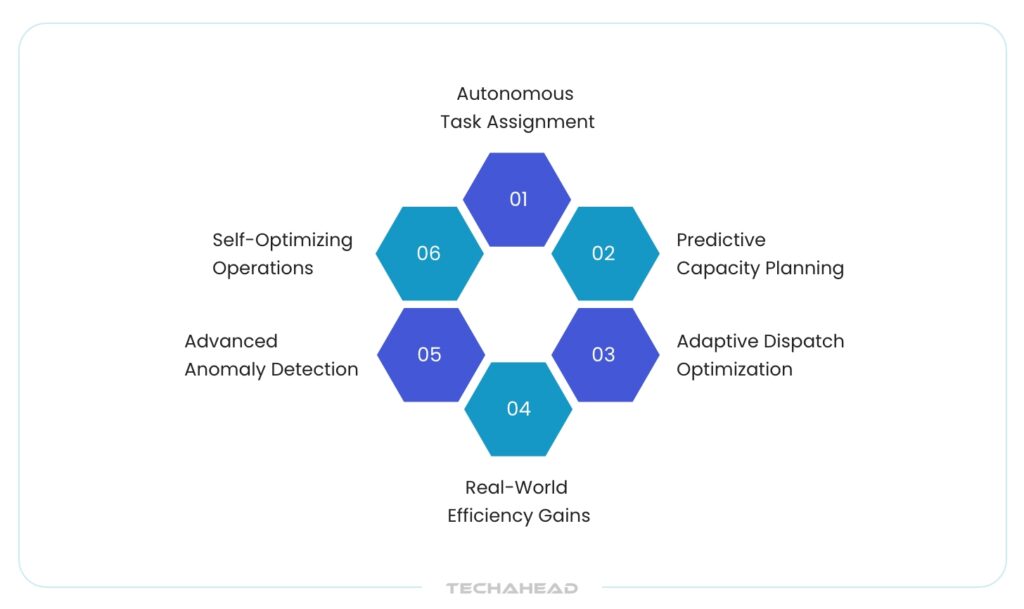
- Autonomous Task Assignment: Multi-agent AI systems allocate field tasks based on predictive maintenance alerts, technician’s experience & skill sets, reducing administrative overhead by up to 40%.
- Adaptive Dispatch Optimization: Agents react to field conditions in real time to minimize mean time to repair (MTTR).
- Predictive Capacity Planning: Agentic AI adjusts technician distribution and inventory logistics to proactively address potential challenges.
- Real-World Efficiency Gains: Telenor, in collaboration with Ericsson, used autonomous agents to optimize radio network tuning and field interventions, achieving a verified 4% reduction in radio unit energy consumption.
- Advanced Anomaly Detection: NVIDIA’s AI Aerial platform leverages agentic AI to detect anomalies, which can deliver 3.5x higher power efficiency and a 45% reduction in network downtime.
- Self-Optimizing Operations: These agents autonomously adapt to data-driven field service ecosystems for operational efficiency.
How Can AI-Driven Autonomy Overcome Legacy Challenges in Telecom?
Legacy telecom systems mean fragmented, siloed architectures, a patchwork of multi-vendor hardware, proprietary protocols, and manual workflows. The biggest challenge? Scalability and interoperability. The operations were mainly reactive processes.
Moreover, with the legacy software/hardware, integrating the new service was slow. In 2025, the industry is overcoming this via “intelligent overlays”. These overlays (AI layers) sit on top of legacy infrastructure without the need for a complete rebuild. Here, agentic AI changes the scenario with real-time feedback and a proactive approach
These agents collaborate in real time (leverage diverse data sources) for efficient telecom operation. For example, instead of waiting for issues to escalate, agentic AI systems proactively initiate corrective actions, whether it is for infrastructure or customer-oriented. Recent deployments show these “self-healing” protocols can reduce manual network operations by 60% With the multi-agent solutions, you can expect better adaptability, agility and resilience.
Conclusion
In short, tomorrow’s telecom winners would not just be the ones with the fastest networks, they would be the ones with the smartest networks. As global data traffic grows by 200% by 2030, the telecom industry is getting more dynamic, and customers? They expect everything to work perfectly, all the time
Really, it is not about whether you should use agentic AI anymore; it is about how fast you can get it going. Because every day you are still managing things manually, your competitors are pulling ahead with smarter, self-driving AI solutions. And those advantages add up fast.
Do not let outdated infrastructure limit your growth potential. TechAhead specializes in developing cutting-edge AI agent solutions tailored specifically for telecom operations.
Our expertise in autonomous network management, predictive maintenance, and digital twin implementation can transform your operations from ‘reactive’ to ‘proactive’.
Ready to future-proof your telecom operations? Contact TechAhead today to discover how our AI agent solutions can drive your autonomous digital transformation.