


 Copy Link
 Share on X
 Share on Facebook
 Share on LinkedIn
Always Active
Required for core functionality such as security, network management, and accessibility. These cannot be disabled.

Uncover the transformative potential of digital and mobile solutions for your industry.





 Last Updated: Sep 29, 2026
Jun 23, 2025
Last Updated: Sep 29, 2026
Jun 23, 2025  1859
1859  12 min. Read


Key Takeaways
“Sustainability is a global challenge and we have to solve it at scale…We’re trying to solve global challenges.”
— Chris Blood, AWS Sustainability Leader
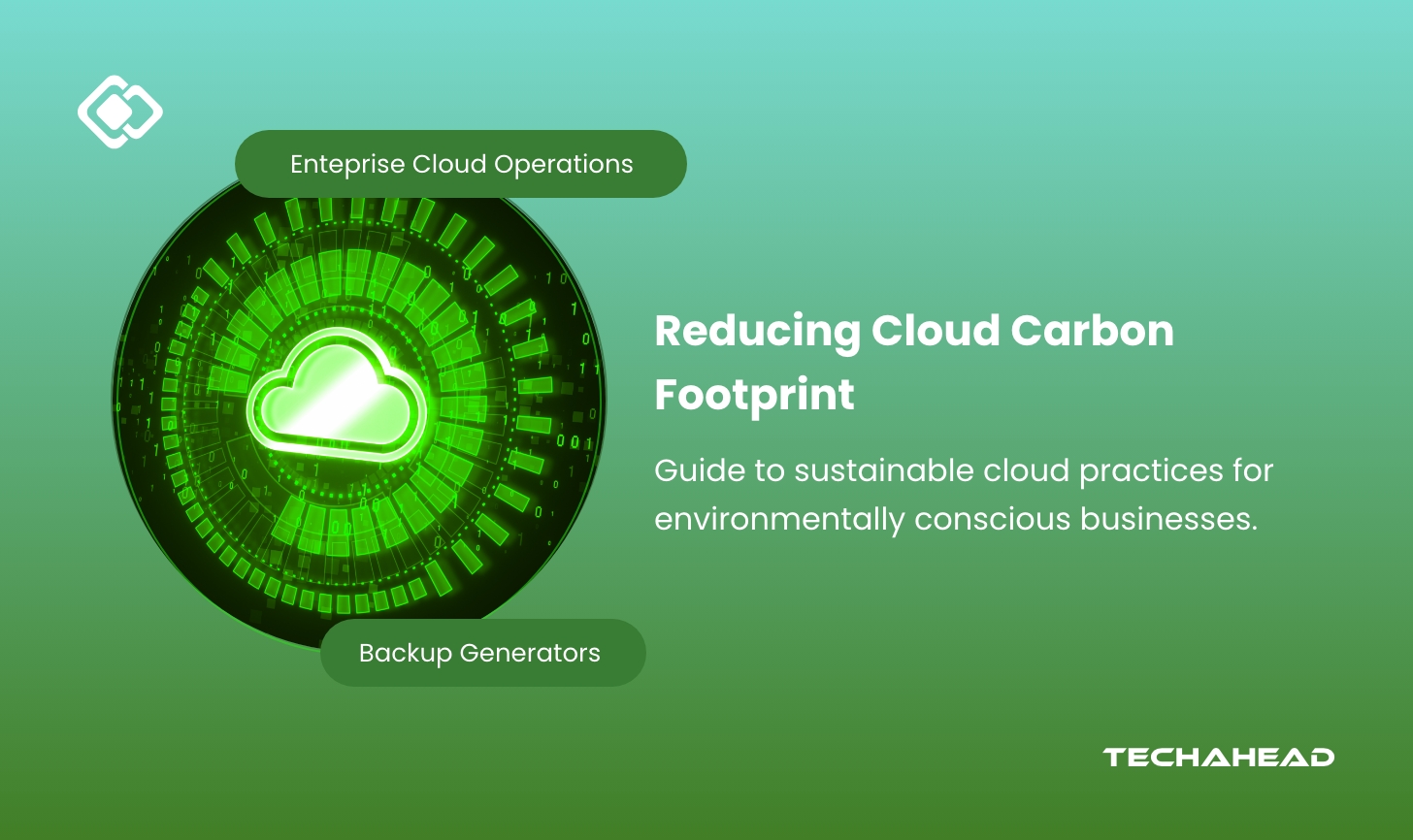
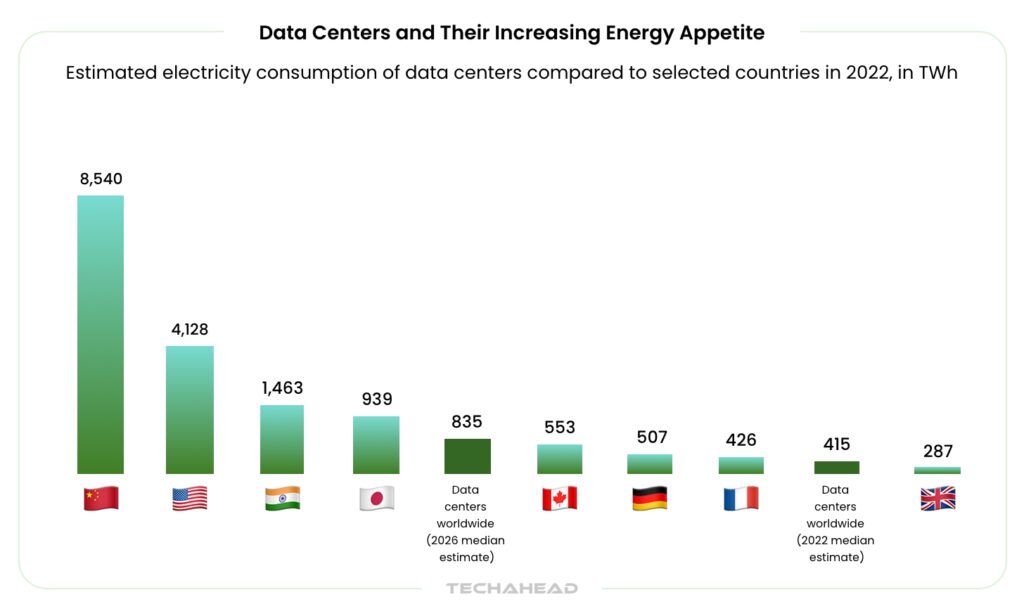
Every click, every transaction, every digital process your enterprise runs contributes to a rapidly expanding environmental challenge. Data centers now consume up to 1.5% of global electricity, with the cloud’s carbon footprint growing 9% year over year. Nowadays, enterprises face pressure from investors, regulators, and customers to demonstrate environmental responsibility. So reducing cloud carbon footprint is not just an environmental imperative, it is a business-critical strategy. In this blog, we are going to explore what you can do to reduce your cloud carbon footprint.
A cloud carbon footprint is the total amount of greenhouse gas emissions due to the use of cloud services. Besides that, consumption of data center electricity, cooling systems and network infrastructure also come under it. The cloud carbon footprint also includes embodied emissions from hardware manufacturing and end-of-life disposal. Every time your team spins up a virtual machine, it results in carbon emissions.
If you are not a cloud service provider, then why should you care about it? Yes, there is regulatory compliance, but there are other aspects for you, such as:
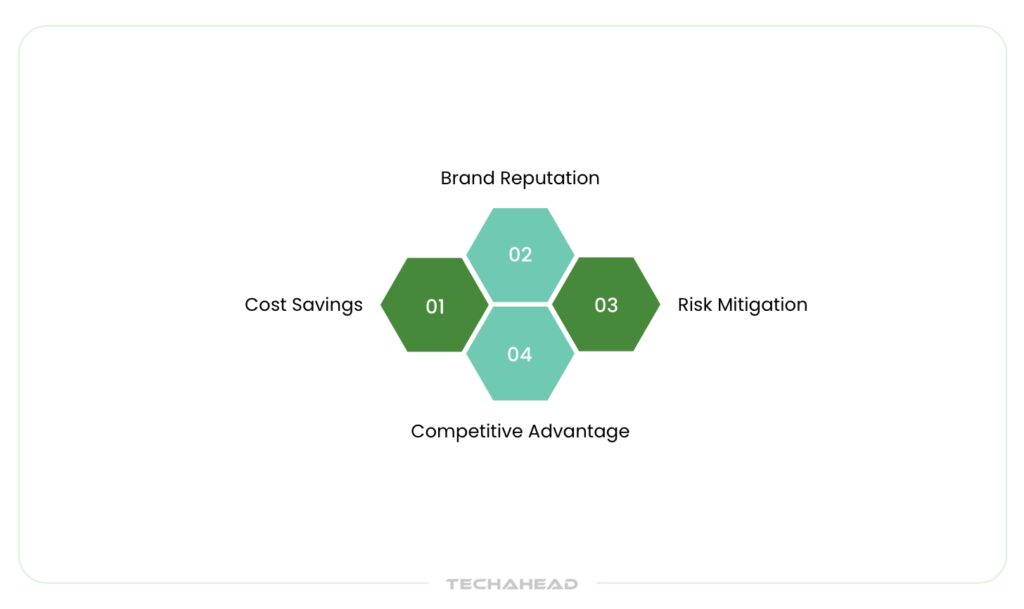
For example, Stripe has made sustainability a core part of its brand, partnering with Watershed to track and reduce its cloud emissions. It is a great move towards eco-friendly practices.
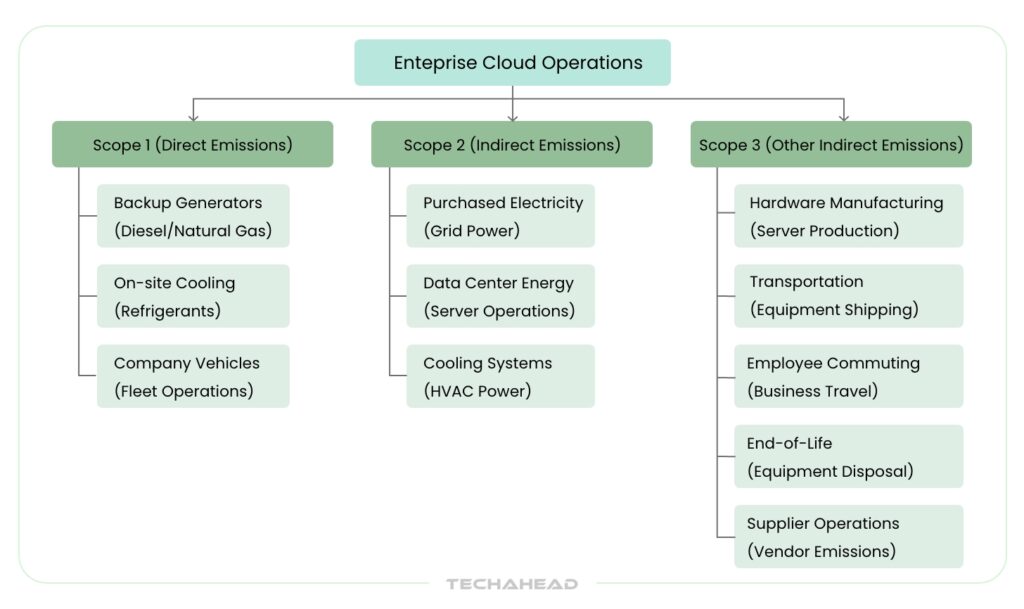
Monitoring the cloud carbon emission is the first step for any reduction strategy. However, how do you accurately track your cloud carbon emissions? You can use the open-source Cloud Carbon Footprint platform (integrates with AWS, Google Cloud, Azure) for frequent visibility (updated on a daily basis) into energy use. Google Cloud’s Carbon Footprint dashboard is another example. It allows you to visualize trends and identify hotspots for optimization.
“Building a sustainable business depends on a new way of looking at everything you do.”
— Justin Keeble, Managing Director for Global Sustainability, Google Cloud
Due to the increasing pressure of digital transformation, you need to rely more on cloud services. However, cloud data centers alone consume about 1-1.5% of the world’s electricity, a figure expected to double by 2030! So how can you unlock environmental benefits? You can follow these ten strategies that help you reduce your cloud carbon footprint while maintaining the business benefits:
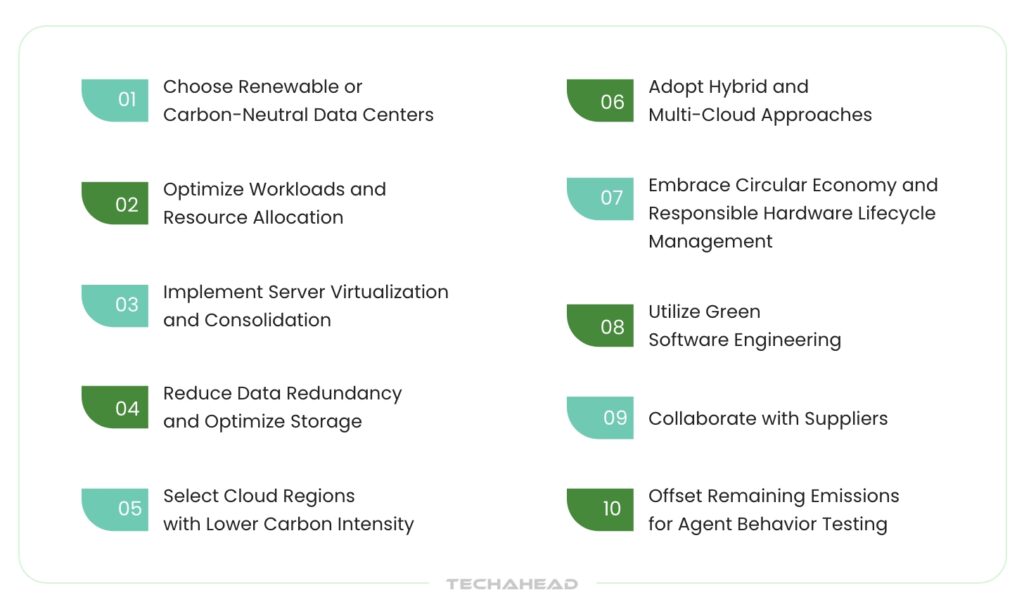
First step, that we have already discussed is you need to migrate workloads to renewable energy powered data centers. Choose a provider, who offers cloud services powered by renewable energy such as solar, wind, or hydro. For example, AWS uses renewable energy and also deploys liquid cooling systems. Google Cloud service is also doing the same. In this way, you not only cut the expenses but also meet the net-zero target.
Are you paying for idle resources? You can implement auto-scaling and load balancing for better resource allocation. Capital One adopted a cloud optimization strategy that included automated scaling and rightsizing of workloads. The result? A 27% reduction in cloud-related energy consumption while maintaining high performance.
Server virtualization is another method that we have discussed. It is a proven energy saver. Brands like Dell Technologies consolidated their global data centers using virtualization. It reduces the physical server count by 40% and slashes energy use by 30%. As a result, Dell also reported lower operational costs due to consolidation.
Do you store more data than you actually need? It can be a hidden energy drain! You should avoid storing rarely accessed data in high-performance storage tiers. You can delete obsolete data and choose storage tier appropriately to cut carbon footprint emissions. You can follow the strategy of Dropbox. They migrate from multiple cloud providers to their own optimized infrastructure. It helps them achieve a drop in cloud energy consumption.
Have you considered how the geographic location of your cloud workloads influences your carbon footprint? Take Netflix, for example. As a global streaming giant, Netflix operates across multiple AWS regions to serve its 280 million members worldwide. Their cloud architecture is designed to dynamically shift workloads and traffic between AWS regions. With the help of AWS’s global infrastructure, Netflix routes user requests to regions where the energy mix is cleaner.
Are you locked into a single cloud provider? It is good for small, mid size businesses. However, if you have large datasets, you can choose hybrid or multi-cloud strategies. It brings more flexibility to run workloads in the most energy-efficient environments. BMW Group adopted a hybrid cloud model to distribute workloads between on-premises data centers (optimized for energy efficiency) and public clouds. As a large enterprise, you can also adapt this strategy to balance performance and sustainability.
However, cloud sustainability is not only about energy consumption! You need to consider other aspects like outdated servers and IT hardware. Microsoft’s Asset Recovery Service is a leading example in this case. They recycle decommissioned hardware and recover rare earth metals. Interestingly, in Denmark, Microsoft’s data center heat is redirected to warm 6,000 homes. In this way, they turn waste into a community resource.
Minimizing energy use (carbon emission) is the aim of green software engineering. You can use tools like JoularJX, PowerAPI, and Cloud Carbon Footprint to measure the energy consumption of the software. Standards such as the Software Carbon Intensity (SCI) and Green Software Measurement Model (GSMM) provide frameworks for benchmarking.
For example, Microsoft has integrated carbon-aware SDKs to schedule compute-intensive tasks when renewable energy is most available. As a result, it reduces emissions but improves the performance.
Collaborating with suppliers ensures that sustainability goals extend across the entire value chain. A 2021 IBM survey found that 95% of IT professionals said their companies would pay an average premium of 6% for products or services from ESG-committed suppliers. You can work with vendors who for instance commit using 100% renewable energy practices.
In this way, you can encourage your industry leaders to reduce the cloud carbon impacts. Major corporations like Unilever and Walmart require suppliers to report (or reduce) emissions. Such collaboration not only helps meet regulations but also builds a competitive advantage in the industry.
Lastly, offsetting remaining emissions is crucial for achieving net-zero targets. You can take initiatives like reforestation, renewable energy, or methane capture for unavoidable emissions. For example, Google Cloud has achieved carbon neutrality since 2007 by purchasing high-quality offsets for any residual emissions.
The best part? The offsetting strategies keep you in the leadership position in your industry and encourage investors to invest in your business based on sustainability factors.
Most of the large cloud service providers like Google and Microsoft are already leading the charge of this transformation. You can choose such cloud companies for reducing carbon emissions.
For example, Google aims for 24/7 carbon-free energy by 2030.
On the other hand, Shopify moved its cloud workloads to Google Cloud specifically for its renewable energy commitments.
You can do this too!
However, if you want to install cloud infrastructure for your enterprise, then you should rely on solar or wind power.
Are you paying more for cloud resources? Proper resource allocation and workload optimization are the right ways to minimize cloud energy use. Make sure, you are only using what you need so that you do not need to pay for unused capacity. You can adjust the following:
You can consult with mobile app development company for a user-friendly analytics to find out and eliminate underutilized cloud resources. It saves both cost and emissions reductions.
Mid-sized businesses should rely on server virtualization, which not only saves costs (pay as you go) but also reduces the carbon footprint. In short, server virtualization allows multiple applications to run on a single physical server. As a result, it reduces the total number of servers required.
On the other hand, consolidation further streamlines the cloud infrastructure. It combines the clients cloud workloads into fewer, more efficient machines.
Generally, cloud service providers prefer these approaches to modernize their IT infrastructure. It reduces their maintenance costs and charges lower fees from the clients. So these strategies are win-win both for service providers and clients.
Talking about reducing your cloud carbon footprint without naming the tools that make it measurable is like discussing a fitness plan without mentioning exercise. Here are six tools that do the work, not just dashboards that look good in a sustainability report.
Google’s built-in carbon reporting tool, available inside Google Cloud Console, shows your gross and net carbon emissions per project, per service, and per region.
It accounts for Google’s renewable energy purchases, so the numbers reflect what is actually hitting the atmosphere; if you are already on GCP, there is no reason not to have this open.
CFE goes a step further than reporting. It scores each Google Cloud region by how much of its energy comes from carbon-free sources on an hourly basis. Regions like Finland and Oregon score above 90%.
Others sit far lower. Scheduling batch workloads, ML training, data pipelines, rendering jobs in high-CFE regions at low-demand hours is one of the most direct emission cuts available to any enterprise cloud team right now.
Built by Etsy’s engineering team and fully open source, Cloud Jewels converts your AWS, GCP, and Azure usage data into estimated carbon emissions using a consistent methodology.
It does not require access to provider-specific sustainability dashboards; it works from billing exports. That makes it the most practical cross-cloud option for teams running multi-cloud environments who want a single, comparable view across providers.
Available directly in the AWS console, this tool shows your estimated carbon emissions from AWS services broken down by geography, service category, and time period.
It also shows how your footprint is trending as AWS expands its renewable energy capacity. The limitation is it is AWS-only and lags actual usage by about three months, so it is better for strategic planning than real-time optimization.
Climatiq is an emissions data API that lets engineering teams embed carbon calculations directly into their own applications and infrastructure monitoring tools.
Instead of checking a separate dashboard, your internal platforms can surface carbon data alongside cost and performance metrics. It covers cloud computing, travel, shipping, and energy sources across 40+ countries.
Kepler is a CNCF project that measures real energy consumption at the pod and container level using eBPF probes. Most carbon tools estimate emissions from billing data.
Kepler measures actual power drawn from the hardware. For teams running large Kubernetes clusters, it is the only tool that tells you which specific workloads are drawing disproportionate energy.
Most enterprises start with whatever their cloud provider offers and stop there. That is a single-provider, but the teams making real progress combine provider dashboards for baseline visibility, Etsy Cloud Jewels or Climatiq for cross-cloud comparability, and Kepler for workload-level precision.
Together, they give you something none of them delivers alone, a complete picture of where your emissions actually come from.
You can consult with cloud service providers about the locations and select the right region that suits your business objective (depending on sustainability and targeted customers).
Carbon intensity of the cloud region mainly depends on the local energy grid. Generally, hydro, wind, or solar powered cloud regions have a lower carbon footprint than coal or natural gas.
Google Cloud and AWS publish carbon data for their regions, which allows you to select the locations. For example, migrating workloads from a coal-powered region in the US to a hydro-powered region in Scandinavia cuts associated emissions by up to 90%.
The journey toward cloud carbon neutrality is no longer optional, it is essential for your enterprise that impacts your business. The strategies outlined in this guide are proven pathways to achieve meaningful carbon reductions. Companies like Netflix, Google, AWS and Microsoft have already demonstrated sustainable cloud practices. However, implementing these strategies is not easy for mid-small size businesses; it needs expertise, strategic planning, and the right technology partnerships.
TechAhead’s sustainability-focused cloud consulting help enterprises reduce their carbon footprint. Our team of cloud architects and sustainability experts will conduct a carbon audit of your current infrastructure and develop a customized roadmap for achieving your net-zero goals. Feel free to contact us for a free cloud carbon assessment and discover how your organization can lead the way in sustainable digital transformation.
We use cookies to ensure our website functions properly, improve performance, and provide a personalized experience. You can choose which types of cookies to allow below.
Required for core functionality such as security, network management, and accessibility. These cannot be disabled.
Help us understand site traffic and user interactions so we can improve performance and usability.
Enable enhanced functionality and personalization such as language or region preferences.
Used to deliver relevant ads, track campaign performance, and measure advertising effectiveness.